A hint of bitterness

Fenugreek seed is one of the superfoods in an Indian pantry. As a kid, however, and even today as a grown up 30-year-old, I haven’t developed much liking for it. And so, most of the times, I just remove it aside in my plate when I see it in my curry or Kadi (made with buttermilk). The elders in my family, however, love fenugreek seeds (methi or मेठी as we call). My dad used to try feeding me Methi ki Kadi–that my mum makes especially for him–ever since my childhood days, but I always ran away when he brought a big morsel towards my face.

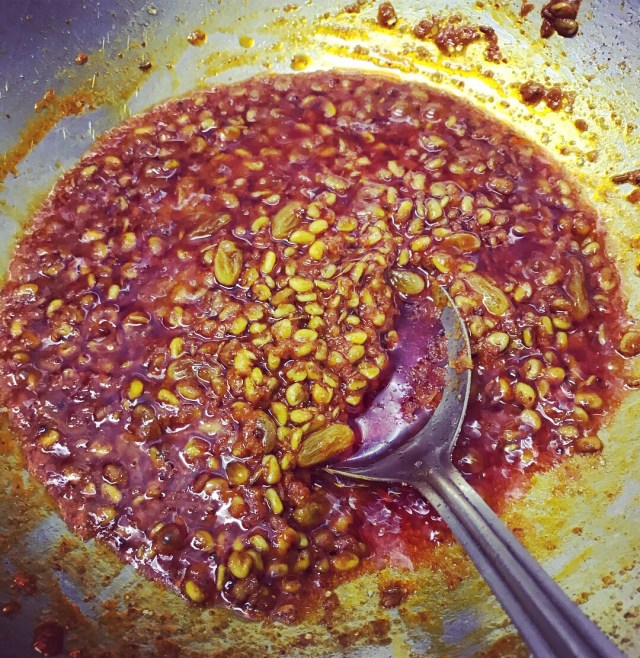
With age, however, I have started liking the flavour it gives to the Kadi or any other dish, but there’s still a long way to go. Yesterday, my mum made Methi ki Kadi with a side dish called Methi ki Launji (or loon-jee). It’s extremely healthy as it keeps digestion in check and controls inflammation. But there’s more to it. Methi ki Launji is both sweet and tangy in taste, and has a hint of bitterness to it; at least I feel so, unlike my dad. The raisins in it add a soft element to the dish, and it surely gives you a break from the regular vegetable recipes.

Recipe: Methi ki Launji

Ingredients:

3/4 cup – fenugreek seeds, salt to taste, oil for tempering, 1/4 cup – raisins (soaked for half an hour), 1.5 tsp coriander powder, 3/4 tsp red chilli powder, 1/2 tsp turmeric powder, 1 tbsp sugar, 1/2 tsp mango powder, a pinch of cumin seeds and asafoetida.

Method:

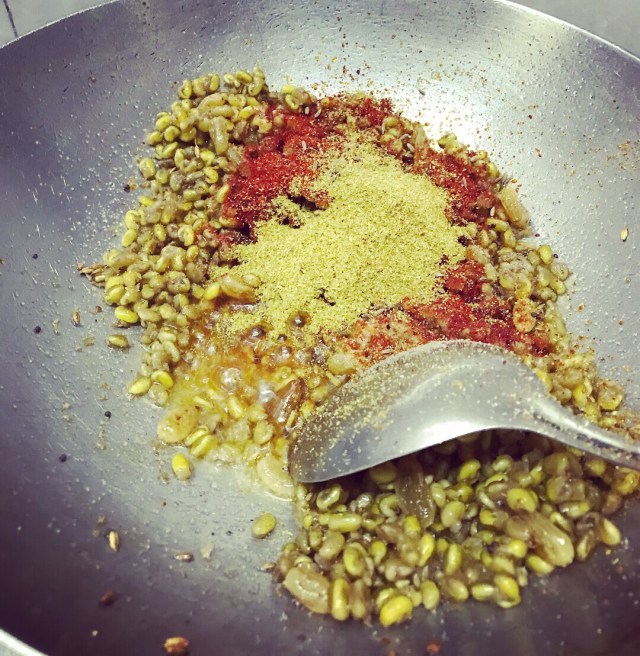
Boil the fenugreek seeds (my mum simply boiled it for 20 minutes); once done, strain it and keep it aside. Now take a kadai (skillet), add oil (according to your preference), and let it heat up a bit. Add the asafoetida, cumin seeds, turmeric powder and quickly add the boiled fenugreek seeds and the raisins. Now add all the other spices, salt and sugar. Let the fenugreek seeds soak in the spices for about five minutes and switch off the flame. Serve it with a parantha or roti.

I think when I start eating Methi ki Kadi and Methi ki Launji wholeheartedly, my dad would surely be proud of me. For this, according to him, is the good stuff! Make this and tell me how you like it.

Khoka, one of the wonders of Khejri tree

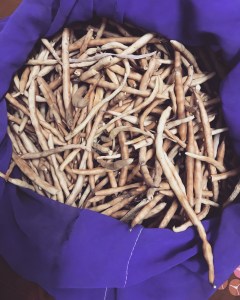
During our summer vacations in Jaiselmer, we kids munched on these Khokha pods and spit its seeds aside. It was something that was done while playing or talking to the cousins. It requires no cooking or washing. Khoka is mostly sweet in taste but not overtly sweet. When the Leeli Sangri (the green pods) grow up on the Khejri tree, they become stiff in texture (when not plucked from the tree) and are called Khoka.

When a bag of Khoka is kept in a room, its sweet fragrance takes over so much so that you can almost find it difficult to bear; but not me! I love it! My Nani got this bag full of Khoka for her eldest son, Deenu (one of my dear Mamas).

The nearby deserts of Jaiselmer enjoy the goodness of Khejri tree; each stage of the tree gives back to its caring keepers. No wonder people worshipped trees back then. And for someone living in the desert, each tree mattered so much!

It’s her day

My blog is all about my mother; it’s my personal journal where I save my mother’s recipes. When I got married into a different community and in a different state, I started to notice the difference and valued Marwari food, especially my mum’s hand-cooked food even more. She never gave us stale or leftover food; she knows how to cook a meal in 15 mins and we have always had freshly made food on our plates. Food trends never mattered for her, but native grains did. In spite of having three kids, mum managed the kitchen extremely well. Abundance, that’s what her kitchen is all about. Abundance of food to feed the family, nearby animals and birds and the underprivileged. Even when we did face a financial crunch, mum never let us feel that we have less; our platter was always full with healthy and flavourful food. One thing I have inherited from her is her love to feed the family and friends without praising herself. Good food is meant to feed souls not your ego; and she is the one who taught me this. For my mother and I, it’s not about how perfect the food is but how we can share with more people around us. I hope I succeed in my endeavour to save all her recipes through my blog; it might take years, but I hope I do my best. Can I cook like her? Not in this lifetime, but I will keep trying till I breathe my last. And so, today, I want to wish all the mothers of the universe, on earth and in heaven, a happy Mother’s Day! A mother’s magic never ends even if she is far away amidst the stars or just a feet away.

Standing in the queue

I paint my dreams auburn, when I know they’ll never come true, when I know they’ll be broken again.

Sometimes, I just feel life is about sailing by.

But if you live a slow death, yes, there can be such times, you need to look at the other side of life.

Look into the mirror, see those freckles and eye circles, the strands of white hair that act like a crown on your head, that chapped smile and hopeless eyes.

And force a smile. May be, just for one more instance, pray, saying that this time, God will paint your dream pink and make it true.

Words

“If all the world hated you and believed you wicked, while your own conscience approved of you and absolved you from guilt, you would not be without friends.”

– Charlotte Bronte in Jane Eyre (also quoted in the Netflix series, Anne with an E).

The Glass Powder

They say time heals everything. Every wound. Every cut. Every scar. But, I somehow, don’t think anything can ever heal the minute broken pieces of the glass powder. When pressed against the skin, it can hurt the most. And when there are a million pieces of glass broken into a powder, the jar can never be kept close. Never. It has to be abandoned. Immediately. And forgotten. Wish, we could abandon our dreams too. Forever.

Words

“Our lives are not in the lap of the gods but in the hands of our cooks. Hence befriend your cook because so much of the enjoyment of life lies within his power to give or take away as he sees fit. It is the invariable test of a wise man whether he has good food at home or not.”

– Confucian (Chinese teacher) view of food (as read in the book, The Essential Andhra Cookbook)

Words

“Sometimes fate is like a small sandstorm that keeps changing direction. You change direction, but the sandstorm chases you. You turn again, but the storm adjusts. Over and over you play this out, like some ominous dance with death just before dawn. Why? Because this storm isn’t something that blew in from far away, something that has nothing to do with you. This storm is you. Something inside you. So all you can do is give in to it, step right inside the storm, closing your eyes and plugging up your ears so the sand doesn’t get in, and walk through it, step by step. There’s no sun there, no moon, no direction, no sense of time. Just fine white sand swirling up into the sky like pulverised bones. That’s the kind of sandstorm you need to imagine.”

– Haruki Murakami in Kakfa on the Shore 

Words


IMG-20160518-WA0008

“If you can’t write a decent short story because of the cold, write something else. Write anything. Write a long letter to somebody. Tell them how cold you are. By the time the letter is received the sun will be out again and you will be warm again, but the letter will be there mentioning the cold. If it is so cold that you can’t make up a little ordinary Tuesday prose, why, what the hell, say anything that comes along, just so it’s the truth. Talk about your toes freezing, about the time you actually wanted to burn books to keep warm but couldn’t do it, about the phonograph. Speak of the little unimportant things on a cold day, when your mind is numb and feet and hands frozen. Mention the things you wanted to write but couldn’t. This is what I have been telling myself.”

~ The Cold Day by William Saroyan

PS: Found this short story in a book titled The Daring Young Man on the Flying Trapeze (Faber and Faber) written by William Saroyan. Bought this book from Any Amount of Books, London.

No looking back

DSC_0298 - Copy - Copy

I never used to cook much when I lived with my parents. After marriage, it was just me and my husband living together in Mumbai. My in-laws lived in a different state. So, there was no fear in my mind as such to get up early and prepare the tiffin on daily basis. 

One day, my mum gave me strict instructions over the phone. “Get up early. Take a bath. Say your prayers and ring the bell in the temple (present in the house). And then start cooking,” she said. The time was set. The lunch-box had to be ready by 8 AM as that’s when he left for work.

So, there I was, up at 5.30 AM, hell-bent on doing exactly what my mother asked me to do. I entered my kitchen only after doing all the three tasks. Rang the bell in my makeshift temple (felt heavenly). Washed my hands, and went near the basin to pick up the spinach leaves I kept the previous night to cook. The best part was, I did everything on time. Presently, the time was 6 AM sharp. And I saw an ant attack on my spinach leaves! The tiny warriors ran on the plate and I didn’t know what to do. So, I sat on my kitchen floor, and carefully, started separating the ants from the huge bunch of leaves.

I was extremely precise in separating them both ants and leaves. Slowly and steadily, I reached a level where my plate started weighing a bit lighter. Sometime, in between, my husband entered the kitchen and made himself a glass of Bournvita. “That’s okay, baby. I’m leaving for work,” he said. I, on the other hand, was in state of horror to push the million ants away from my spinach leaves. “I’m sorry. It’s such a mess here,” I responded, irritably.

And guess what? When he returned home in the evening around 6 or 7PM, I was still cleaning the same bunch of spinach leaves!

The following day, after the spinach and ant episode, I woke up in the last minute and prepared the lunch in my night-suit, gave the lunch-box to him and went back to complete sleep, while my husband went off to work. And that became my routine.

Well, now you would have guessed my speed when I started out working in the kitchen. I was damn slow. Things just registered late in my mind. Month after month, you could see my experiments with measurements going haywire, and I had to learn a lot from my mistakes. 

I have a passion for reading magazines, and it was in Marie Claire India magazine (discontinued now), in which I spotted the recipe of Amritsary Choley. The magazine used to carry beautiful photo essays, and I tore this particular page that comprised a chef’s recipe of it. In the big photo on that page, there was the holy Golden Temple, and in a small shot, you could see a bowl of Amritsary Choley. It was written in a simple language, and it just clicked to me that the recipe could be the path breaker for me as a home chef.

dsc_1342

So, I tried the recipe on one of the weekends, and loved it to the hilt. It’s rare when you make something that looks similar to the recipe’s original photo. And I was happy!

When I went to Amritsar, after a few years, I realised the flavours of the city’s local food items are not just magical, but inspiring as well. You start believing in good food, and good life. And when you can create an enchanting recipe at home, it does feel special.

And when it comes to my kitchen skills, I’d say, there is still a lot of scope of improvement. But, hey, it doesn’t matter more than one’s love for good food. Right? 

Recipe: Amritsary Chole with Ajwain Atte ki Poori

Ingredients

¾ cup – chickpeas (soaked overnight)
1 onion – finely chopped
1½ tomato – grind into paste
1 tsp – ginger and garlic paste
2-3 – dried red chillies
1 tsp – carom seeds (star of the dish)
1 tsp – cumin seeds
2 tsp – coriander powder
½ tsp – turmeric powder
1 tsp – red chilli powder (totally depends on your preference)
salt to taste
1½ tbsp – ghee
1½ tsp – chana masala (store-bought)
a few pinches – garam masala
a few pinches – anardana (for sour taste) OR tamarind pulp
For garnish

Coriander leaves – chopped
Ginger – finely cut, length-wise
Green chillies – as per your wish

Method

  1. Soak the chana or chickpeas overnight.
    2. Take the chana in a pressure cooker, add water, a tsp of ghee and turmeric powder, and close the lid. Give this 5 whistles, and then keep checking if the chickpeas have cooked properly or not. Keep the boiled chickpeas aside. Make sure there isn’t too much water, because we want a thick consistency, and not a runny one.
    3. I use a cast iron skillet to make my choley dark. So, in a cast iron skillet or kadai, add the ghee, turmeric powder, carom and cumin seeds, red chillies, and let it crackle for a few seconds. Now, dump in the chopped onion and ginger-garlic paste and start sautéing it.
    4. Now, add in the tomato paste, the spices, salt and sauté for a few minutes. You want the paste to become thick, but make sure that it doesn’t stick.
    5. Once the mixture is cooked well, add in the boiled chickpeas.
    6. Add some water, and let it boil for 10-15 minutes on low flame. Cover it with a lid, but keep checking in between.
    7. Once done, serve it with hot and fluffy pooris, and don’t forget to garnish. You can also serve some sliced raw onions, green chillies and lemon wedge to go with the dish.

Note: The last time I added anardana in this dish, I could take its hard texture in my choley. So, make sure you don’t add too much of it.

Recipe: Ajwain Atte ki Poori

Ingredients

whole wheat flour
2-3 pinches of salt
1 tsp carom seeds
1 tsp oil

Method

Mix all the ingredients, and make a tight dough. Make small balls, roll a ball into a small round shape, and fry it in oil. As you dip one in the oil, press it with the frying ladle from all sides to allow the poori to puff up. Make sure the flame is medium to high, and not low.