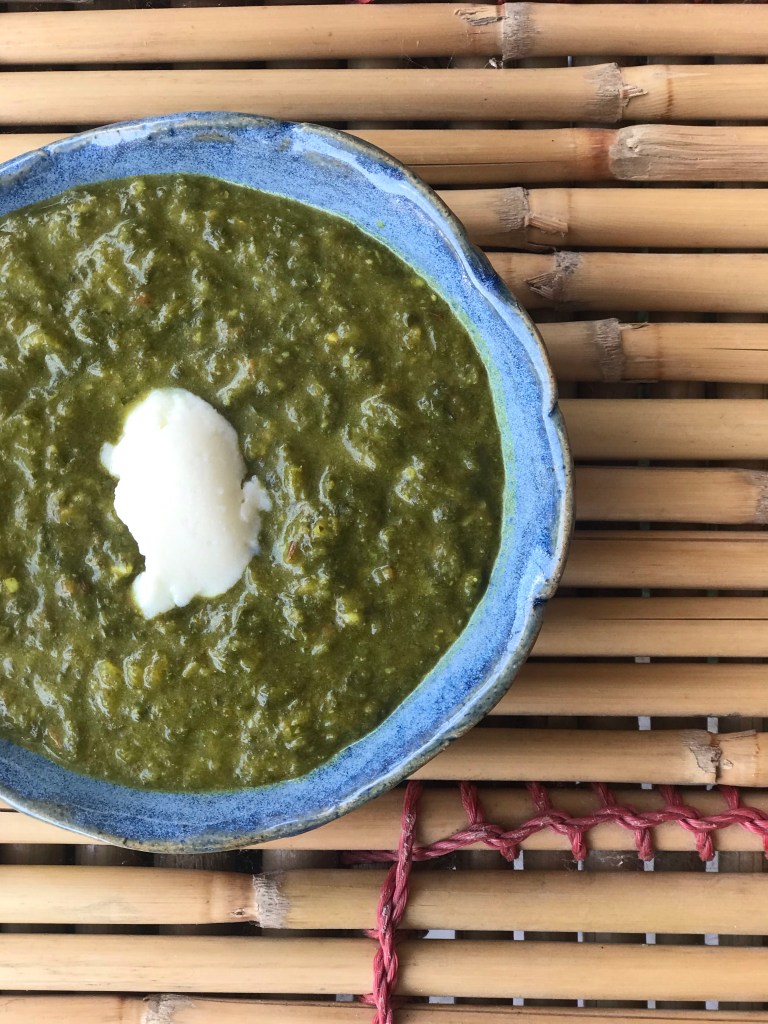
Winter Special: Slow-cooked Sarson ka Saag

Motherhood can teach you so many things. For me, it’s this slow-cooked saag that I love to feed my kids in winters—even if it’s made once a year. And the rebel cook in me goes like—why do I kill the veggies in the cooker? Why the speed? Why blend all the greens? It took me a couple of years to nail this recipe. But I now love to make it! Here’s how.

Ingredients:

Sarson (mustard leaves), methi (fenugreek leaves), bathwa, palak (spinach), pudina (mint leaves; optional), maize flour (makai ka aata), onion, tomato, ginger, garlic, green chillies, ghee, homemade butter, salt to taste, kitchen king masala, garam masala, asafoetida, cumin seeds, turmeric powder, red chilli powder, coriander powder. Sometimes, I add a hint of kasuri methi too. Sometimes I skip it.

The prep:

Go to a nearby mandi, or wherever you find fresh winter greens. Buy a bunch of each green mentioned.

Now, I usually take half a bunch of each of these greens (for the recipe). Perfect for 2-3 people. But, sometimes, I take the entire bunch that the veggie guy sells. That much is perfect for 4-5 people. 

Now, thoroughly wash every veggie and chop it finely. This way, you won’t have to mash it too much. A hint of pudina (mint leaves—even 1 cup works) will add an aromatic flavour to this dish. I love it!

Once you have cleaned and chopped all the veggies, throw it in a big pan with half cup of water. Don’t panic. It will go down to half in 3-5 minutes. Let it simmer. You can put on the lid once the quantity lessens and the cooking process begins. No salt needed here.

Keep checking your greens. As there is the lid allowing it to steam it well, you won’t have to use a blender. Just give it a good mix with your spoon and you should be good.

Second step:

Grate 1 medium-sized tomato. Finely chop 1 medium-sized onion. This measurement is perfect if you take 1 bunch of every green. Now hand-pound 1-2 green chillies, a hint of ginger and 5-8 cloves of garlic. Once this is done, do the tadka and throw it in the pot of greens.

For the tadka, take a small pan. Heat some ghee. Once hot, add cumin seeds. Asafetida. Turmeric powder. Red chilli powder. Coriander powder. And quickly add the green chilly-garlic-ginger paste. After a minute, throw in the chopped onion. After a minute of sautéing, add the tomato paste. Now add salt. When making saag, it’s a bit tricky with the salt. Try not to go overboard. You can always add more later in the cooking process. Also, if you plan to use store-bought butter, you are anyway going to add more salt later.

Add a tsp of kitchen king and two pinches of garam masala as well. Let this cook a bit and throw it all in the pot of greens (when you see that the greens have cooked nicely). Mix it properly.  After 2-3 minutes of cooking it with the greens, you may add ½ or 1 cup of warm water to make it a bit runny otherwise it will be too thick to eat. 

Don’t miss the ‘Aalan’

This saag is called a saag because of maize flour. Take a small bowl of water (room temperature) and mix 1 tablespoon of maize flour in it. Add this yellow paste to your saag (after you have added the tomato-onion paste). This is going to give it that aroma and make it body. Without this, your saag won’t taste like saag. 

Taste. Taste. Taste. 

Give your saag a taste. Adjust the flavours if need be. Throw in some homemade butter/makhan for that desi taste. A spoon of ghee on top will make it shine as well. It takes me 30-40 minutes to make it (prep time excluded).

Serve it with makai ki roti (don’t miss the butter on top), a nice salad of onions, carrots and radish, chaas (buttermilk), and, a small chunk of jaggery.

Background music score: Ek Lau by Shilpa Rao, Dhaani and Najaney Kyun by Strings

Palak ka Saag

If you have your roots in the northern region of India, chances are high that you love your Saag. Now, usually, a Saag is made of mustard leaves, spinach and chinopodium album (that is sarson, palak and bathua in the local lingo). But as these are available in winters only, one can only dream of a saag during the hot summer days.

My mother-in-law loves her Saag. She is someone who would always be on time, and so, she’d spend her entire morning preparing for this, so that we can have this Saag at noon (and on time). So, this is her recipe; this is how she makes it. And I love it. Its rustic flavours are nourishing for your health. Have it with your whole-wheat/cornmeal/sorghum rotis/chapattis.

Ingredients:

One bunch of spinach, half glass water, 2 tbsp – gram flour (Besan), salt to taste, garlic cloves (three), ginger (1 tsp), 1 medium-sized onion, 2 small tomatoes, green chillies (two, if spicy), oil/butter for tempering, 1/4 tsp each of coriander and turmeric powder, two pinch – asafoetida, 1/2 tsp red chilly powder, a pinch of cumin seeds.

Method

1. Clean your spinach in water. Chop it roughly, including the stems. In a cooker, add in these leaves. Whisk one tbsp of gram flour in a small bowl and add it to this. Add in water and a bit of salt. Give it a whistle or two. And then, mash it with a potato masher. Some people prefer to grind it in a mixer. My MIL likes a coarse texture, so she avoids doing so.

2. Now, finely chop the garlic, green chillies, ginger, and onion. I used a vegetable chopper when I helped her prep. Keep it aside all together in a bowl. Then, finely chop the tomatoes and keep aside separately.

3. In a skillet, add in some oil. Then, add in the cumin, asafoetida, turmeric, and the onion, garlic, ginger and green chillies. Sauté till for two-three minutes, then, add in the tomatoes. Now, add in a bit more salt and the rest of the spices. Sauté for another five minutes.

4. Now, add in a tsp of gram flour and mix it really well. Whisk the gram flour paste beforehand if you want to, so that there are no lumps.

5. Lastly, add in the mashed spinach. Now, you don’t want too much liquid in your Saag, nor do you want it to be too dry. So keep mashing and stirring it, till you achieve the consistency. And voila!