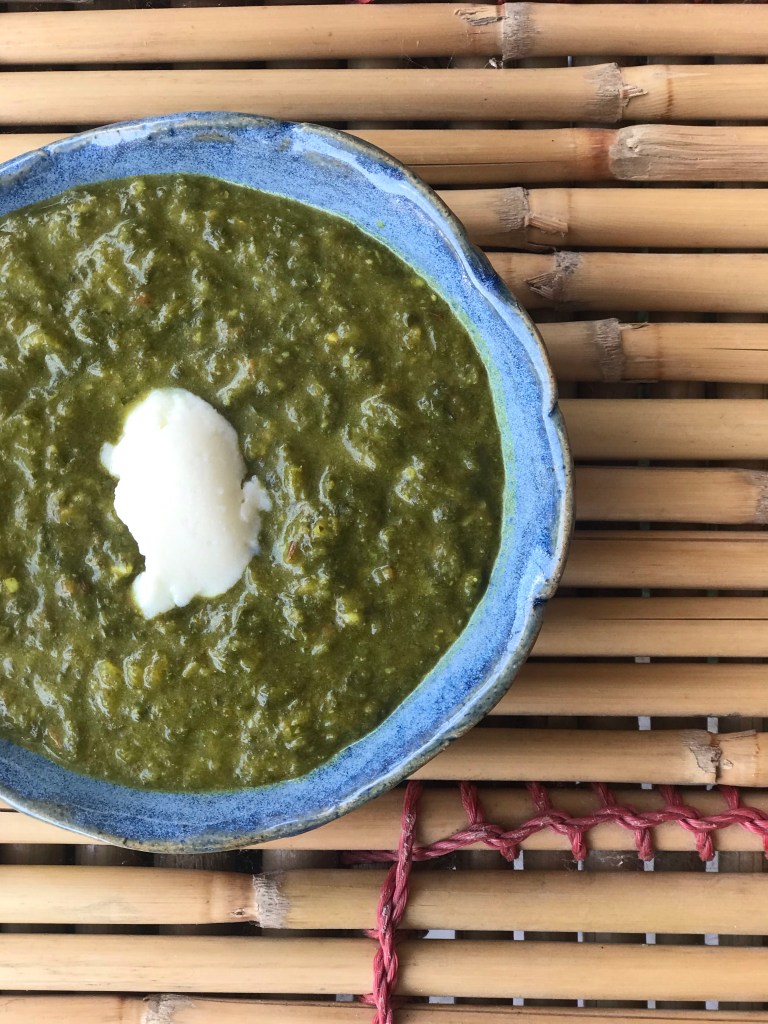
Winter Special: Slow-cooked Sarson ka Saag

Motherhood can teach you so many things. For me, it’s this slow-cooked saag that I love to feed my kids in winters—even if it’s made once a year. And the rebel cook in me goes like—why do I kill the veggies in the cooker? Why the speed? Why blend all the greens? It took me a couple of years to nail this recipe. But I now love to make it! Here’s how.

Ingredients:

Sarson (mustard leaves), methi (fenugreek leaves), bathwa, palak (spinach), pudina (mint leaves; optional), maize flour (makai ka aata), onion, tomato, ginger, garlic, green chillies, ghee, homemade butter, salt to taste, kitchen king masala, garam masala, asafoetida, cumin seeds, turmeric powder, red chilli powder, coriander powder. Sometimes, I add a hint of kasuri methi too. Sometimes I skip it.

The prep:

Go to a nearby mandi, or wherever you find fresh winter greens. Buy a bunch of each green mentioned.

Now, I usually take half a bunch of each of these greens (for the recipe). Perfect for 2-3 people. But, sometimes, I take the entire bunch that the veggie guy sells. That much is perfect for 4-5 people. 

Now, thoroughly wash every veggie and chop it finely. This way, you won’t have to mash it too much. A hint of pudina (mint leaves—even 1 cup works) will add an aromatic flavour to this dish. I love it!

Once you have cleaned and chopped all the veggies, throw it in a big pan with half cup of water. Don’t panic. It will go down to half in 3-5 minutes. Let it simmer. You can put on the lid once the quantity lessens and the cooking process begins. No salt needed here.

Keep checking your greens. As there is the lid allowing it to steam it well, you won’t have to use a blender. Just give it a good mix with your spoon and you should be good.

Second step:

Grate 1 medium-sized tomato. Finely chop 1 medium-sized onion. This measurement is perfect if you take 1 bunch of every green. Now hand-pound 1-2 green chillies, a hint of ginger and 5-8 cloves of garlic. Once this is done, do the tadka and throw it in the pot of greens.

For the tadka, take a small pan. Heat some ghee. Once hot, add cumin seeds. Asafetida. Turmeric powder. Red chilli powder. Coriander powder. And quickly add the green chilly-garlic-ginger paste. After a minute, throw in the chopped onion. After a minute of sautéing, add the tomato paste. Now add salt. When making saag, it’s a bit tricky with the salt. Try not to go overboard. You can always add more later in the cooking process. Also, if you plan to use store-bought butter, you are anyway going to add more salt later.

Add a tsp of kitchen king and two pinches of garam masala as well. Let this cook a bit and throw it all in the pot of greens (when you see that the greens have cooked nicely). Mix it properly.  After 2-3 minutes of cooking it with the greens, you may add ½ or 1 cup of warm water to make it a bit runny otherwise it will be too thick to eat. 

Don’t miss the ‘Aalan’

This saag is called a saag because of maize flour. Take a small bowl of water (room temperature) and mix 1 tablespoon of maize flour in it. Add this yellow paste to your saag (after you have added the tomato-onion paste). This is going to give it that aroma and make it body. Without this, your saag won’t taste like saag. 

Taste. Taste. Taste. 

Give your saag a taste. Adjust the flavours if need be. Throw in some homemade butter/makhan for that desi taste. A spoon of ghee on top will make it shine as well. It takes me 30-40 minutes to make it (prep time excluded).

Serve it with makai ki roti (don’t miss the butter on top), a nice salad of onions, carrots and radish, chaas (buttermilk), and, a small chunk of jaggery.

Background music score: Ek Lau by Shilpa Rao, Dhaani and Najaney Kyun by Strings

Exploring a beautiful Konkan village

Recently, we went to a beautiful homestay near Ratnagiri.

It took us almost eight hours to reach there. Upon arrival, we were welcomed with some delicious Kokum sharbat. Little did we realise the next four days would be our best time in an offbeat place like this.

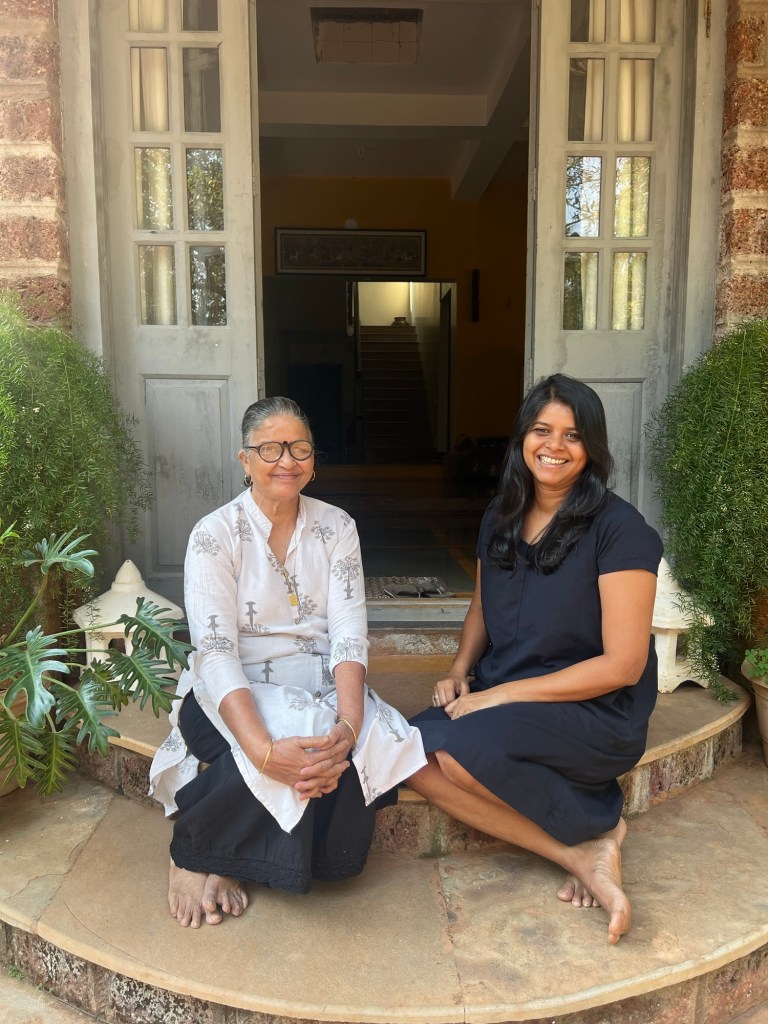
Owners of the homestay, Atithi Parinay

Our room was right above the kitchen area, which was nice, because my kids kept asking for something or the other (to drink/eat)! Our room was part of the building where Medha and her mother resided. So, luckily, for us, Medha interacted with the kids till midnight and they had a gala time together! That was our first night at the homestay. Kids already felt like home.

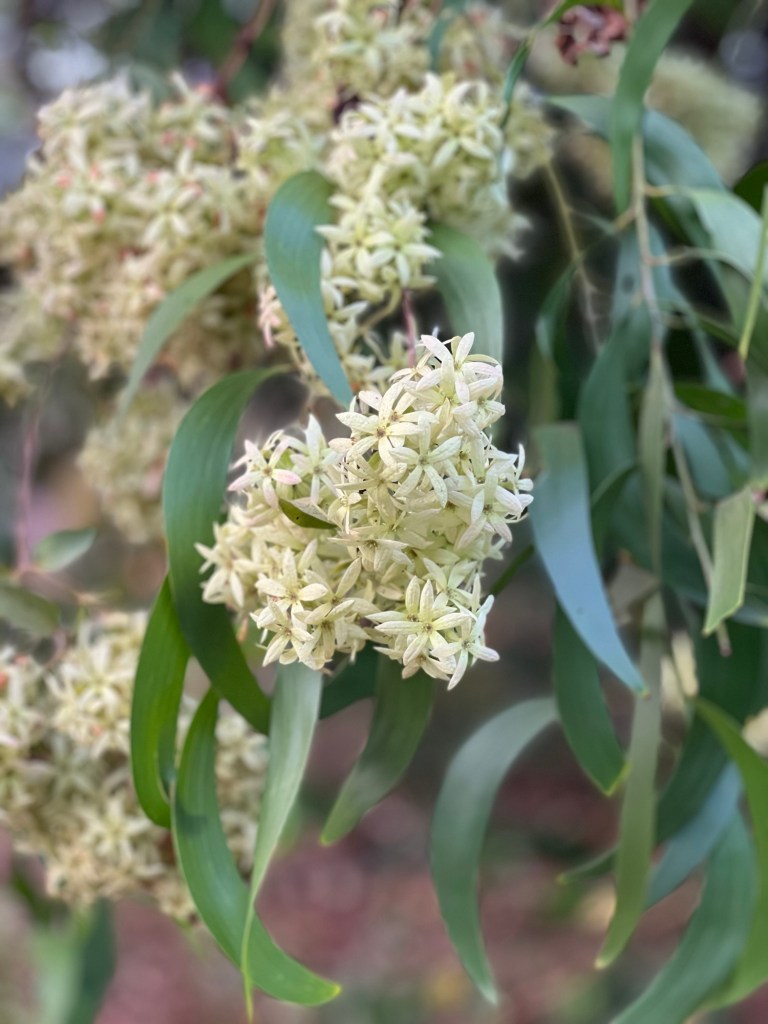
Backyard of the homestay

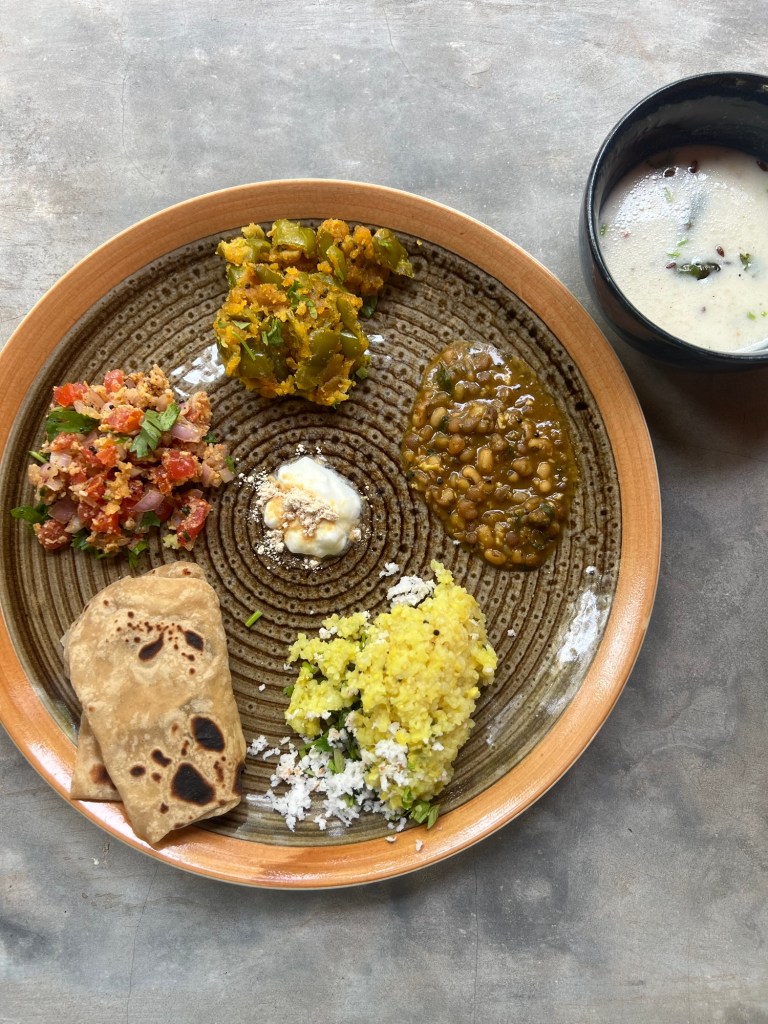
Atithi Parinay is an all-vegetarian place, in fact, you won’t even get garlic and onion in the food. But in spite of it having a satvik kitchen, none of the food items repeated in the course of my four days here. I was in love with the food! Didn’t even miss any Paneer butter masala or Pav bhaji or any of our continental food stuff for that matter. The local recipes of blew my mind. For instance, there would always be a matki or an usal, a salad, a chutney, a dal, roti and rice. Local spice mixtures like Daangar made their way to my plate.

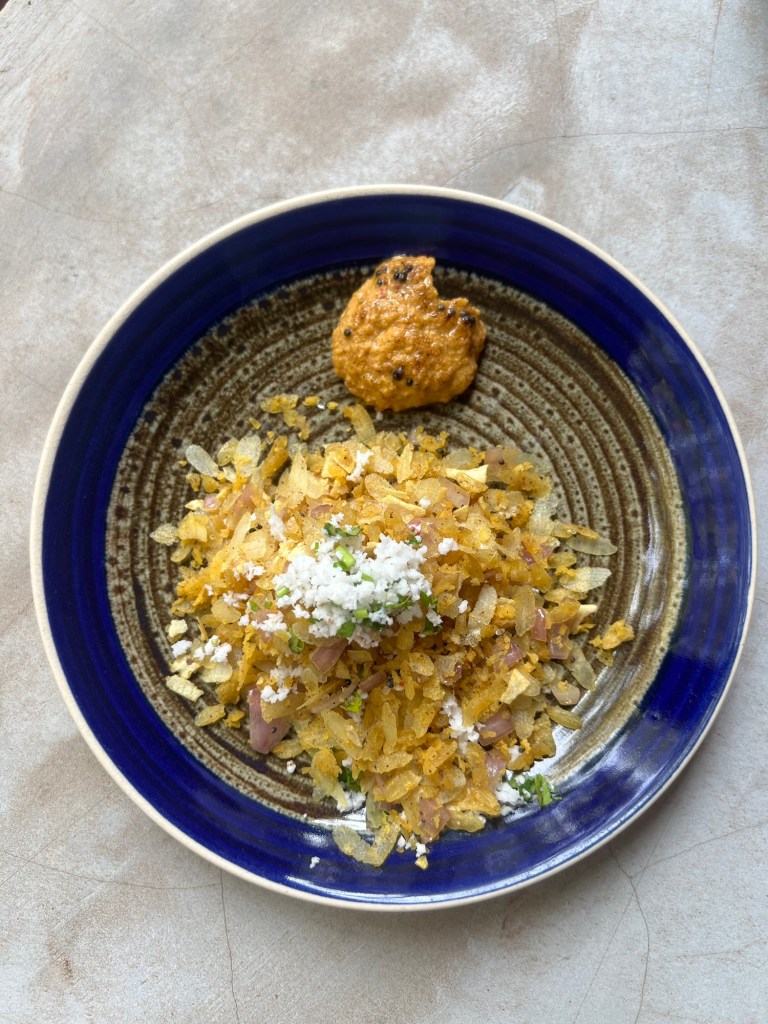
Of course, this being a coastal region, shredded coconut was seen in some dish or the other, but it was all a party for a native food lover like me. Dapde Pohe, Sabudana Khichdi, Sol Kadhi, Dal (with kokum), koshember (every day, a new variety was served), rice flour crepes, a chutney preparation that ranged from raw mango to coconut, local sweets like modaks that were made of rice flour and some sweet coconut-flavoured filling–it just added to our overall homestay experience. Add to that some vibrant talks that I had with Medha that made our meal times so fun! 

We went to the nearby beaches (Ware beach and the Malgund beach), where we saw a hornbill and a jackal. A morning treat! We also went to a nearby famous Ganapati temple that is almost 600 years old.

This coastal area is like a sleepy town, and so, you won’t like that touristy vibe here. Which offers a break from the usual commercial spots.

We spent most of our time at the homestay. And absolutely loved it. You can take 1-2 hour beach time in the morning and in the evening, but you really don’t need to bother missing your meals anyway. The food at the homestay is far better than the local restaurants, especially for families with toddlers. 

It’s interesting to see how Atithi Parinay is run by an all-women led team. I saw Medha talk about a young guy who is helping with social media marketing, but apart from that, I see women run the place like a pro. From cooking and cleaning to maintaining the open green space of the homestay, these women make sure of an incredible hospitality is being offered to their guests. 

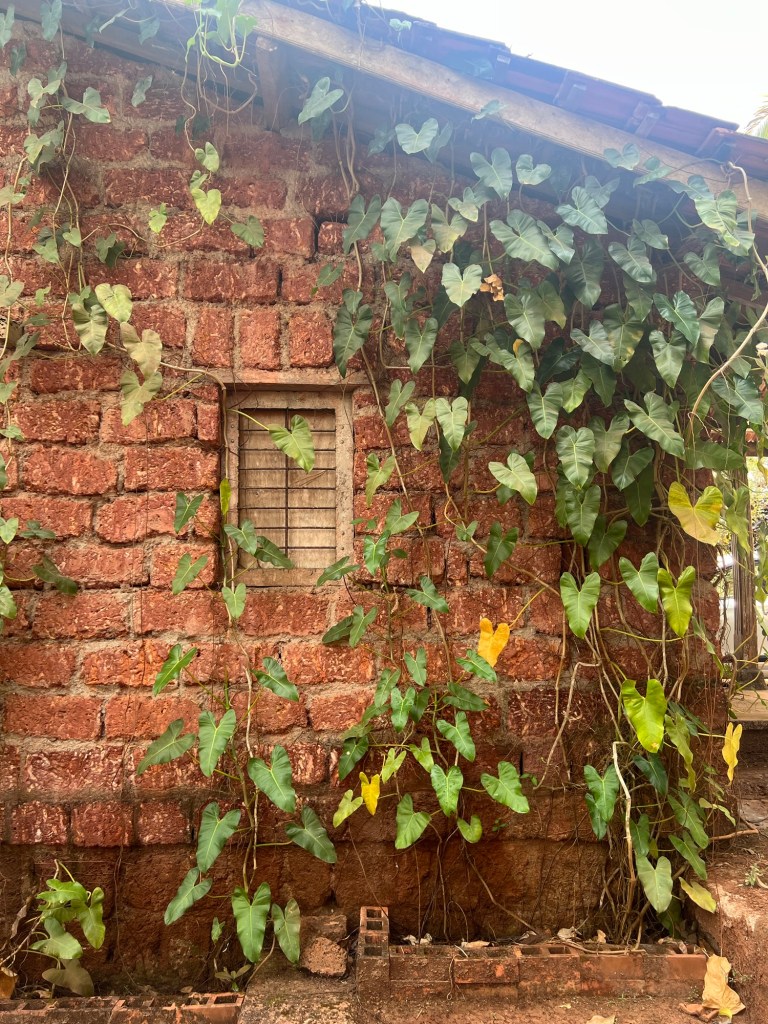
Walks around the homestay

It’s also a good idea to take a stroll around and soak in the calm and green of the coastal village. 

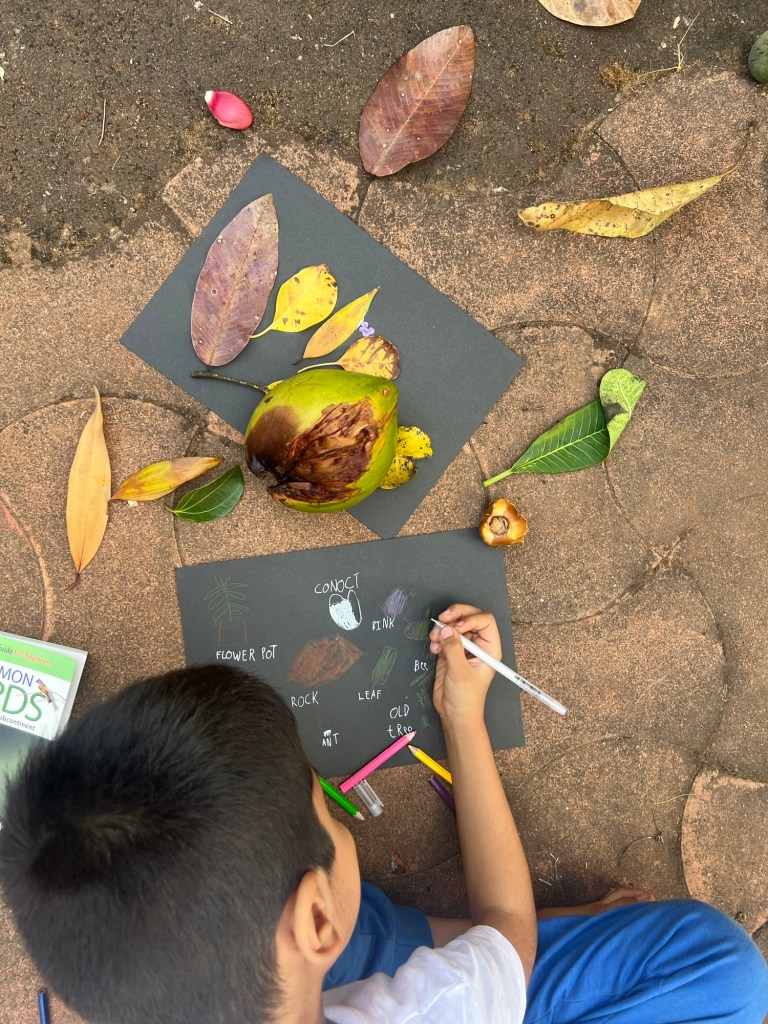
When here, you can unwind and create some art, read a book, watch the birds (I enjoyed the view of a kingfisher twice from my room’s window), relax on the swings, go on walks, and enjoy the good food. 

Note:

1) Visit the Ganapatipule temple around 6AM in the morning, as you’ll be stuck in long queues during the day.

2) Do buy Yojak food products near the temple. During summers, you can pick mangoes from a local farmer.

3) If you are not a homestay fan, check out the Blue Ocean the Fern resort as it offers some scenic beach views.

4) We missed going to the lighthouse near Malgund beach. So either forget things and just chill at the beaches (like we did) or be ready to chase time and visit the lighthouse and head back on time to avoid getting lost without internet connectivity. You can download the map in your phone that can last-time confusion on the road, just in case the connection goes weak. 

5) Do take care when exploring the beaches around. You’ll be attracted to clicking pictures on the road, here and there, but you really have to be careful. Avoid the beaches when the tide is high, especially those who have toddlers with them. 

6) We travelled here from Mumbai and had two meals made from home that we carried with us (as suggested by Medha). If you too have kids in the car, it’s better to carry homemade food because there aren’t really good food options on the way. You might get a Vada pav or poha or even a dosa but not a proper thali-like meal.

Dadpe Pohe

7) Things you can pack when travelling with toddlers: couple of busy bag folders to avoid kids getting cranky, plastic mats for the beach, extra towels, chappals, clothing sets for the kids when heading to the beach. Tiny plastic buckets and shovels to make sand castles. Frisbee? A dump truck toy to help your kid make a mess on the beach sand? Mosquito repellent cream. Binoculars. A fresh loaf of bread and perhaps a tiny jam bottle to save those last-minute hunger pangs.

Let me know how you liked this place. Happy travelling!

Photo courtesy: All clicked by me

How motherhood changed my relationship with food 

The last three times I made Dal I realised a problem. It was too bland, and the more I tried to play around with the flavours, I could not understand why it still lacked colour. Food was meant to be served. Edible food. Something that was homemade and served on time. Who cares for that dal tadka I craved?

Now, it’s a good run to get the right kind of flavours even with my favourite dishes. The game of ingredients over likings, and daily menu chaos over fancies for world cuisine took over my life in no time. And I taunted my mother how she has changed as a cook. She would laugh at it (like she does over all my weird taunts). Can I laugh on what has happened to me now? But, I know how to nail a good salad in minutes. My survival techniques in the kitchen too.

There is so much I see around. Mums doing videos of what their kids are eating (I can’t, in spite of being at home all the TIME). Beautiful reels of native cooking. I can’t. Why would be a good question. Why, do I find hitting on the sofa with nothing more to do is ever so relaxing?

I’m busy looking for creative things we (I and my kids) can do for an hour or two during the day. The actually creative process is even more tiring. But the end result? Oh. Even if we have something basic to eat, I love the painting we try to do. Or the book we try to read. Or just exploring something about the planet.

I do want to talk about food people I meet around. But even those transcribed notes get lost in notebooks I don’t remember where exactly I arranged while cleaning up the toy-laden flat of ours.

What do I want in life? Nothing much as of now. I want to start making more cookies with my kids. More cake. More cold coffee. And in-between all of this, I want to balance it with bajri or Dal khichdi. Add a dash of pancakes and laadi pavs. Make a good ‘busy bag’ for my kids and just get lost in the streets of the city or a nearby lush hilly villages in the country. That’s my sukoon. And oh. Don’t miss on those midnight sneak-outs in the kitchen. That bag of crispy corn chevda. Aha.

No more do I have the energy to watch interesting food videos. I want to look for veggies beyond aloo at the grocery store. How to hydrate my little girl? She hardly has any water during the day. That’s the topic that doing the rounds in my mind. May be a fancy straw or a coloured plastic bottle can do the trick? Who knows.

For the past four years, I have been settling in cities and then unsettling and settling again. What a storm. With two kids. Sometimes I’m focussed in the kitchen, the other times I struggle to make a basic meal. I have help, but I just want to embrace this city for now. Want to enjoy a good pause. In one place. Where there is no uncertainty. Just a mundane routine. For years or even decades.

Yes, I’m forgetting how to write (the tiny bit that I knew). I find myself anxious throughout the night. Drained before dinner times hit. But, somehow, with magic (thanks to the serious talks I have with the little people at home), I find hope. I find hope even in that school tiffin dabba with a sukhi sabzi and roti.

And here’s what I want to do. Think of ways in which we can sit and learn new words together. And how can i let my children explore this world and find beauty. Constantly. So, what if I can’t find it myself sometimes. I was never this kind of a person, but whatever. We got to find it. So, yeah. Fine dining do I crave? No. Just basic food that has been made well. Don’t get me started on my love for thandi roti and achar/pickle, a roasted slice of white bread with a homemade jam, and khari (a Parsi bakery find) with chai. And while I enjoy a meal, my kids should enjoy a good view. Hills, beaches, hammocks, you name it. Will that be part of the deal? Only then can we talk about good food!

Just like Rasam

There are some recipes that you don’t want to mess up or change, while a few recipes constantly evolve. For me, of late, this has been my Rasam and my homemade pasta sauce. 

My days, suddenly, are jam-packed. And there’s a new rhythm at home. My kids are playing mostly on their own. Lots of sketching. Scooter-riding. Basketball dribbling. We have moved to Mumbai. I have lost my sweetest maids, and Yuvi is without his Gurgaon friends. But we have each other to cope with this change. 

Amidst our busy evening, when the kids make plans to hit the outdoors, I realised I have to make something different than just Kadi chawal or Dal chawal.  So, I made Rasam and we all ate it with all our hearts. Thanks to the next-door food store that delivered Appalam papads that went perfectly with it. 

I went back to my cousin, Kanchan Rathi’s audio notes. Found her recipe and there, I was ready to make it.

Recipe: Kanchan’s Rasam 

Ingredients:

2 tomatoes 
7-10 cloves of garlic
black pepper (1-2 tsp)
Arhar Dal (optional) 1-2 tsp
Cumin seeds – 2 tsp (for spice mix), ½ tsp (for tadka)
turmeric powder 
asafoetida 
salt to taste
oil/ghee
fresh tamarind pulp (I use around 3/4th cup) 
coriander leaves 
mustard seeds 
curry leaves
dried red chillies (I never have it when I make rasam)

Method:

1.        First up, roast cumin seeds, arhar dal (optional), and whole black pepper in a kadai for 2-3 minutes. 

2.        Now, clean the garlic and get 6-10 cloves of garlic. It depends on how you like it. 

3.        Take a mortar and pestle and ground the spice mix. You can also use the grinding machine. This time around, I started pounding with the black pepper, then cumin seeds and the dal, and lastly, in the same mixture, I added in the cloves of garlic and coarsely grinded it too. 

4.        Now, I take a medium-sized steel vessel. Add some ghee. Let it heat up. Throw in some mustard seeds, asafetida,  cumin seeds, dried red chillies (optional), curry leaves and turmeric powder. Mix it a bit and add the spice mix you made with your pestle. Give it a stir. 

5.        Chop the tomatoes (my cousin squeezes them out with her fingers for a rustic touch) and hand-pound them a bit for a coarse touch. Add these to tadka. Now, add in the tamarind pulp (strain it) and a couple of glasses of water (boil it beforehand if possible).

6.        Once the Rasam has boiled for 6-10 minutes, add your chopped coriander leaves, salt to taste. Give it a taste, and if it tastes well, switch off the flame. Kanchan says, the more you boil your rasam, the tastier it is. 

7.        Serve hot with Appalam papad and hot rice.  


I hope you like the dish as we did it tonight. The pasta sauce recipe is coming up tomorrow. Again, it’s an evolved version. And I love it. 

A food tour of Chandni Chowk

A long overdue trip to an ancient Delhi area comes into being as I step out for a heritage walk with a friend. It was planned just a night before we took the metro train together from Gurugram to Chandni Chowk. And while life has its own commitments—for me, it’s my two kids—I could still take the trip as my husband pushed me for it. “We are changing cities in less than a month’s time. So, you better go for it,” he said. 

Thanks to the changes that happened to the busy area of Chandni Chowk in 2018, we had only E-rickshaws and cycle wallahs around us. Thank God, we had some space to walk. Minutes of us walking a few feet from the metro station, young men start following us as if we were looking for lehengas. “Bhaiya, lehenga nahi lena. Hum shopping ke liye nahi aaye hai,” I told one of the guys after he followed us for a couple of steps. 

I skipped my breakfast. Didn’t comb my hair. Just landed at Chandni Chowk with my jacket and a friend. It was a busy morning as my in-laws were stepping out to their city, but I really pushed myself for this local trip. And so, I was hungry. 

We started with Matar Kulcha. The freshly cut ginger, onions and tomatoes tricked us to believe that it might be tasty, and boy, we were not wrong. It was lip-smacking! It costed us some 30 to 50 bucks for a plate. The kulchas were thin and freshly roasted. 

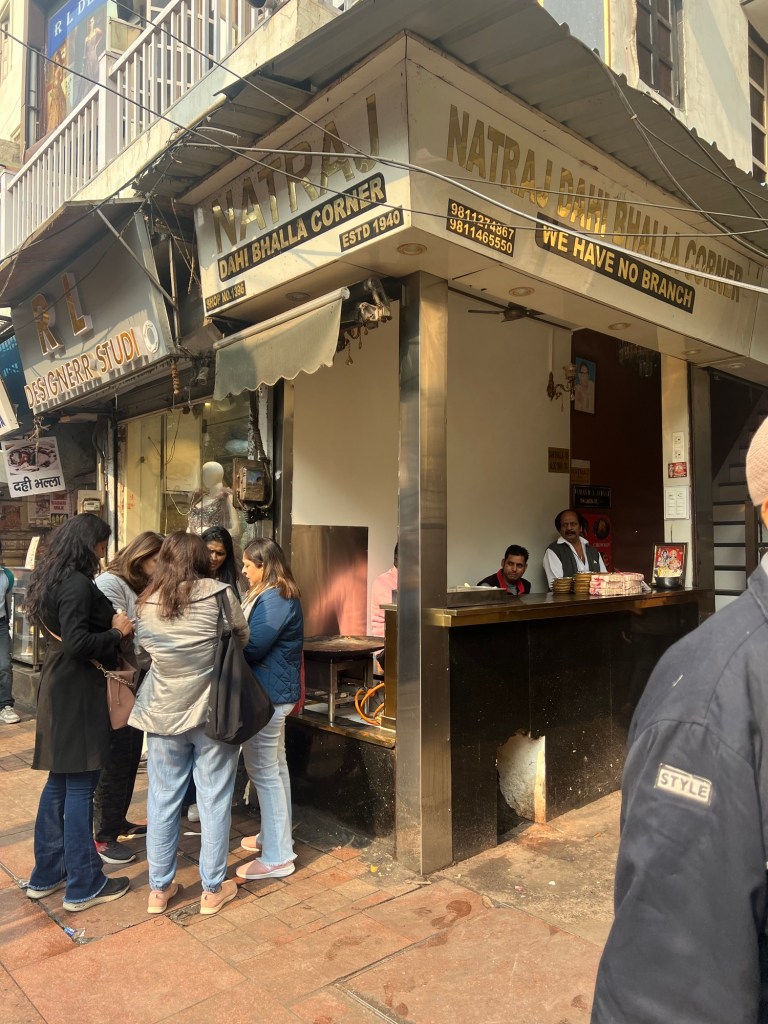
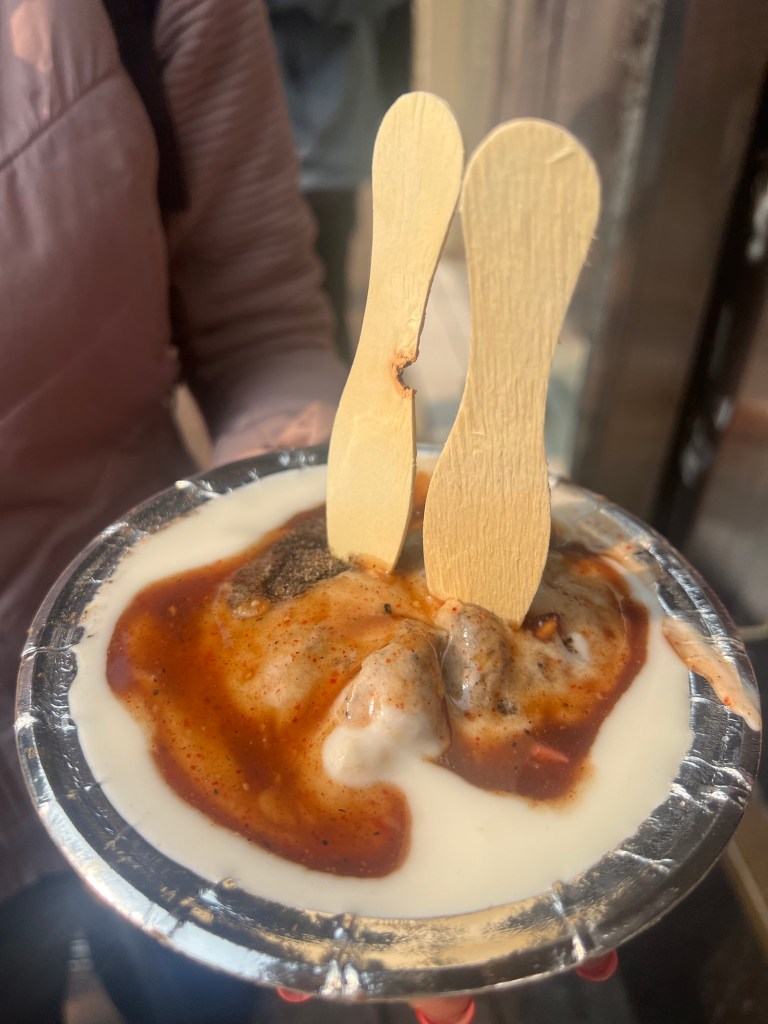
We left that lane (a few metres from the metro station), and towards the end of the lane was Natraj. So my friend, Namisha Singal, asked me if I was up for a plate of Dahi Bhalla. Though the plate was a bit cold for a cold December morning like this, we still liked it. She was wanting an aloo tikki or something with it, but we could easily finish the plate. The spice mix that went on the Dahi Bhalla made the cut. “My mother used to save this spice mix and use it on salads later on,” Namisha told me. Her father came to Chandni Chowk almost every month, and he went back to Faridabad with a little bag of Dahi Bhallas. 

After a few minutes, we met our heritage walk leader, Jibin George. It was amazing how he had these old paintings to show us on his iPad and we could clearly compare the changes. Soon we tasted our third dish. 

Jalebis. The shop’s name is Jalebi Wala. It had a board nearby that said Haveli Dharampura. So don’t get confused when you see 12 more Jalebi walas in the area. I was not so excited about this, but I was totally blown away by these jalebis! Two reasons I loved them: The chaashni or the sugar syrup was not so sweet. Plus, it had a runny texture, and not your typical sticky texture. Second, the labelis were both moist and crispy. And these were not too sweet either. So, the key for a really yum plate of jalebis is, hold on to that sugar. It really refrains you from having more. It is one of the best things I have tried in my lifetime! Imagine, I’m almost 40! So, you don’t have to miss these ever! I was told this shop has been running for 3-4 generations. And it’s the simplicity of these shop owners who make you respect them even more. 

Daulat ki Chaat

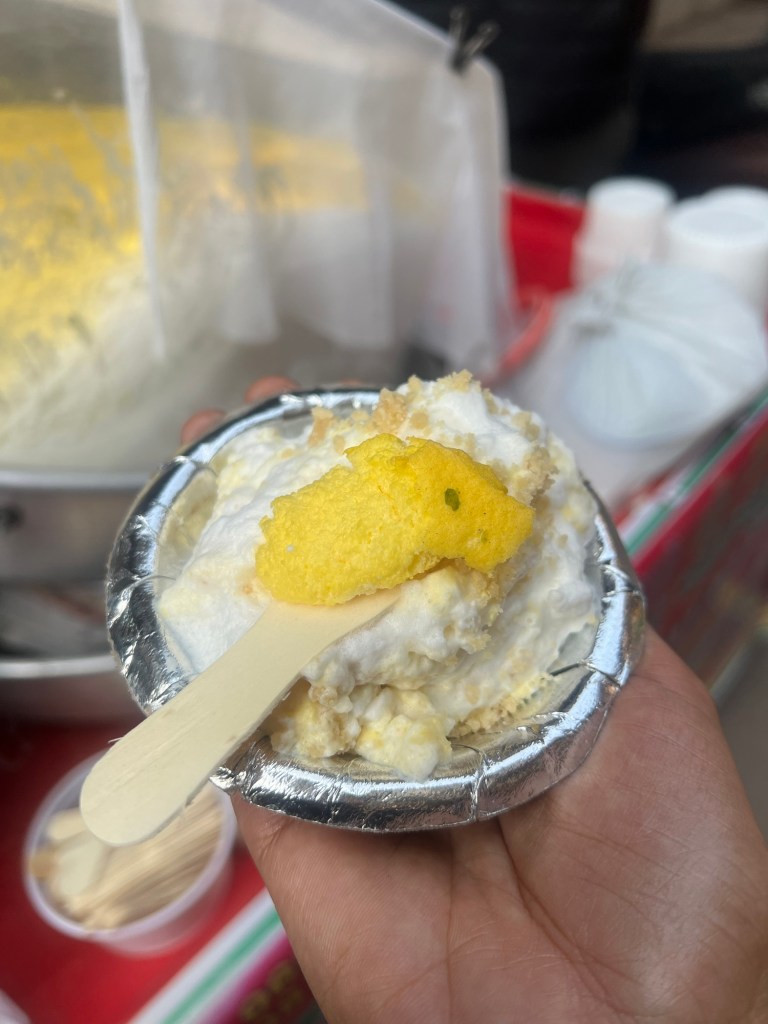
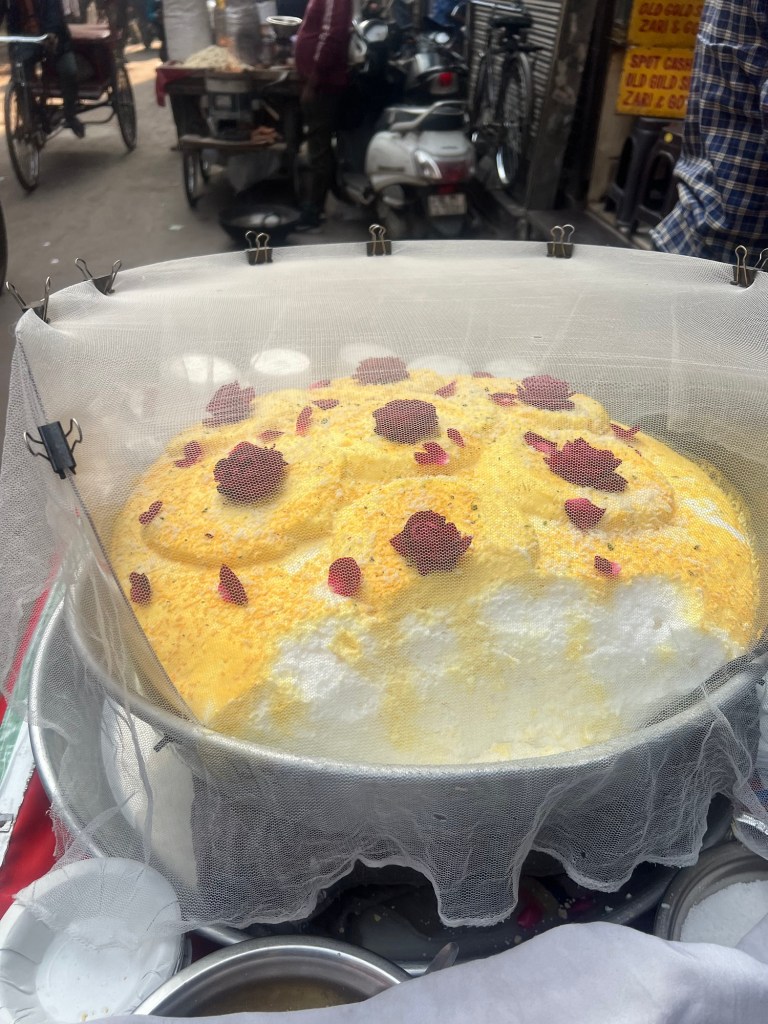
My fourth dish came about in the same lane. Daulat ki Chaat. When people told me about it, I imagined a big blob of aloo tikki with mithi chutney or something. But it was way beyond it. Daulat ki Chaat is basically milk froth. It stays as is thanks to the cold weather. Some of it is white, while some of it tastes of Kesar and is yellow in colour. It had a spoon of mawa too and a sprinkle of dry fruits like pistachio. Did I like it? It was too sweet for my palate, but I still managed to complete half a plate. The guy took 200 Rs for three plates of this Chaat. 

We entered a lane called Dariba Kalan. Interestingly, we happened to spot a Pani Puri wala. His cart looked super clean. He was also wearing gloves. So, I went ahead and asked my friend if she was up for a plate of Pani Puri. She ended up finishing her plate, but I couldn’t go beyond one puri. Even so, I didn’t finish that either. And I realised, if a cart is neat, it still doesn’t guarantee the best taste. Pani Puri is truly a tricky dish. She grabbed a nice cup of ginger tea, and we moved on to Parathe Wale Gali. Wow! I almost pinched myself here. As a mum of two toddlers, living in one of the best areas in Gurugram, what am I doing here? How could I manage to come so far? Am I mad? And I realised, it was one of the best decisions of my life. This heritage walks. We should take such walks often in life. Jibin explained the lanes and the history of the place so well—I could connect it so well; I will never get confused about any of the lanes next time. Delhi is truly beautiful if you take a chill pill and get the hang of it. Don’t just keep walking. Wait. Ask someone for the best way out, and you should manage to walk out of it with a smile! I don’t know if I make sense here, but anyway, here I was. Trying not to think of my elder child’s cough or the other child’s pick-up time from school. 

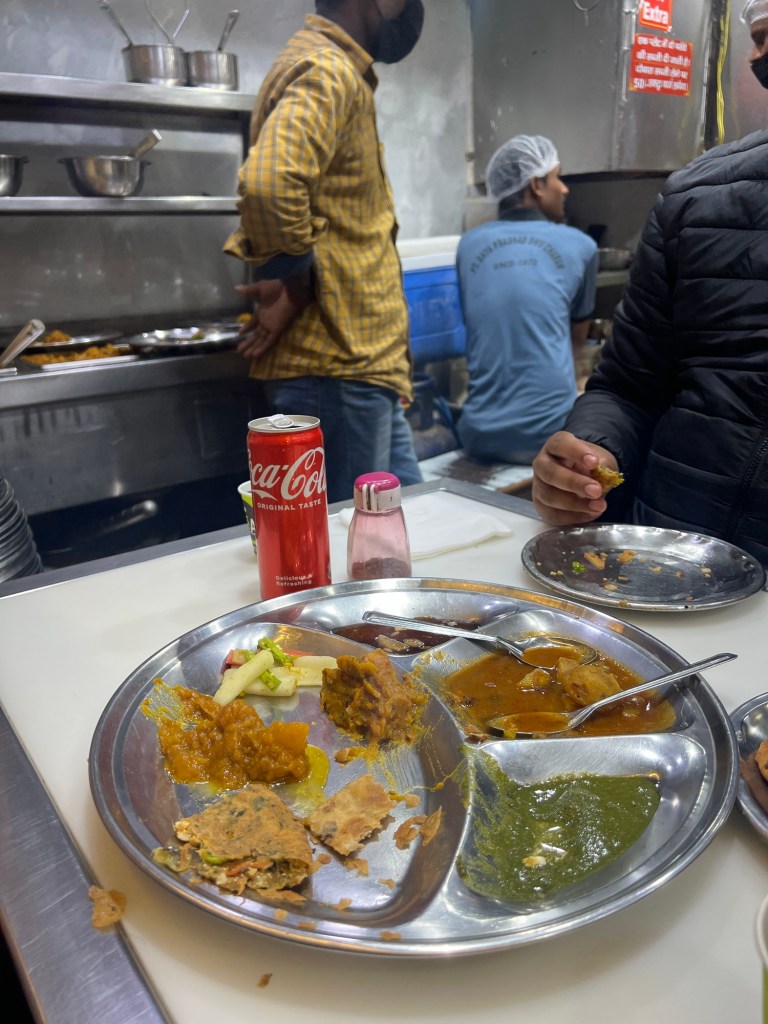
Enters: Pandit Gaya Prashad Shiv Charan. I have seen fried parathas on TV. Of course, I had my doubts if I would like any Parathas here. But I was wrong. The parathas were lip-smacking. But what truly made it work for me was the way it was presented. We get out seats early on, and are served a plate full of everything but parathas. We have tari wali aloo ki sabzi, sukhi aloo, hari chutney, mithi chutney, circa pickle (veggies in vinegar), and kaddu ki sabzi (pumpkin sabzi). The tables were wiped well, and the place looked tolerable in spite of the line outside the shop. The menu was damn confusing, but we somehow ordered two types of parathas. Lemon paratha was the first one. I was curious to see their style of serving lemons in a paratha and they were smart. There was a simple spread of lemon pickle inside the paratha. It tasted okay, and an eye-opener of a dish for me. Simple yet a bit complex. Next was a mixed veg paratha. And I totally enjoyed finishing my thali here. Will I go there again? Hell, yes. This is magic! 

The next dish in your list should be Chole Bhature. But we were too full for it. Of course, the next time I’m here, I’m going to try it. But Jibin pointed out the two places that serve the best Chole Kulche in Chandni Chowk. Kanwarji Bhagirath Mal and Tiwari Ji Chole Bhature. Life is simple, if we keep it simple. Going to the busy lanes of Chandni Chowk was so different than just reading about it on Instagram. We should go out there, more often. We shouldn’t abandon our historic, old corners of the city. It really brings so much together for me. Makes me feel small but valued. We got to value this. Do you know what I mean? 

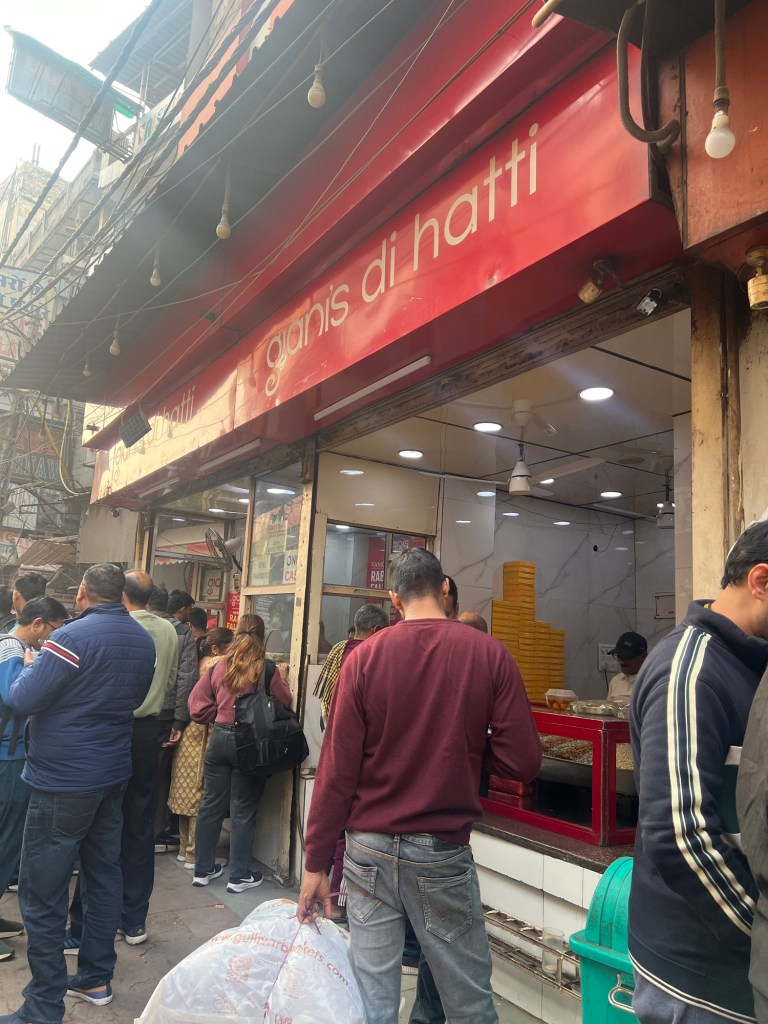
End your trip with a glass of Falooda Kulfi at Gianis di Hatti.

All pictures credit: Deepika Bhutra Nandal

Palak ka Saag

If you have your roots in the northern region of India, chances are high that you love your Saag. Now, usually, a Saag is made of mustard leaves, spinach and chinopodium album (that is sarson, palak and bathua in the local lingo). But as these are available in winters only, one can only dream of a saag during the hot summer days.

My mother-in-law loves her Saag. She is someone who would always be on time, and so, she’d spend her entire morning preparing for this, so that we can have this Saag at noon (and on time). So, this is her recipe; this is how she makes it. And I love it. Its rustic flavours are nourishing for your health. Have it with your whole-wheat/cornmeal/sorghum rotis/chapattis.

Ingredients:

One bunch of spinach, half glass water, 2 tbsp – gram flour (Besan), salt to taste, garlic cloves (three), ginger (1 tsp), 1 medium-sized onion, 2 small tomatoes, green chillies (two, if spicy), oil/butter for tempering, 1/4 tsp each of coriander and turmeric powder, two pinch – asafoetida, 1/2 tsp red chilly powder, a pinch of cumin seeds.

Method

1. Clean your spinach in water. Chop it roughly, including the stems. In a cooker, add in these leaves. Whisk one tbsp of gram flour in a small bowl and add it to this. Add in water and a bit of salt. Give it a whistle or two. And then, mash it with a potato masher. Some people prefer to grind it in a mixer. My MIL likes a coarse texture, so she avoids doing so.

2. Now, finely chop the garlic, green chillies, ginger, and onion. I used a vegetable chopper when I helped her prep. Keep it aside all together in a bowl. Then, finely chop the tomatoes and keep aside separately.

3. In a skillet, add in some oil. Then, add in the cumin, asafoetida, turmeric, and the onion, garlic, ginger and green chillies. Sauté till for two-three minutes, then, add in the tomatoes. Now, add in a bit more salt and the rest of the spices. Sauté for another five minutes.

4. Now, add in a tsp of gram flour and mix it really well. Whisk the gram flour paste beforehand if you want to, so that there are no lumps.

5. Lastly, add in the mashed spinach. Now, you don’t want too much liquid in your Saag, nor do you want it to be too dry. So keep mashing and stirring it, till you achieve the consistency. And voila!

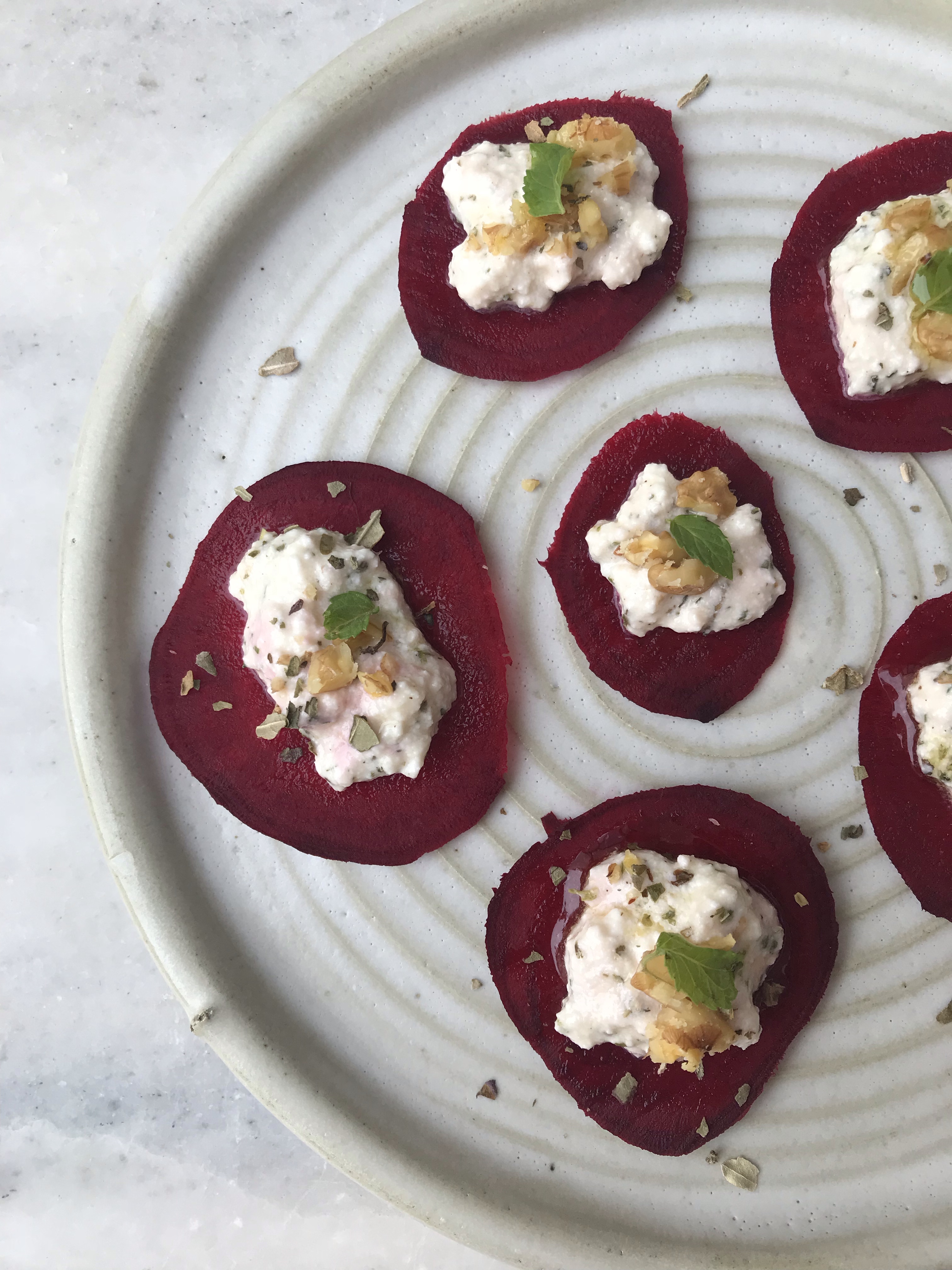
Italian-style Beetroot Salad

I have always used beetroots in juices. Other than that, it has always gone overlooked in the fridge. But this salad is something that I can make not only at home but as a party appetiser too. I saw many versions of it, but this is something I did it to suit myself (according to my kitchen resources). Hope you like it as much as I did.

So, here’s how I made it. I finely sliced a fresh beetroot. Would recommend using a mandoline.

For the filling, I mixed fresh yogurt (although Greek yogurt would be great) and cottage cheese. I mixed three tbsp of yogurt with half a cup of mashed cottage cheese. Added salt and pepper for seasoning. Next up I added dried basil and mint leaves. Mint here made all the difference. I didn’t have fresh basil leaves, but that would take the taste a notch higher and closer to the true Italian flavours. Finished the filling with a drizzle of olive oil. Kept it in the fridge for later.

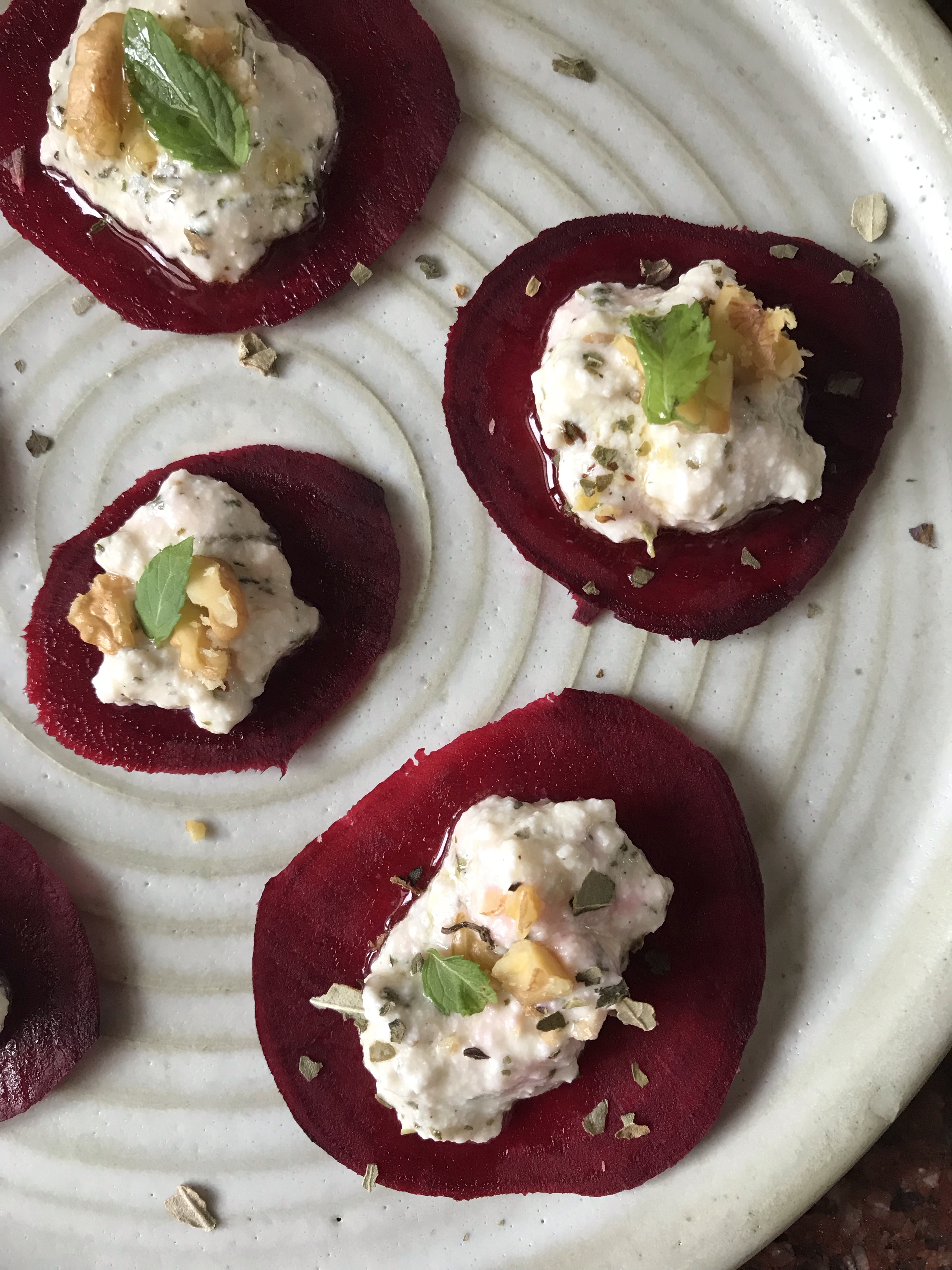
When I was ready to plate, I took my beetroot slices and arranged them on the plate. Now, if you have more time, you can marinate the slices in some kind of a vinegar but I only drizzled a few drops of lemon juice on it. Add in the filling on each slice; I found using my hands better here rather than a spoon.

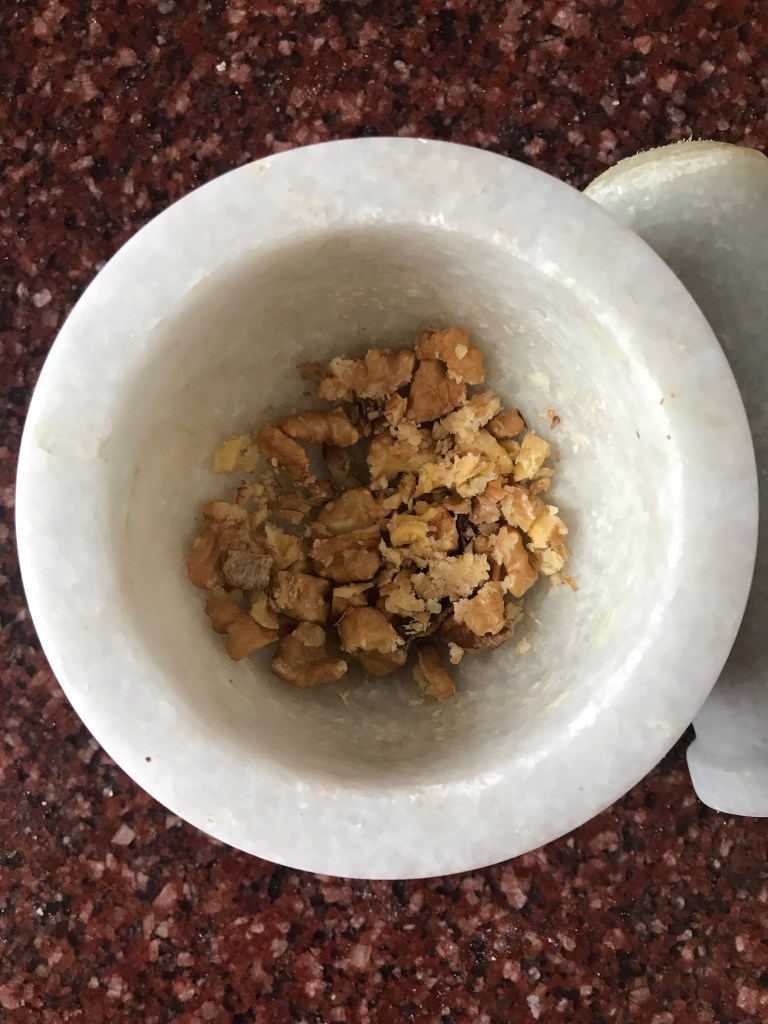
For garnish, you can use any nuts and herb of your choice. I added crushed walnuts and mint leaves. And of course, a drizzle of olive oil. Again.

I can’t wait to try it again and share with my friends. But I guess, it will take a few more months or probably an year to get the party season started again.

Recipe inspiration: Pickle & Honey and The Peasful Vegan

There’s more to cabbage

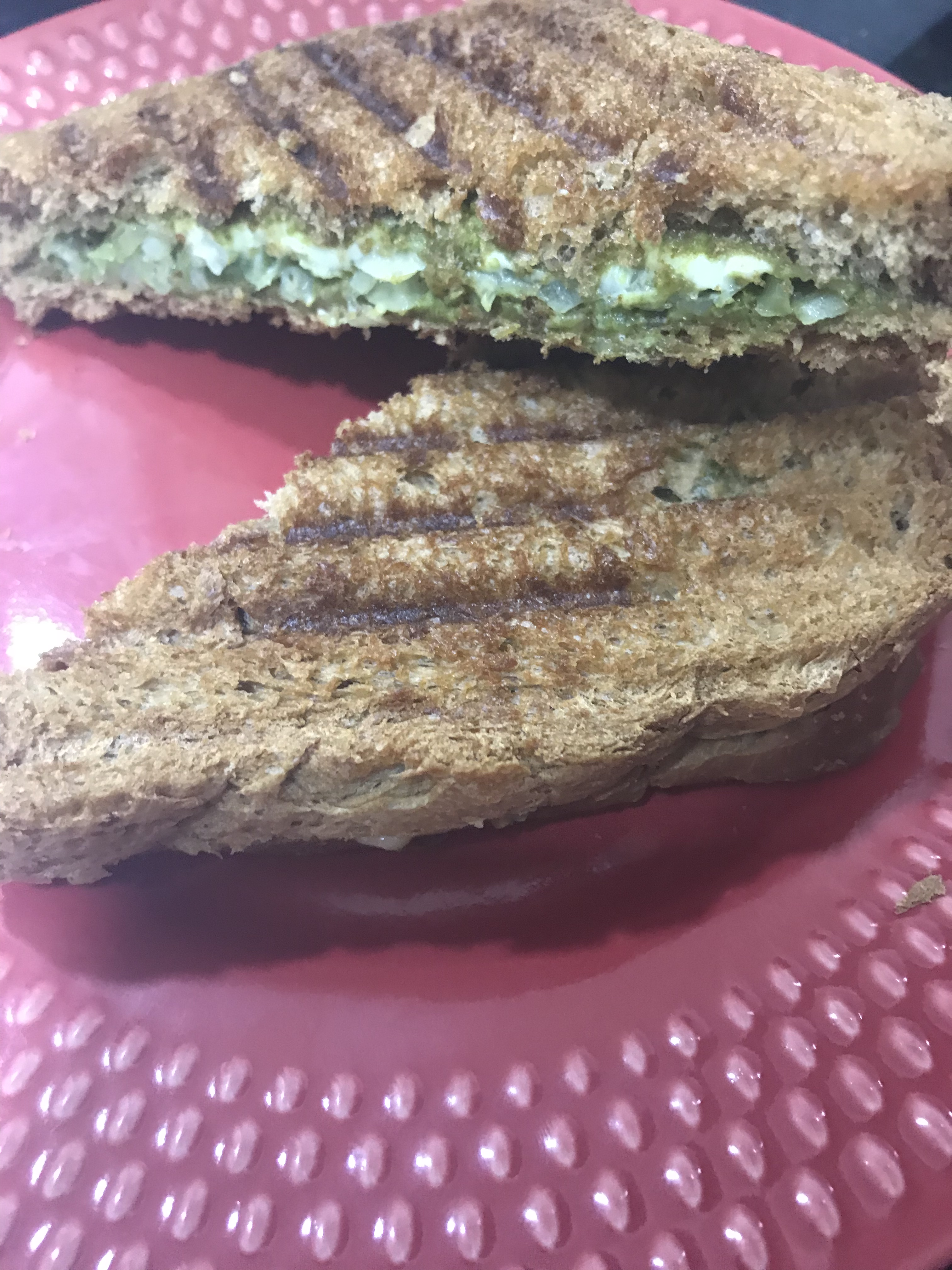
I always used to end up thinking a dish to two that I could do with cabbage. But, not anymore. Thanks to my neighbour aunt in Surat, Vinod aunty, who is an ardent lover of street food. She introduced me to this amazing grill recipe and I must say, it’s the best thing she could tell me. She is elder than my mom, and we still connect so well. All because of our love for food.

I also end up doing the same bread recipes, and finishing that packet of bread can become a task for sure. But when my fridge has cabbage, I know I’m good. Over to this Surati style cabbage grill recipe that calls for a handful of ingredients only, and tastes delicious. Keep those letters in capital though.

Recipe: Cabbage grill (perfect for that 4PM hunger strike at home)

Method:

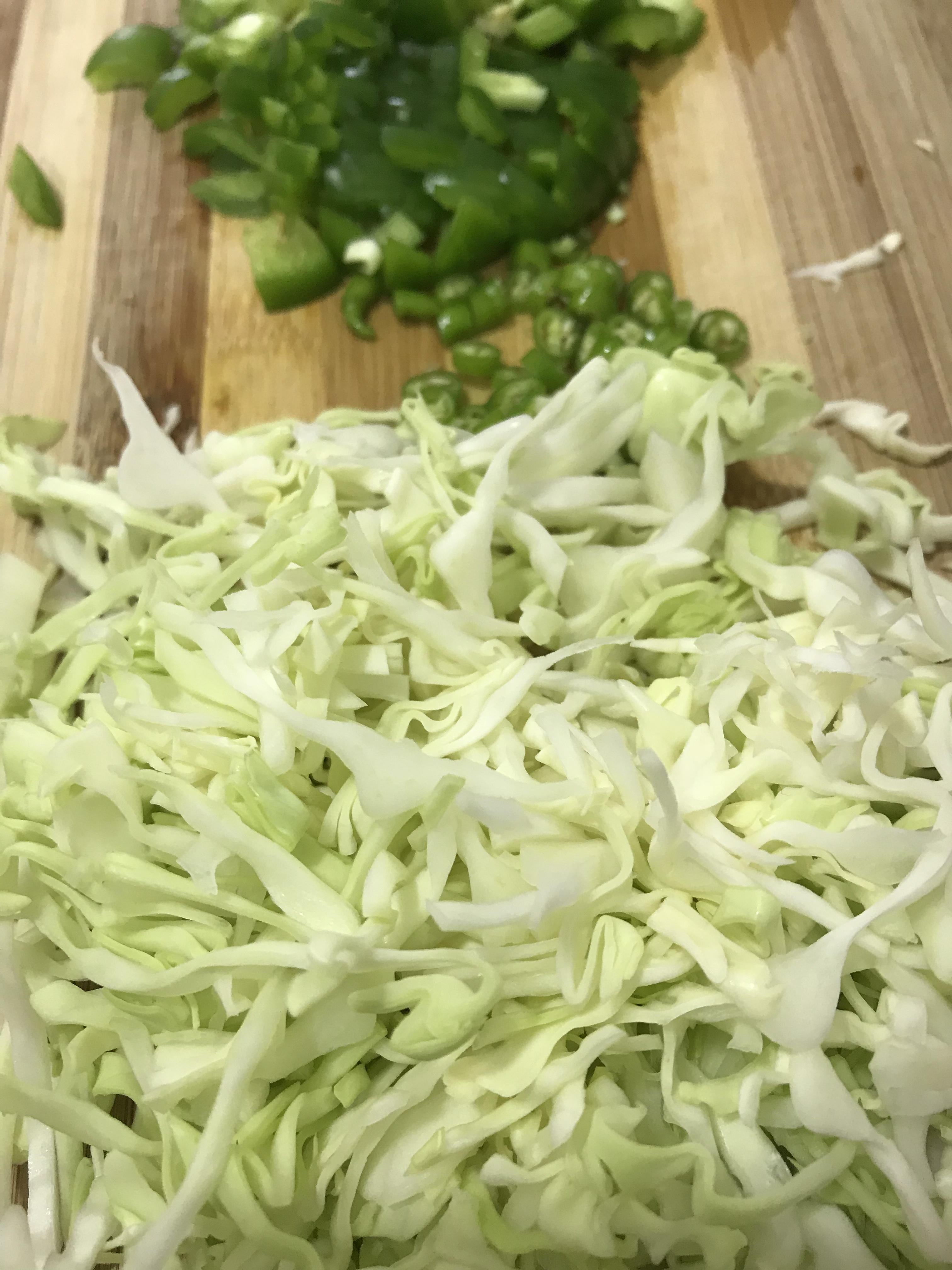
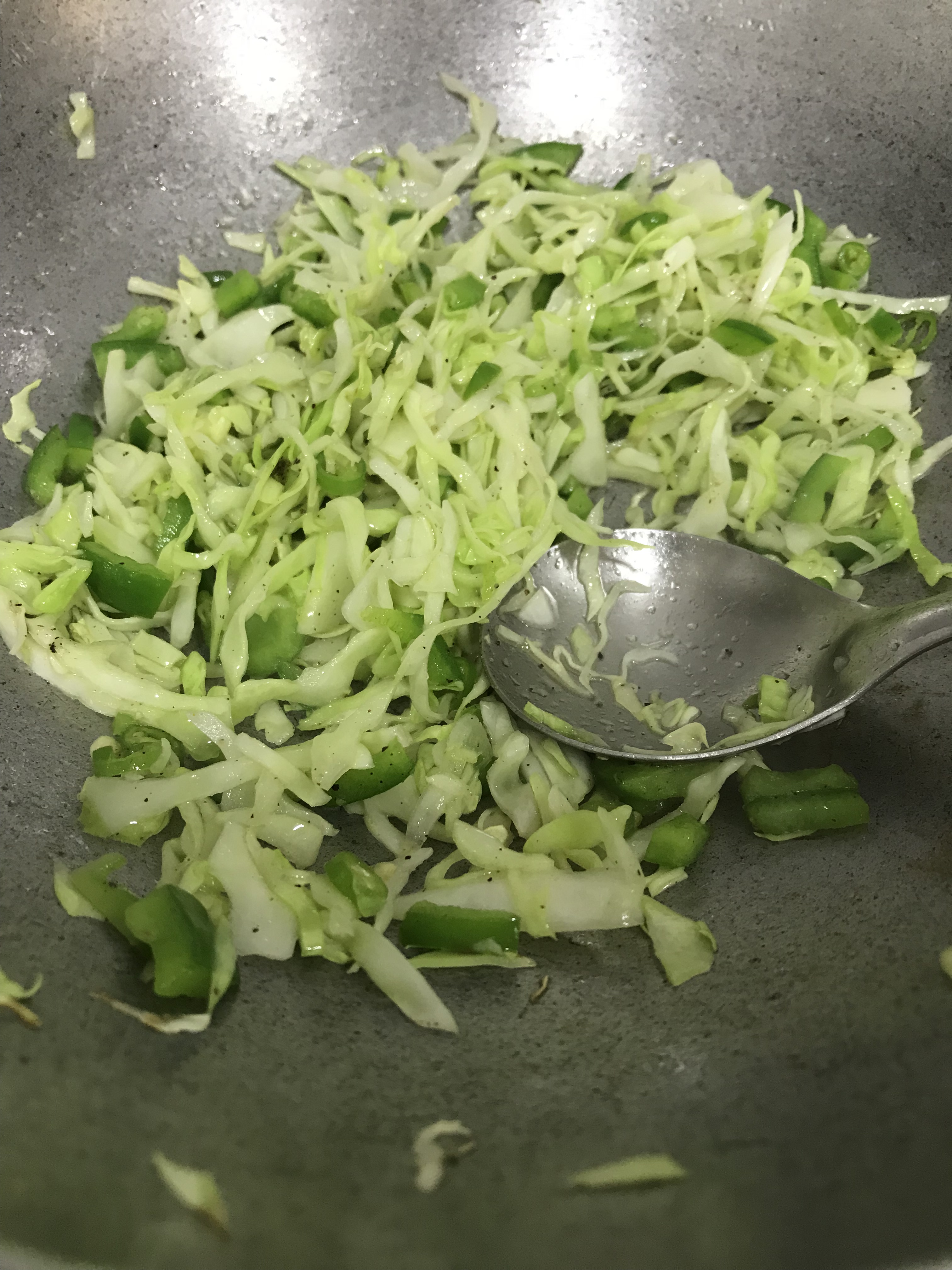
Finely chop some cabbage. The quantity depends on how many grill sandwiches you want to make; I take half a cabbage for three people). Finely chop a green chilli. You can take one more if you want to keep the heat meter high. Chop half a capsicum. Now, take a wok, add in a tbsp of oil. Dump the chopped veggies into it. Add salt and a good pinch of black pepper (I like to go overboard with this ingredient though). Let the mixture soak the water. We need to half cook the cabbage here. Once done, take it off.

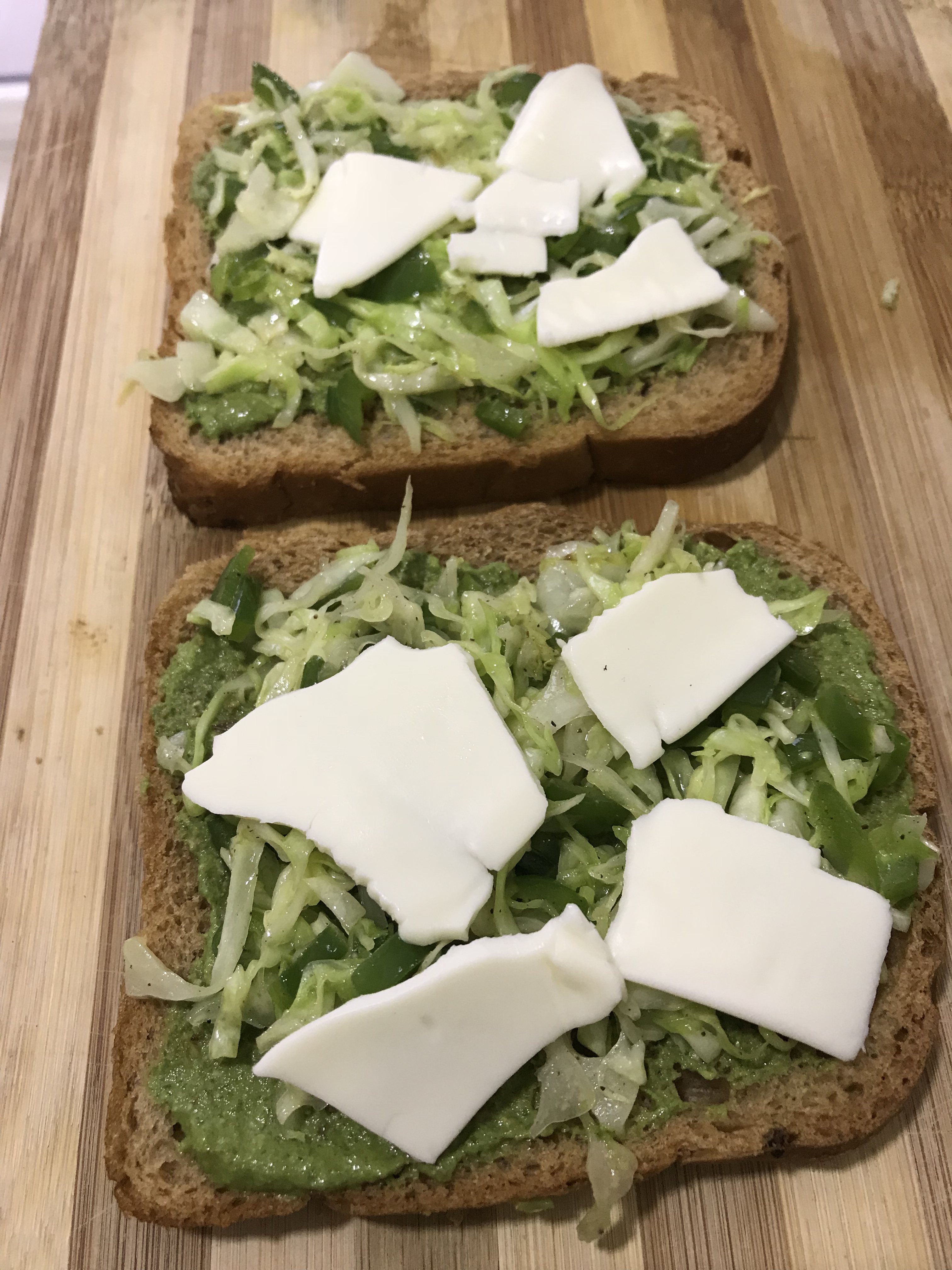
Now, take two slices of bread. Apply some coriander chutney (coriander leaves, ginger, salt, juice of half a lemon, green chillies and cumin seeds) on both the sides. Add in the filling that we just made. Add some cheese if you want to. Now grill this sandwich and serve it with some tomato sauce.

I would love to hear from you, so let me know how you like the taste of this recipe! Ciao!

PS. This dish always reminds me of Surat, and how a good bread toast with green chutney can make for an excellent snack. My nostalgia with the city I grew up in never ends, no? Anyway. Make this at home and you will taste a slice of Surat’s food scene, too. All right, enough.

Morning mantra

IMG_4344

In today’s day and age, we have access to huge streams of knowledge that pours in from all social media pages, mobile apps and informative websites. Still, it remains a challenge when it comes to eating healthy. Let’s accept it, implementing a nourishing diet on a daily basis can be daunting, and one might feel the urge to remove the packet of noodles or ready-to-eat food item so that you can bring some kind of food to the table on time. Distraction is easy, but remaining attentive can be tough. Have a mother at home who likes to feed you good food? In that case, I envy you. As I and my husband have to depend on each other for this.

So, recently, I have begun keeping my breakfast the healthiest meal of the day. It’s usually multigrain rotis (I mix around five to six flours like jowar, bajra, chana, makki and wheat flour) that we have with curd and pickle. Multigrain rotis are filled with fibre and can also help those who have constipation.

During our breakfast time, we also like to have a fruit or two like banana, kiwi, pomegranate or chikoo (in season now), and a handful of soaked nuts like walnuts, raisins, almonds and figs. We finish off our breakfast with a glass of milk.

When I’m too lazy to cook, we like to have a banana with milk as our mini morning meal. During summers, it can be a filling smoothie comprising soaked nuts, seeds, banana, peanut butter and cocoa powder.

Also, before stepping out for work, my husband grabs a spoonful of pumpkin or flax seeds. I keep munching on them and on some salted watermelon seeds (we call it coolie in our language) that my mum keeps sending me.

Some days, I like to make stuffed Parathas (options like grated cottage cheese with onions, boiled potato masala, cooked radish or cauliflower, or some boiled and mashed green peas) and serve it with fresh curd and a tsp of lemon pickle. On other days, it’s Poha, Upma or even Dalia.

Also, a bowl of fresh, homemade curd is a must for me! I like to have it plain. Curd has good bacteria, and it is good for your gut health as well. Also, if you’re recovering from an illness or feel low in energy, a glass of coconut water can help too. I had it this morning myself. Usually, I struggle to finish off my fruits in the morning, but then, I have them during the day.

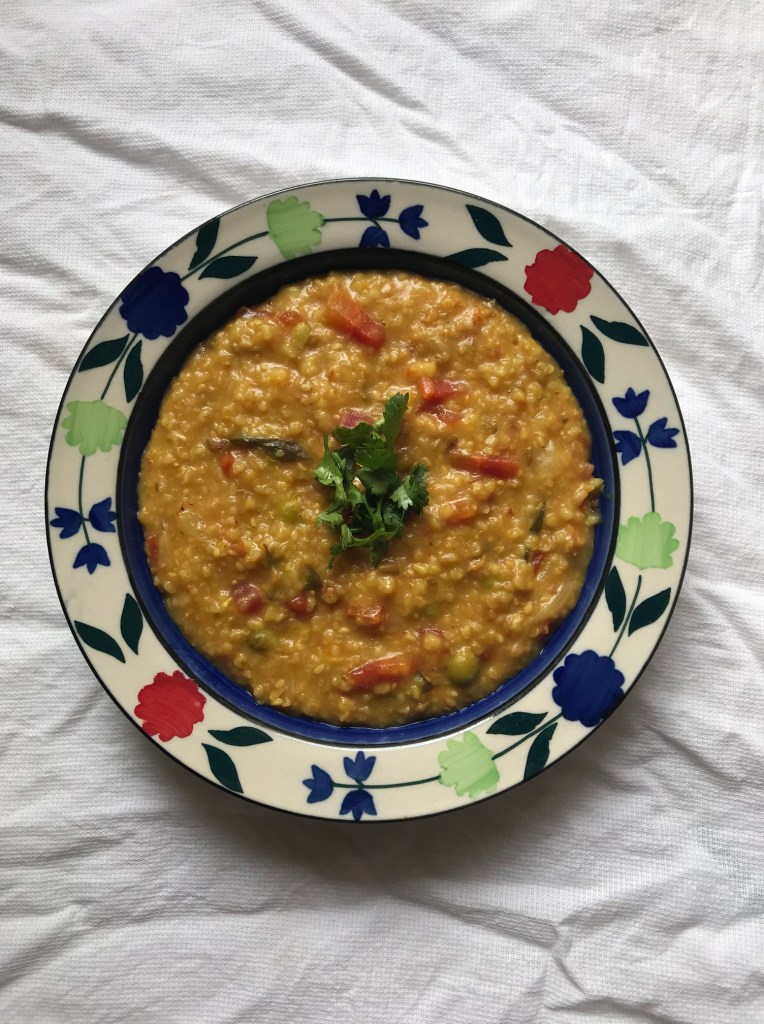
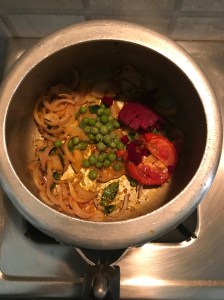
Today, I had a few veggies in the fridge, like half tomato, a small piece of beetroot and carrot, and a bowl of frozen green peas. So, I thought, why not make some vegetable Dalia and use the leftover veggies that can go ignored soon? Frankly, it’s rarely that I make Dalia, but I keep reminding myself of the resolution I took up this year: finishing off what I have in my kitchen pantry. And a jar of Dalia was stuck in one of the shelves since ages. So, it will be best if I finish it soon.

My recipe of vegetable Dalia is inspired by Pramila’s Cook Book, a YouTube channel that I follow for Rajasthani recipes. Pramila, who seems to be based in Jodhpur, is too good, and she deserves more followers than she already has. Do check out her channel if you like Rajasthani cuisine. This is my version of the vegetable Dalia and you can give it a twist with whatever is available on hand.

Having said all this, there are days when we go off track and end up forgetting the nuts or a fruit. But we should keep striving for a healthy diet, as much as we can, right? What did you have for breakfast today?

Recipe: Vegetable Dalia

Ingredients

¾ cup – Dalia or broken wheat (Pramila suggested toasting dalia before soaking it for an hour)
veggies of your choice – I used chopped onions, finely chopped carrots, a handful of frozen peas, half a tomato and half beetroot.
curry leaves (optional)
ghee
salt to taste
spices (½ tsp each – turmeric, coriander powder, red chilli powder)
2 tbsp – split green mung dal (soaked for an hour)
a pinch of asafoetida
¼ tsp – cumin seeds
coriander leaves – for ganish
½ tsp – ginger (crushed)
1 green chilli (chopped)

IMG_4343

Method

1. In a cooker, heat some ghee. Add the asafoetida and cumin seeds. Let this crackle and give it a quick stir.
2. Next, add in the curry leaves, ginger, green chilli and onion. Give it a mix. After about a minute, add in the other veggies as well. Now, keep tossing it or stirring it every 20 seconds or so.
3. After about 2-3 minutes, add in the soaked Dalia (make sure you wash it thrice), split green dal, salt and spices. Give it a mix and keep roasting it for another minute.
4. Now, add in some water. I like to cover the Dalia so much so that I can see one and a half inch of water. Now, give it five to six whistles.

The humble pumpkin

IMG_2970

At home, back in Surat, we never had pumpkin in our household. As I have mentioned several times in my earlier posts as well, my parents grew up in the deserts of Jaiselmer (Rajasthan) and they never had loads of vegetables in their kitchens anyway. Those were barren lands then unlike the present times. My aunt (my masi/mum’s elder sister) actually once told me, how they almost always had Kadi (a spiced buttermilk dish) in the kitchen. Even green chillies (leeli mirchi in our language) were special back then, she added. “So, when it was leeli mirchi with kadi, it was special!” she said, with an innocent smile.

And, it continued almost in the similar way in Surat (Gujarat) as well. Things like paneer (cottage cheese), pumpkin and colocasia root (arbi) have never been part of my childhood. Slowly, we did start including local ingredients in our dishes, but it’s still not too much.

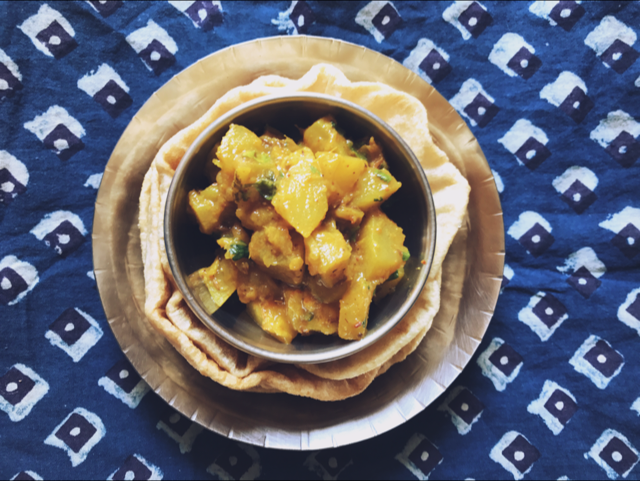
So, when I taste the different yet local vegetables here in Delhi NCR, it takes me some time to get used to it. But, there have been a couple of instances, when I tried something in the office, and it totally blew my mind. And one of the instances has been the combination of Pethe ki sabzi (pumpkin) and Pooris.

In my last workplace, it was in that congested room where we all colleagues used to sit down and eat our lunch, happily. A workmate, who originally belonged to Muzaffarnagar (Uttar Pradesh), asked me to taste his lunch. As usual, it was overloaded with stuff; his mother always gave him extra portions for us all. And I asked him what it was, but he asked me to taste it anyway. It was the first time I tasted pumpkin. And it blew my mind!

The sweetness of the whole-wheat Pooris with the sweet and tangy pumpkin sabzi was a mouth-watering combination. It just melted in my mouth, and I couldn’t believe the heavenly taste of it. I could recognize the taste of fenugreek in it, with a bit of mango powder and sugar. Every element of the dish, in fact, stood out. I couldn’t help but wonder, how can such a simple combination as this one be so delicious. After a few bites, we exchanged our lunch boxes. I had to.

You know, it takes time for someone in her 30s to appreciate something she hasn’t tasted before. At least when it comes to the veggies. And I truly loved the pumpkin curry that my workmate’s aunt made for him. I could sense his background, and suddenly, I was also curious to explore the food of Uttar Pradesh. I’ve certainly missed out, I thought to myself.

So, dear reader, go ahead and try this combination at home. That is, if you’re like me, someone who’s obsessed with simple, regional food. Don’t be ashamed of something you haven’t had till now. Most pumpkins available in the market are too big, but I always end up finding a small one with which I can make this sabzi at least twice a month. And, guess what, I made this for my husband’s lunch box this Valentine’s Day. Not a fancy dish, eh? Too rustic? Well, wish I cared.

Recipe: Pethe ki khatti meethi sabzi (pumpkin/yellow squash)

I would like to thank one of my favourite YouTubers, Nisha Madhulika for this recipe. It’s always a delight to watch her videos. This dish turned out to be just what I tasted in my office cubical. Words fall short when one has to describe Nisha ji’s cooking skills.

Ingredients

Yellow pumpkin – 1½ cup (chopped; also, remove the seeds and soft pulp)
oil – 1 tbsp
turmeric powder – 1 tsp
coriander powder – 2 tsp
red chilli powder – ½ tsp
ginger paste – ½ tsp
green chilli – 1 (chopped)
salt to taste
juice of half a lemon (you could use mango powder if you want)
fenugreek seeds – 2 pinches
sugar – 1 tbsp
coriander leaves (chopped)
garam masala – ½ tsp
cumin seeds – ½ tsp
asafoetida – 1 pinch

Method

Pumpkin is almost like potato, but I believe it takes a little less time to cook. If not paid attention, it can go utterly soft.

1. Peel and chop the pumpkin. Make sure you remove the seeds and the soft part that’s there in the middle.
2. Take a kadai or wok, heat some oil in it. Once hot, add the asafoetida, cumin seeds and fenugreek seeds. After a few seconds, add the ginger and the green chilli, followed by the turmeric powder and red chilli powder.
3. Next, add in the coriander powder and salt. Now is the time to soften the pumpkin. So, add in about a cup of water, and close the vessel with a lid.
4. Keep checking, and once the veggie has turned soft, add garam masala, sugar and the lemon juice. Finish it with a good sprinkle of chopped coriander leaves.

I always serve it with fried whole-wheat pooris, exactly what I tasted for the first time. I really don’t want to change my memory of it.