Winter Special: Slow-cooked Sarson ka Saag

Motherhood can teach you so many things. For me, it’s this slow-cooked saag that I love to feed my kids in winters—even if it’s made once a year. And the rebel cook in me goes like—why do I kill the veggies in the cooker? Why the speed? Why blend all the greens? It took me a couple of years to nail this recipe. But I now love to make it! Here’s how.

Ingredients:

Sarson (mustard leaves), methi (fenugreek leaves), bathwa, palak (spinach), pudina (mint leaves; optional), maize flour (makai ka aata), onion, tomato, ginger, garlic, green chillies, ghee, homemade butter, salt to taste, kitchen king masala, garam masala, asafoetida, cumin seeds, turmeric powder, red chilli powder, coriander powder. Sometimes, I add a hint of kasuri methi too. Sometimes I skip it.

The prep:

Go to a nearby mandi, or wherever you find fresh winter greens. Buy a bunch of each green mentioned.

Now, I usually take half a bunch of each of these greens (for the recipe). Perfect for 2-3 people. But, sometimes, I take the entire bunch that the veggie guy sells. That much is perfect for 4-5 people. 

Now, thoroughly wash every veggie and chop it finely. This way, you won’t have to mash it too much. A hint of pudina (mint leaves—even 1 cup works) will add an aromatic flavour to this dish. I love it!

Once you have cleaned and chopped all the veggies, throw it in a big pan with half cup of water. Don’t panic. It will go down to half in 3-5 minutes. Let it simmer. You can put on the lid once the quantity lessens and the cooking process begins. No salt needed here.

Keep checking your greens. As there is the lid allowing it to steam it well, you won’t have to use a blender. Just give it a good mix with your spoon and you should be good.

Second step:

Grate 1 medium-sized tomato. Finely chop 1 medium-sized onion. This measurement is perfect if you take 1 bunch of every green. Now hand-pound 1-2 green chillies, a hint of ginger and 5-8 cloves of garlic. Once this is done, do the tadka and throw it in the pot of greens.

For the tadka, take a small pan. Heat some ghee. Once hot, add cumin seeds. Asafetida. Turmeric powder. Red chilli powder. Coriander powder. And quickly add the green chilly-garlic-ginger paste. After a minute, throw in the chopped onion. After a minute of sautéing, add the tomato paste. Now add salt. When making saag, it’s a bit tricky with the salt. Try not to go overboard. You can always add more later in the cooking process. Also, if you plan to use store-bought butter, you are anyway going to add more salt later.

Add a tsp of kitchen king and two pinches of garam masala as well. Let this cook a bit and throw it all in the pot of greens (when you see that the greens have cooked nicely). Mix it properly.  After 2-3 minutes of cooking it with the greens, you may add ½ or 1 cup of warm water to make it a bit runny otherwise it will be too thick to eat. 

Don’t miss the ‘Aalan’

This saag is called a saag because of maize flour. Take a small bowl of water (room temperature) and mix 1 tablespoon of maize flour in it. Add this yellow paste to your saag (after you have added the tomato-onion paste). This is going to give it that aroma and make it body. Without this, your saag won’t taste like saag. 

Taste. Taste. Taste. 

Give your saag a taste. Adjust the flavours if need be. Throw in some homemade butter/makhan for that desi taste. A spoon of ghee on top will make it shine as well. It takes me 30-40 minutes to make it (prep time excluded).

Serve it with makai ki roti (don’t miss the butter on top), a nice salad of onions, carrots and radish, chaas (buttermilk), and, a small chunk of jaggery.

Background music score: Ek Lau by Shilpa Rao, Dhaani and Najaney Kyun by Strings

A food tour of Chandni Chowk

A long overdue trip to an ancient Delhi area comes into being as I step out for a heritage walk with a friend. It was planned just a night before we took the metro train together from Gurugram to Chandni Chowk. And while life has its own commitments—for me, it’s my two kids—I could still take the trip as my husband pushed me for it. “We are changing cities in less than a month’s time. So, you better go for it,” he said. 

Thanks to the changes that happened to the busy area of Chandni Chowk in 2018, we had only E-rickshaws and cycle wallahs around us. Thank God, we had some space to walk. Minutes of us walking a few feet from the metro station, young men start following us as if we were looking for lehengas. “Bhaiya, lehenga nahi lena. Hum shopping ke liye nahi aaye hai,” I told one of the guys after he followed us for a couple of steps. 

I skipped my breakfast. Didn’t comb my hair. Just landed at Chandni Chowk with my jacket and a friend. It was a busy morning as my in-laws were stepping out to their city, but I really pushed myself for this local trip. And so, I was hungry. 

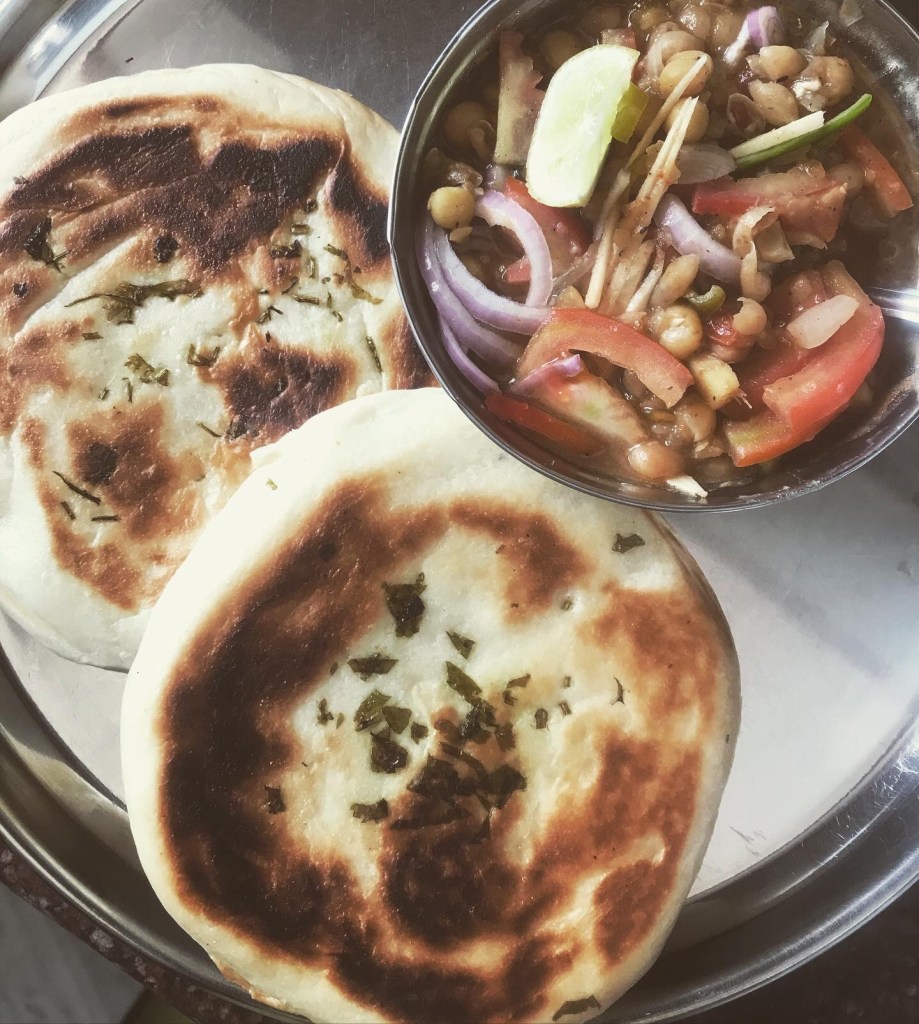
We started with Matar Kulcha. The freshly cut ginger, onions and tomatoes tricked us to believe that it might be tasty, and boy, we were not wrong. It was lip-smacking! It costed us some 30 to 50 bucks for a plate. The kulchas were thin and freshly roasted. 

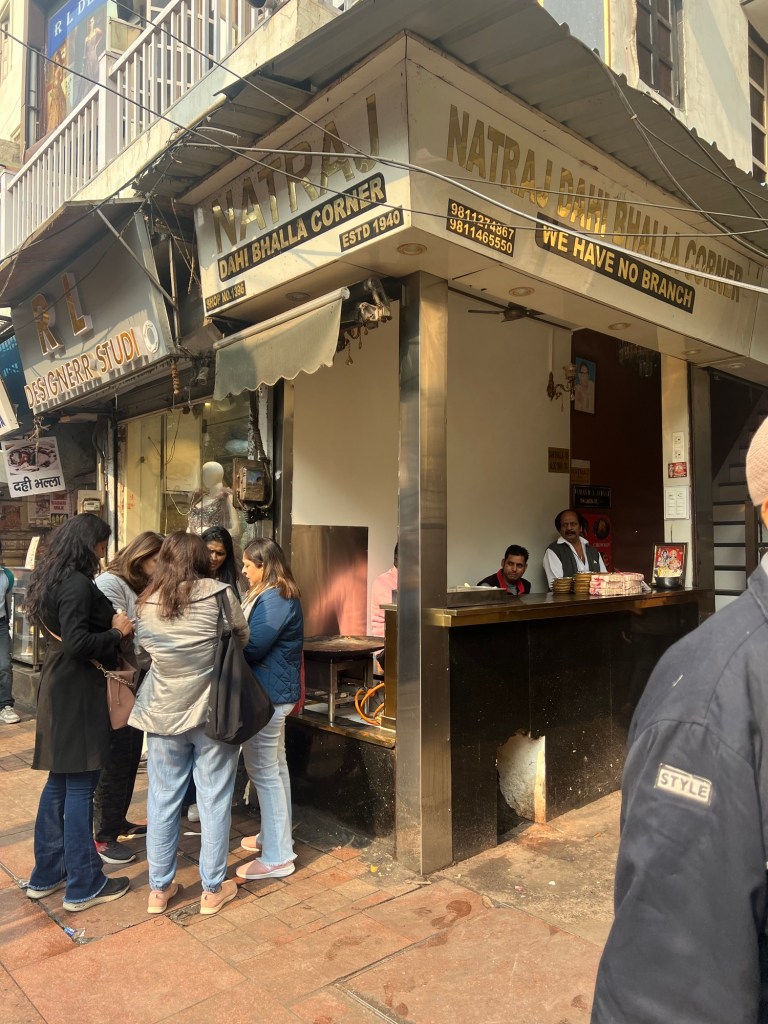
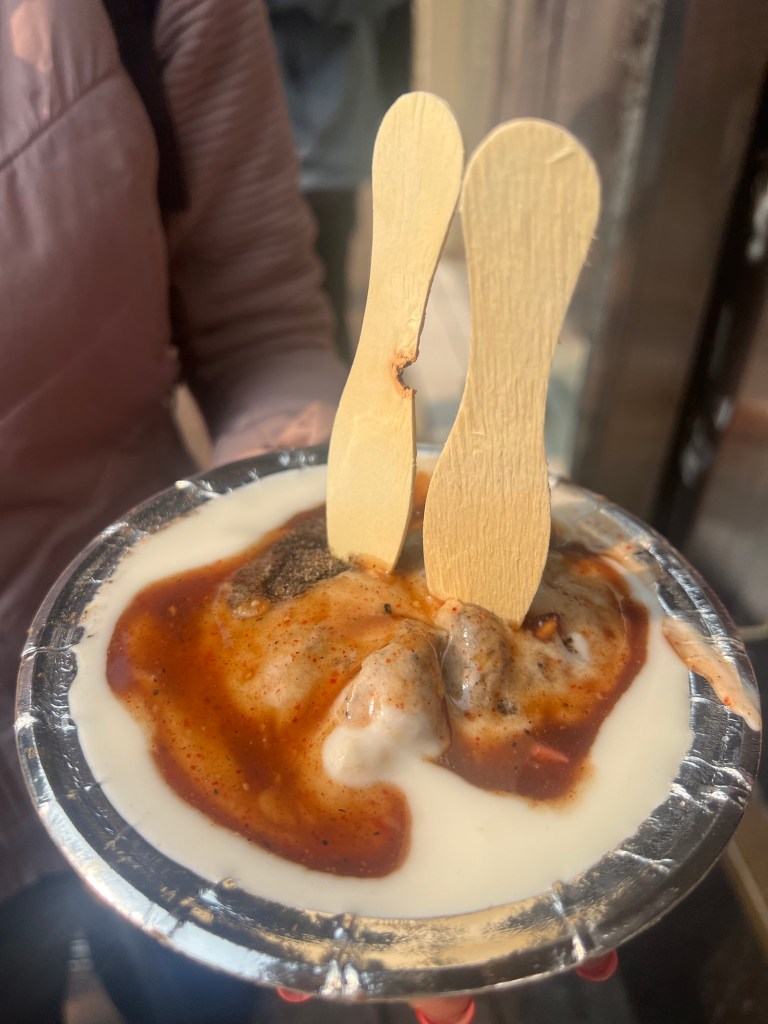
We left that lane (a few metres from the metro station), and towards the end of the lane was Natraj. So my friend, Namisha Singal, asked me if I was up for a plate of Dahi Bhalla. Though the plate was a bit cold for a cold December morning like this, we still liked it. She was wanting an aloo tikki or something with it, but we could easily finish the plate. The spice mix that went on the Dahi Bhalla made the cut. “My mother used to save this spice mix and use it on salads later on,” Namisha told me. Her father came to Chandni Chowk almost every month, and he went back to Faridabad with a little bag of Dahi Bhallas. 

After a few minutes, we met our heritage walk leader, Jibin George. It was amazing how he had these old paintings to show us on his iPad and we could clearly compare the changes. Soon we tasted our third dish. 

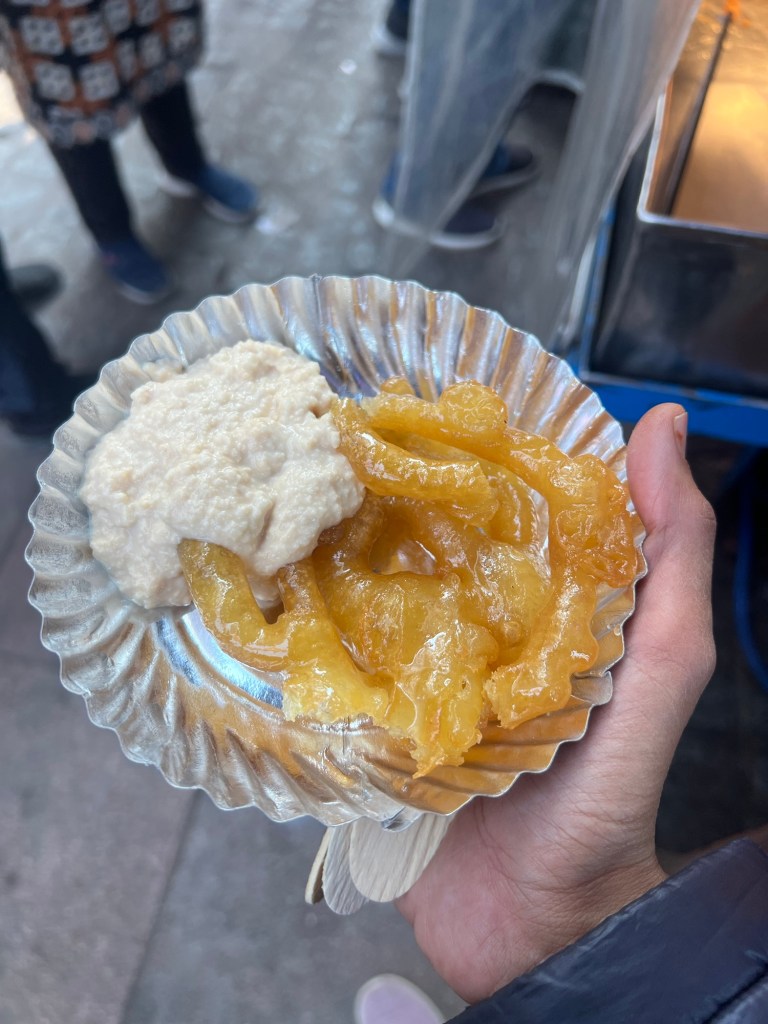
Jalebis. The shop’s name is Jalebi Wala. It had a board nearby that said Haveli Dharampura. So don’t get confused when you see 12 more Jalebi walas in the area. I was not so excited about this, but I was totally blown away by these jalebis! Two reasons I loved them: The chaashni or the sugar syrup was not so sweet. Plus, it had a runny texture, and not your typical sticky texture. Second, the labelis were both moist and crispy. And these were not too sweet either. So, the key for a really yum plate of jalebis is, hold on to that sugar. It really refrains you from having more. It is one of the best things I have tried in my lifetime! Imagine, I’m almost 40! So, you don’t have to miss these ever! I was told this shop has been running for 3-4 generations. And it’s the simplicity of these shop owners who make you respect them even more. 

Daulat ki Chaat

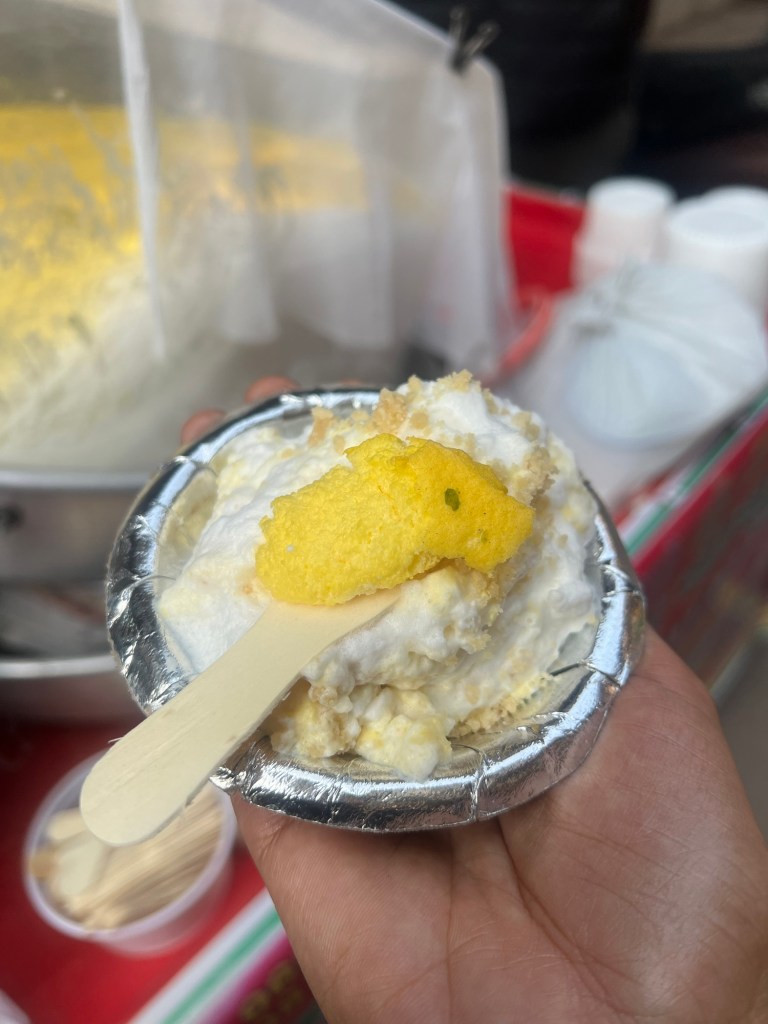
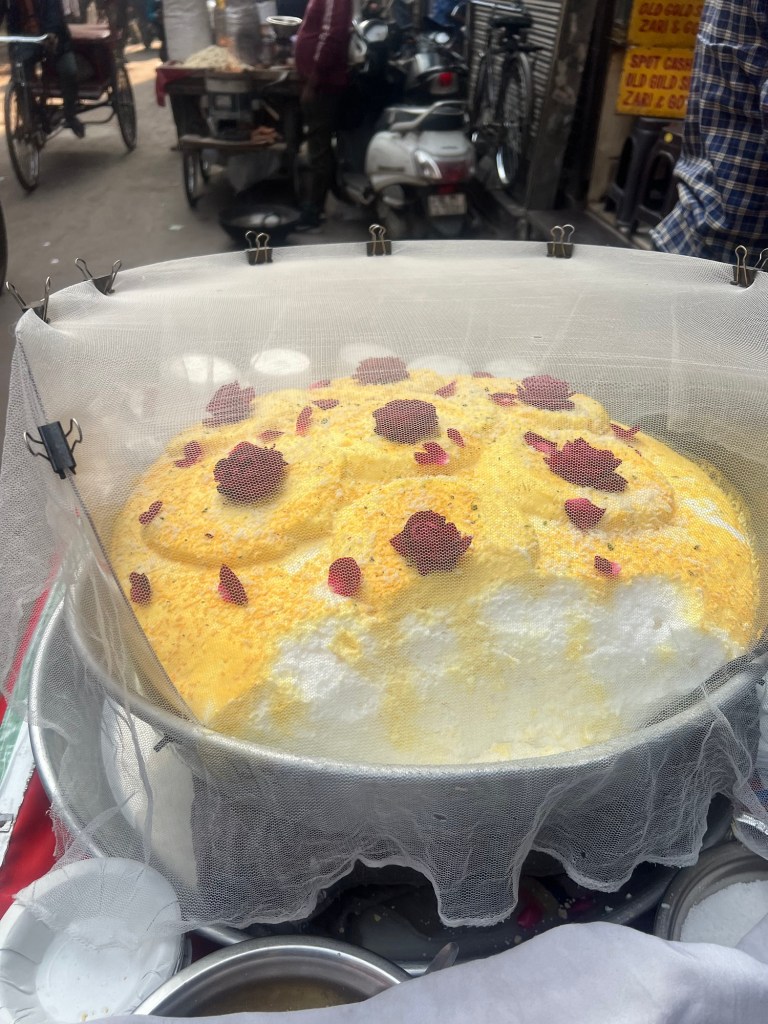
My fourth dish came about in the same lane. Daulat ki Chaat. When people told me about it, I imagined a big blob of aloo tikki with mithi chutney or something. But it was way beyond it. Daulat ki Chaat is basically milk froth. It stays as is thanks to the cold weather. Some of it is white, while some of it tastes of Kesar and is yellow in colour. It had a spoon of mawa too and a sprinkle of dry fruits like pistachio. Did I like it? It was too sweet for my palate, but I still managed to complete half a plate. The guy took 200 Rs for three plates of this Chaat. 

We entered a lane called Dariba Kalan. Interestingly, we happened to spot a Pani Puri wala. His cart looked super clean. He was also wearing gloves. So, I went ahead and asked my friend if she was up for a plate of Pani Puri. She ended up finishing her plate, but I couldn’t go beyond one puri. Even so, I didn’t finish that either. And I realised, if a cart is neat, it still doesn’t guarantee the best taste. Pani Puri is truly a tricky dish. She grabbed a nice cup of ginger tea, and we moved on to Parathe Wale Gali. Wow! I almost pinched myself here. As a mum of two toddlers, living in one of the best areas in Gurugram, what am I doing here? How could I manage to come so far? Am I mad? And I realised, it was one of the best decisions of my life. This heritage walks. We should take such walks often in life. Jibin explained the lanes and the history of the place so well—I could connect it so well; I will never get confused about any of the lanes next time. Delhi is truly beautiful if you take a chill pill and get the hang of it. Don’t just keep walking. Wait. Ask someone for the best way out, and you should manage to walk out of it with a smile! I don’t know if I make sense here, but anyway, here I was. Trying not to think of my elder child’s cough or the other child’s pick-up time from school. 

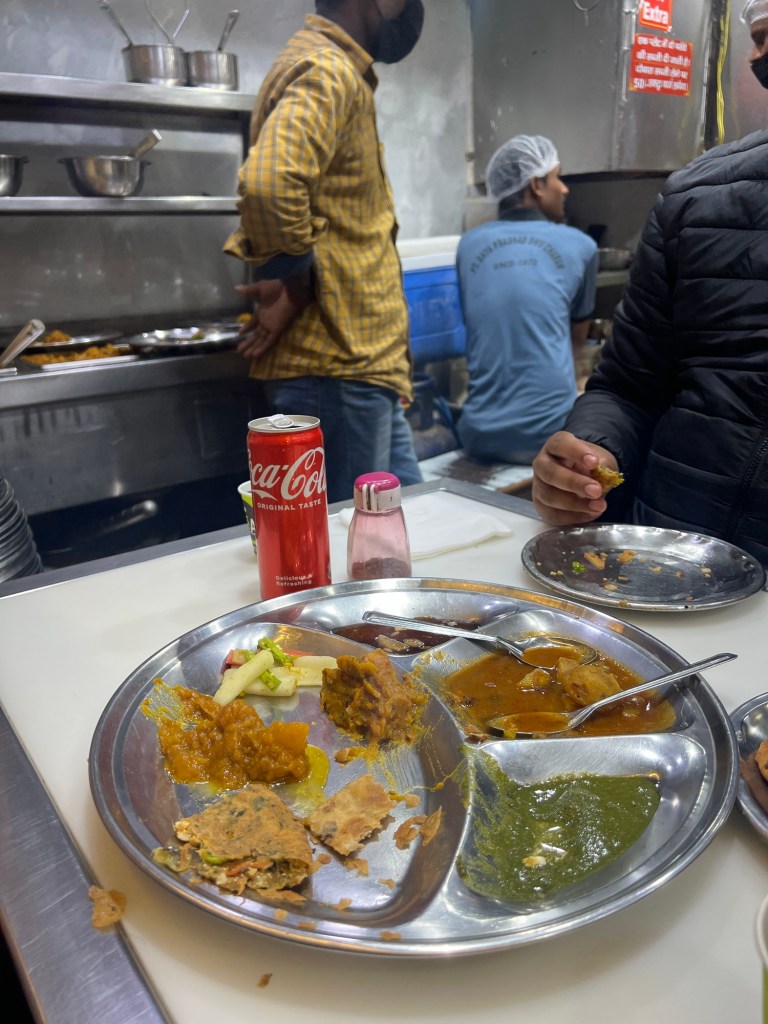
Enters: Pandit Gaya Prashad Shiv Charan. I have seen fried parathas on TV. Of course, I had my doubts if I would like any Parathas here. But I was wrong. The parathas were lip-smacking. But what truly made it work for me was the way it was presented. We get out seats early on, and are served a plate full of everything but parathas. We have tari wali aloo ki sabzi, sukhi aloo, hari chutney, mithi chutney, circa pickle (veggies in vinegar), and kaddu ki sabzi (pumpkin sabzi). The tables were wiped well, and the place looked tolerable in spite of the line outside the shop. The menu was damn confusing, but we somehow ordered two types of parathas. Lemon paratha was the first one. I was curious to see their style of serving lemons in a paratha and they were smart. There was a simple spread of lemon pickle inside the paratha. It tasted okay, and an eye-opener of a dish for me. Simple yet a bit complex. Next was a mixed veg paratha. And I totally enjoyed finishing my thali here. Will I go there again? Hell, yes. This is magic! 

The next dish in your list should be Chole Bhature. But we were too full for it. Of course, the next time I’m here, I’m going to try it. But Jibin pointed out the two places that serve the best Chole Kulche in Chandni Chowk. Kanwarji Bhagirath Mal and Tiwari Ji Chole Bhature. Life is simple, if we keep it simple. Going to the busy lanes of Chandni Chowk was so different than just reading about it on Instagram. We should go out there, more often. We shouldn’t abandon our historic, old corners of the city. It really brings so much together for me. Makes me feel small but valued. We got to value this. Do you know what I mean? 

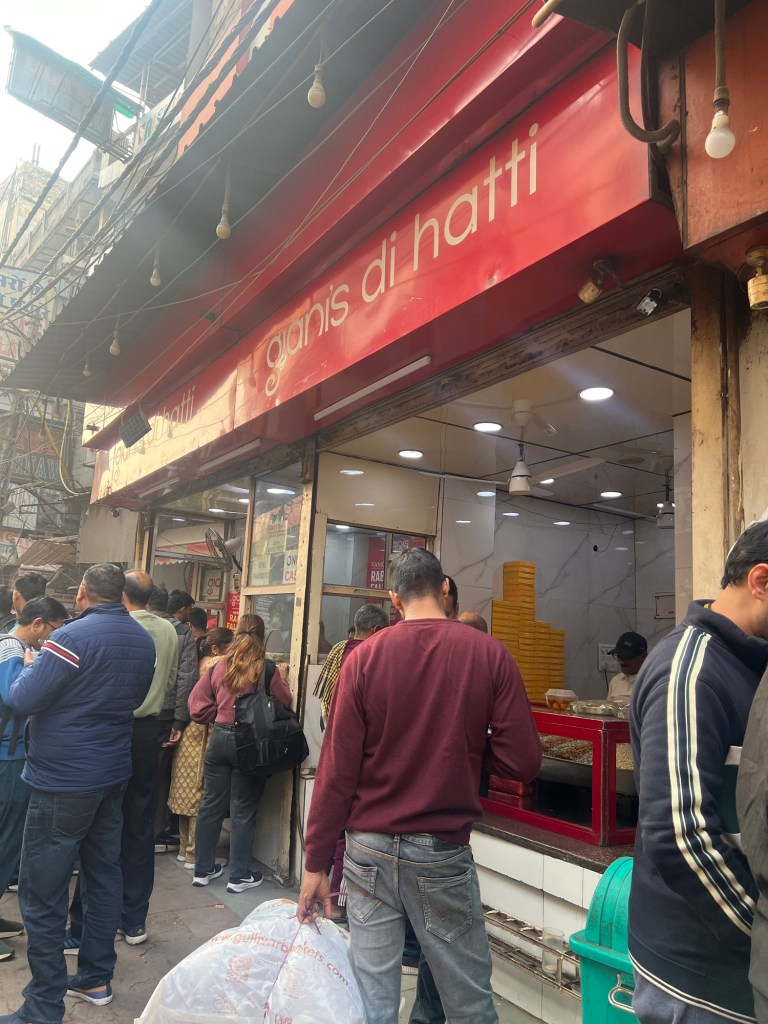
End your trip with a glass of Falooda Kulfi at Gianis di Hatti.

All pictures credit: Deepika Bhutra Nandal

Taste Memory Talks: Safar Ke Saathi

I’m a slow traveller in life. I have my own pace, my own observations and my own learnings. It’s never defined by a trend or a person. I usually make my own silly mistakes (sometimes huge ones) or happy discoveries and learn along the journey.

I’m someone who dies for meaningful conversations. And so, recently, when I saw an 86-year-old enthusiastically solve his Sudoku puzzle and read a fat book, I was bound to start a conversation.

He said he was reading a food book about mangoes. And shared a few interesting snippets from the book. All underlined by him. But that wasn’t the start of the conversation.

He talked about his vibrant career in Science and his education graph. And places. Of course. That was the highlight of our conversation. He talked about Delhi, Lucknow, Japan, Lahore and more. He also took a note of this blog of mine. Not many people care to do that.

Towards the end of my talk (read: we were travelling together in a plane with my husband next to me who was as excited to talk to him), I recorded his voice and here, you can hear him out talking about Chandni Chowk and a few other dishes he loves in Delhi.

Dr Ashok Jain has an extremely interesting background. Born in Lahore and grown up in Bihar, he has seen life that is beyond my imagination. From teaching kids (without going to school) to getting big degrees thanks to his passion for Science, Dr Jain has come a long way and how.

He proudly calls himself a Dilli Walah. And I found whatever he said as golden words. His paper-like skin on his hands told me he’s truly lived a rich life even though his simple outlook can fool you. And that’s what I love about such people. Sometimes, the most interesting personalities (with their interesting clothes, makeup and whatnot) have nothing much to share—hardly any reflections in life. I would call that a poor life in true sense. While simple people like Dr Ashok Jain can make every minute of the hour interesting as they take you along their journey, slowly, without any rush.

Yes. I’m that traveller, who’d happily ditch her earphones and novel and carry on a chat of a lifetime. And it’s one of the reasons why I love travelling. Because it helps me forget the anxiety that I might have during flights or just random travel times.

Hear out a few things that he talked about with this little audio clip. What kind of a traveller are you?

Hope to meet you soon, Sir. Delhi is truly a beautiful city!

Delhi-style Matar Chola (with Kulcha)

It was yesterday when I and my husband were going about in the car with our kid to buy something, and I ended up watching these food carts selling Chola Kulcha. At one particular cart, I saw a school girl waiting for her turn, and the food seller was busy mixing his matar chola with some fresh veggies; the aroma was something that I could notice while sitting in the car. Now, given the current situation, we try not to indulge in roadside or restaurant food. And I knew I had to make it at home, come what may. So, late in the evening, we went to buy some white matar and kulcha for our Sunday lunch.

We have lived in Gurgaon for almost five years, and in our residential area, there was this famous Chola Kulcha guy by the name Pramod. There were always some SUVs parked near his food cart. For the nearby office people, this food cart was like a blessing. And it was the same for us. Every weekend, we tried to buy a plate of Chola Kulcha with a glass of buttermilk at his place. And with every plate, we became even more certain he makes it the best.

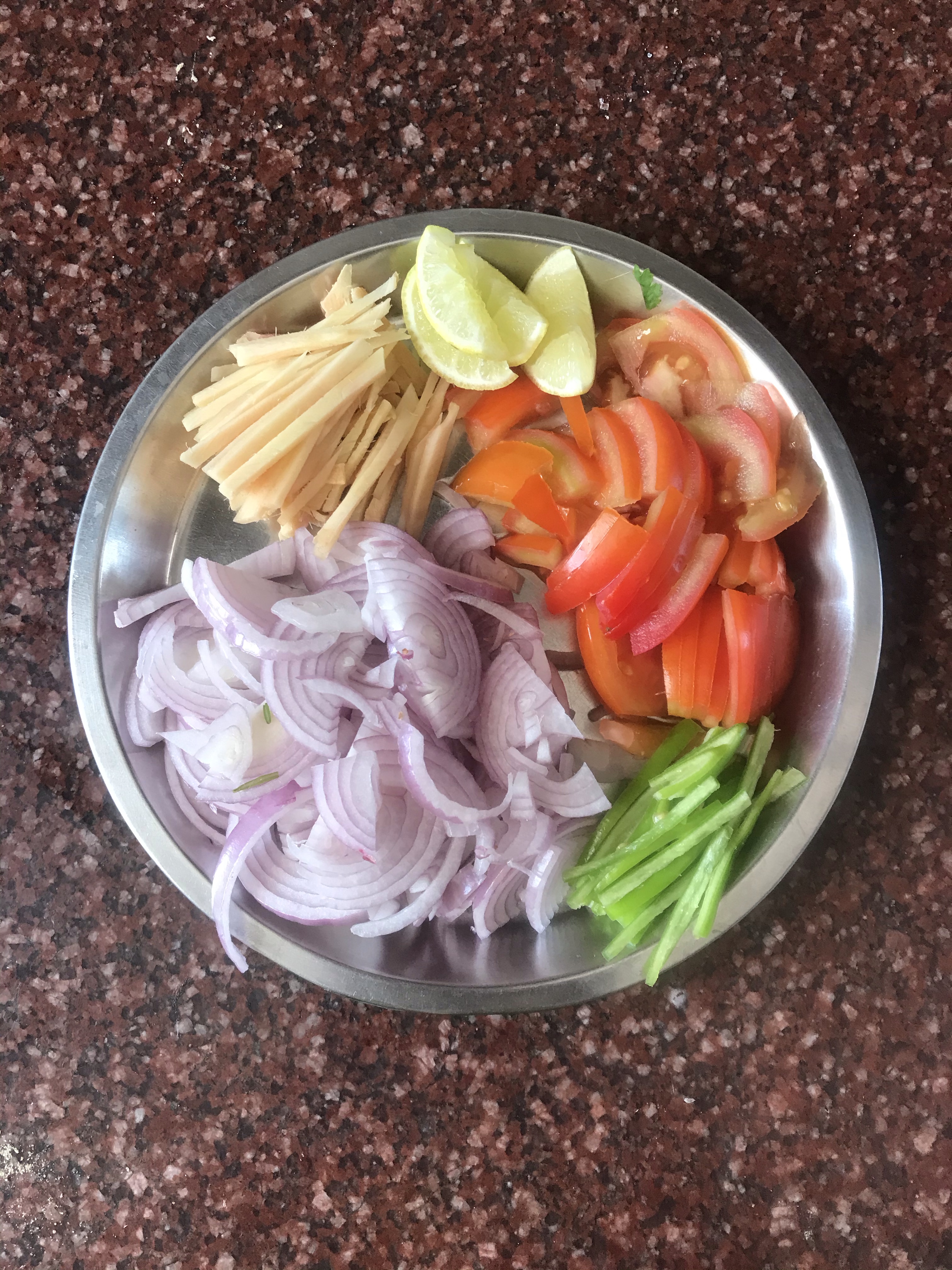
This is what you require to garnish your bowl of Matar Chola: ginger, green chilly (preferably a pickle), tomato, onion and lemon wedges. Pramod people also give their customers a salad that comprises beetroot, cucumber, carrot and onion–but I just went with the garnish.

Recipe: Matar Chola
Adaption from: Meenu Tomar’s Kitchen (thank God for her)

Ingredients:
White matar – 350 gms
Onions – 4 (two for the gravy, two for garnish)
Tomatoes – 4 (two for the gravy, two for garnish)
Green chillies – 2-4 (mild ones)
Ginger – 2 tsp finely chopped, 2 tbsp – sliced, length-wise
Lemon – 2 (juice of a lemon, and lemon wedges)
Spices:
Garam masala – ¾ tsp
Chola masala – 1 tsp
Salt to taste
Rock salt – 1 tsp
Cumin powder – 1 tsp
Black pepper powder – ½ tsp
Red chilli powder – 1 tsp
Chat masala – 1 tsp
Raw mango powder – 1 tsp
Coriander powder – 1 tsp  
Other ingredients:
Tamarind chutney or tamarind water – ½ cup
Coriander leaves – ½ cup
For final garnish ingredients, refer to the image I shared above.

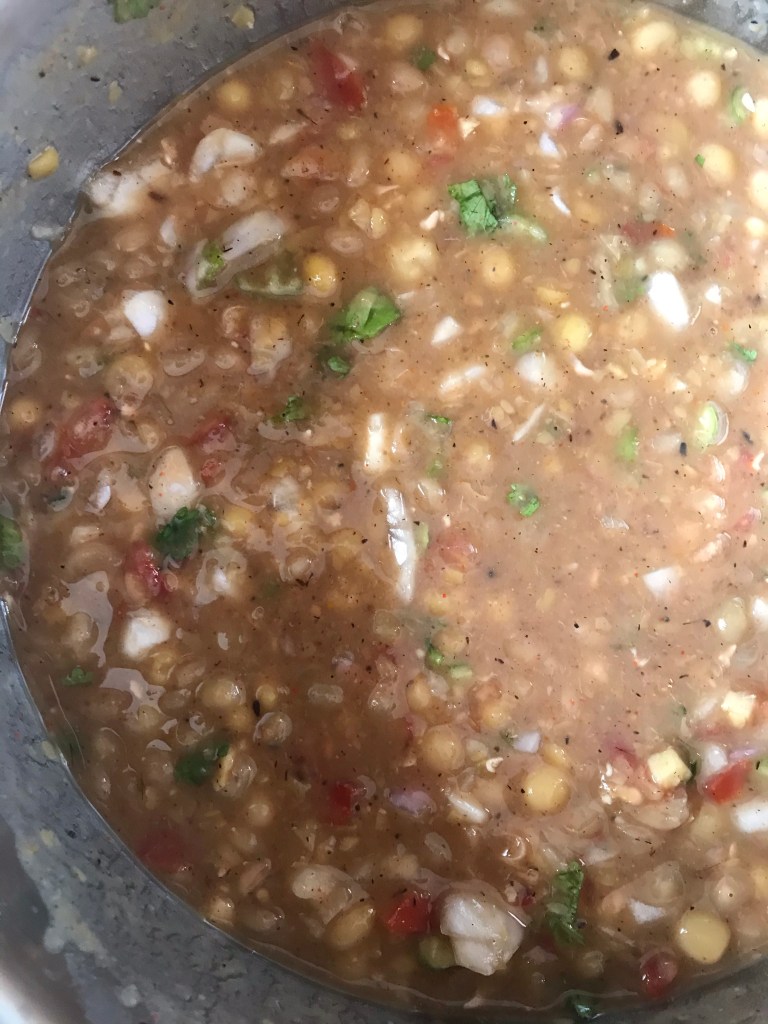
This is how the gravy looks, which has raw veggies and loads of spices in it.

Method:

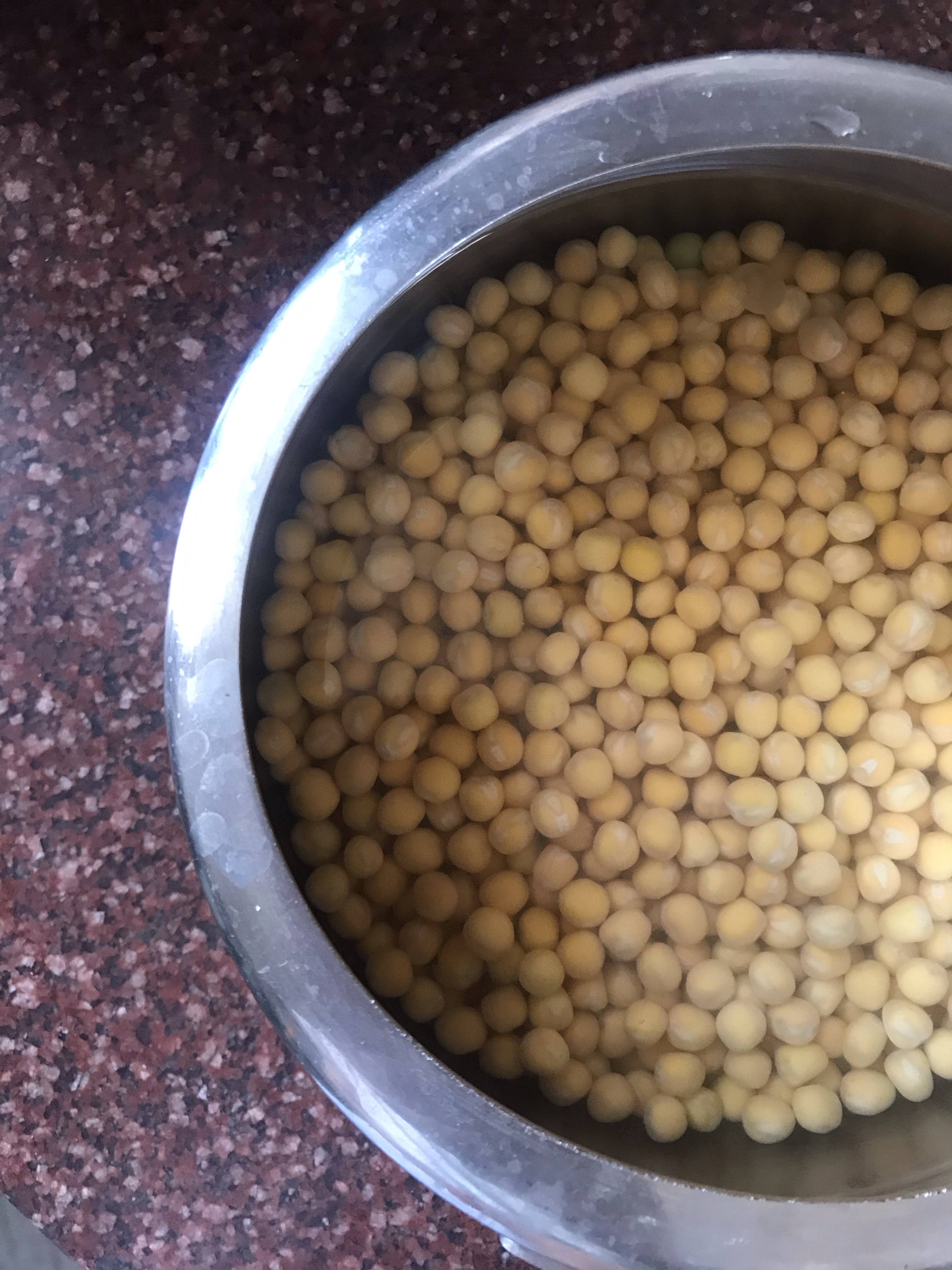
  1. Soak the white matar overnight. Next morning, give it a boil in the pressure cooker. This will take a hell lot of time, so be patient. You can go for six whistles on low flame. When it comes to the quantity of water, I would say, make sure the matar is well-dipped in water. Then, you can add another cup, and it should be good.
  2. Once the matar is cooked, add in all the spices; ginger, green chillies, coriander leaves, tamarind water, etc. Keep a plate separate that includes all the stuff you need to garnish. Mix this well. Use a potato masher, mash a bit for a better consistency.
  3. Now, before serving, heat this mixture, and once hot, take a bowl of it in a plate. Add in the garnish materials as shown in the image: ginger, green chilly (you can use a homemade pickle as well), tomato and onion. Keep a lemon wedge in the plate as well.
  4. Serve this with roasted Kulchas.