Life is what you make it

IMG_20170826_141114_016

I wish, life was as simple as this recipe. Hibernate for a few hours, strain all the negative energies out, and come out shining. But the fact is, it’s not. Hell, it’s worse. Even if you live life on your own terms, it’s still tough. And you constantly have to fight crazy situations you never dreamt of. When I see winners around me; people who can’t stop celebrating, people who are too busy in raising kids; people who are living the lives of their dreams, I wonder, why it isn’t so with me? How I wish I came out battling every fear, every negative energy I get from a few people and every regret with ease.

August-September is officially the worst months of the year for me. And the current record has a similar pattern like the past times. So, how do you think I will cope now? It makes me feel even worse when I think of October, as I will be turning 30, and believe me, I have achieved nothing at all in life. Yes, I have the best support system in terms of family, but on my ‘own’ grounds I have reached nowhere. But, here’s how I think I can save my boat from sinking. I’m joining an art class from tomorrow for which I was waiting for years. I’m extremely thrilled to pick up the paint brush–instead of a phone or a keypad–and draw something beautiful. I hope, I learn a technique or two and can pat my back for doing something.

How I truly wish, life could be as simple as this recipe. Hibernate for a few hours, strain all the negative energies out, and come out shining.

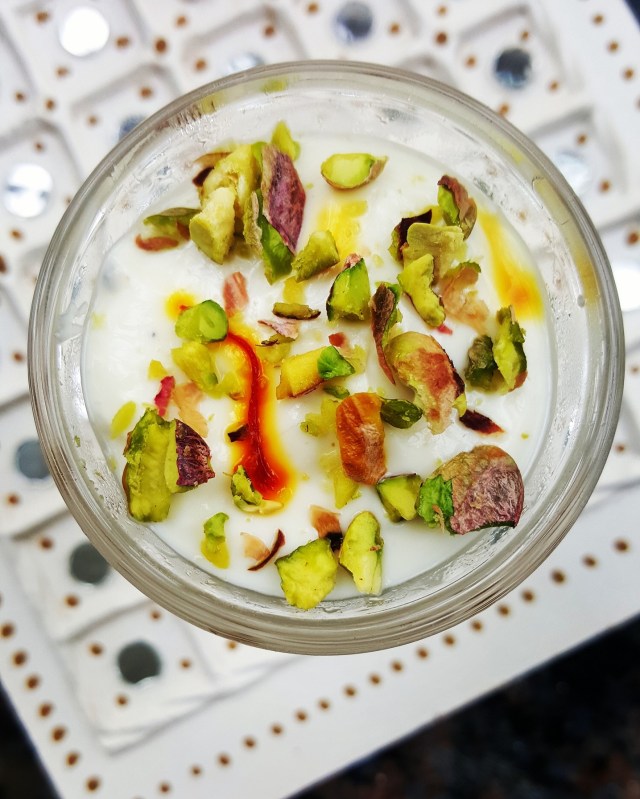
Recipe: Shrikhand (Sweetened Greek yogurt)

If you come home at 7PM and you want to have dessert at 10PM, you can make this Gujarati dish. All you need is fresh curd. But, my experience says that it tastes better after 12 hours when kept in the fridge. Sorry for the dreadful timeline. Life is tough, buddy. But this wait would be rewarding, I can promise.

Ingredients

600 ml homemade yogurt (shouldn’t be sour)
3-4 spoons of sugar
½ tsp cardamom powder
a few threads of saffron
powdered, unsalted pistachio nuts (fresh and crunchy)
1 tsp cold milk

Things/tools you would need

White muslin cloth (don’t take the stained one with which you strained your beetroot juice; no, actually, you can)
Steel strainer (I use a round, medium-sized strainer that looks like a small wok)
3 shot glasses (why? it’s the best size you can go for with this much curd)

Method

1. Cover the strainer with a damp muslin cloth (make sure you clean it properly; I wash it five times to remove all the detergent or dust from it). Now, slowly, put the curd in this; spoon by spoon. Make sure you have a deep container resting well below the strainer in which all the water can be collected.
2. Pull the four corners of the muslin cloth slowly and tie roll it till it’s tight. Don’t go ahead and press the curd with your fingers; it will strain from the cloth and come out. I have done this mistake twice. All you want to do is remove all the water from the curd, and this can happen slowly, and on its own. Just leave it to rest. Some people tie a knot and keep this curd muslin bag hanging on the kitchen tap, where all the water can dip in the sink. But, I find it a bit risky. Can’t see my curd falling down the sink. Anyhow.
3. Leave this for almost three hours. Yes, the yogurt will take this much time to completely thicken up.
4. After about three hours, you will be surprised to see the water. Mind you, this is whey protein. So, if you’re a health junkie, you can drink it to build muscles. Sorry. I was trying to be funny. Don’t ever get this thought going in your mind like me.
5. Now, remove the thick yogurt in another round vessel. Add the sugar and cardamom powder. And all you have to do now is whisk them with a ladle, whisker, spoon or whatever you have in hand. I usually whisk it for 3 to 4 minutes, till I taste the yogurt for sugar and it comes out fine. Also, you might find the yogurt a tad bit tangy, but, don’t worry. The poor thing was out of the fridge for three hours.
6. Take the tsp of milk in a tiny bowl and add the saffron threads in it. Give it a mix and throw in the yogurt mixture.
7. With the help of a tsp, add this mixture in your shot glasses. Once done, add a single thread of saffron on it. Store these glasses in the fridge (not freezer) for a few hours or say, 12 hours. Do add a thread of saffron on top, as it will leave a beautiful yellow colour the next day. And when keeping the glasses in the fridge, you will have to cover them. I just put a round plate on my glasses. You could use the fancy cling film.
8. Before serving, garnish the glasses with roughly pounded pistachio nuts. If the nuts are salted, ignore this step altogether.

IMG_20170826_143649_536

After eating my Shrikhand, I almost end up eating up my spoon too. Hope you don’t. Until next time…

PS. There’s an epic joke attached with Shrikhand. Back in the days when we used to live in Mumbai, my husband usually went to Matunga to buy our veggies and kitchen items. So, one day, he saw Shrikhand in one of the shelves. He was about to pick it up, and I stopped him abruptly. “Don’t you dare buy this Shrikhand! I will make it for you in five minutes at home! That will be the best,” I answered him coldly. “All you have to do is whisk the yogurt,” I added. “I can do that like a pro,” and I went on. And, I never, ever made any Shrikhand at home. I never made any.

It’s only now and the first time, that I made Shrikhand at home (in my six years of marriage). And, now I can’t stop making it. Dear husband loves it so much!

When it rains, it pours!

DSC_0431

I grew up in an apartment or condominium as you’d like to say. And my father’s house is still the same, since almost 29 years. Now, in our building, we’ve had many people coming in and going out. But a few of them have been living there since the start, including us and a Jain family. Almost a decade ago, when I was in my teens, a new member joined this Jain family. The woman happens to be one of the most inspiring people I have met in life till now, and we connected the moment we sat to chat.

When I first met Pooja, whom I call Pooja bhabhi, I got to sense what simplicity is all about. Pooja likes to live her life extremely simple, though she herself is a strong-headed woman. There are no frills or nothing fake about her. Her reactions are almost straightforward, and she is one of those women who will advise what’s right, and not what you want to hear all the time. So, when she smiles, you know she means it. What I also like about her is that she is a spiritual person, and believes in karma. In spite of being married to an affluent family, she never shows that every human being should have so much money, unlike most of the people like her, with whom I only feel suffocating.

Pooja came to Surat from Jaisingpur, Kolhapur district, Maharashtra. And I love her cooking. What was common between us was the hobbies we had, be it singing, seeking inspiration from the common people around us, cooking, and not to forget dancing in the rains. Pooja had to manage a huge kitchen as a newlywed daughter-in-law, but when she glanced the first pour of the season, she couldn’t control her feet. She had to rush to the terrace and enjoy the rains like a child. And I liked it too. So, I used to be back from school, and we happened to eat lunch or an evening snack together, and suddenly, we saw rains. Or, it would be a lazy Sunday morning, when we finished our breakfast together, and we saw the rains. And we knew, we had to dance in the rains at least once in the entire season.

After enjoying our singing and dancing session in the beautiful rains, we came back, changed, and met again to enjoy a sweet dish called Dudhi ka halwa (bottle gourd pudding). Now, I didn’t know that such a simple vegetable could be turned into a yum sweet dish. But, Pooja bhabhi did a brilliant job at it. She used to grate some bottle gourd, and make a quick halwa, and believe me, its satiny texture blew my mind with every morsel that I took from the hot bowl in which she served me this freshly prepared dish.

Dudhi ka halwa is very different from other halwas that are made of almond or wheat flour or semolina. Its texture is the winner for me, and the other thing that I love about it is the fact that it has minimal sugar. Yes, it still does taste sweet, but it hardly has any sugar in it.

So, the next time you see rains pouring, do go out, drench in the beautiful showers, and come back home and prepare this sweet dish. It’s only then will you be able to enjoy the smallest yet the most beautiful things about life. And just like me, you will find hope. Just don’t burn your tongue. 

Happy rains!

Recipe: Dudhi ka halwa (lauki/bottle gourd pudding)

Ingredients:

1 small- or medium-sized fresh bottle gourd
4 tbsp clarified butter
½ cup malai or fresh cream (I take the first layer of the fresh milk that I boil and keep in the fridge)
3 tbsp sugar or less
1 or 2 cups milk (depending on the quantity of the grated bottle gourd)
2 pinch of cardamom powder, completely optional

Method

  1. Peel the bottle gourd and grate it.
    2. Heat the ghee in a steel skillet on low flame. Meanwhile, press the grated bottle gourd between your palms and remove all the water from it. Remember, you don’t want to make this grated vegetable go dark brown. So, always be on your toes, and rush a bit faster. This way, you will always find the grated veggie white and fresh-looking.
    3. Once the ghee is hot, add the grated bottle gourd in it. Now, stir it continuously.
    4. The deal here is to get rid of the raw taste of the bottle gourd. I usually turn the heat to medium at this stage; me being impatient. After about 12 minutes of stirring, you will see that the quantity will go down slightly, and the veggie will throw out its natural aromas. This is when you know that the cooking process has begun.
    5. Now, add the fresh malai. I break all the rules here and add as much as I like.
    6. Stir the malai in, and now, you will have to solidify this malai into a khoya-style texture. So, keep stirring, and after about 15 minutes you’ll see that the malai has turned into tiny solid cream-coloured pieces.
    7. Add in the milk. I usually add milk till it covers the content in the skillet nicely. Let the boiling process begin. Also, you don’t need to cover it with a lid. It’s better to stir every minute then to let it burn under a closed lid.
    8. Once, all the milk evaporates, the halwa will leave out all the ghee from the corners. This is when I add my sugar. I take about 2 or 3 spoon sugar. You could add more if you want to.
    9. Let the sugar melt, and you can shut the flame.

Note: When you taste the halwa when it’s still in the skillet, you might find it a tad bit feeka or sugarless. This is because when it cools down, it gets its sweetness. In short, less is more, when it comes to sugar in Dudhi ka halwa.

Break the monotony

There’s something about me and Asian flavours. I feel like I was born to like Soy sauce. Add this sauce to my rice, soup, noodles and even my salad, and I will eat with a big smile. So, last weekend, I was raking my brains yet again, as to what to cook! Seriously, there’s no dearth of inspiration on the net, but there’s just so much in my kitchen, and only so much I can make of it.

Cucumber is one thing you’ll always find in my fridge. English cucumber, to be precise. So, I  happened to scroll for some recipes on YouTube, and I found this weird recipe of smashed cucumbers. Chef John of Food Wishes is one of my favourite YouTube food vloggers, and I loved how he made this salad, and I went ahead and tried it.

You know, you always like the steps involved in a recipe, and the many ingredients that it calls for, but in reality, only simple recipes can save your day. Because when you’re really hungry, all that matters is how quickly you can cook up a dish.

Raw dishes like salads are something I’ve always enjoyed. Contrary to my weight, which is extremely low, I should be eating fat, carbohydrate, protein and high-calorie food items. But, who cares! There’s something about the freshness, crunchy texture and dressing that I’m always lured towards all sorts of salads, and recently, Asian salads have taken the focal light. No wonder, sprinkle some toasted sesame seeds on my bowl, and I will never leave my salad.

Recipe: Chinese-style Smashed Cucumber Salad

Okay, first things first, it’s not compulsory for you to take only cucumbers. You can always take more veggies like bell peppers and spring onions, for colour. But I liked how chef John made it, and I don’t want to disturb his dish much. I didn’t have rice vinegar, so I added lemon juice. And you can always add more seeds like toasted pumpkin or sunflower seeds to make it more healthy.

Ingredients

1 English cucumber, washed
1 tsp red chilli flakes
½ tsp salt
½ tsp sesame oil
½ tsp sugar
juice of half a lemon
½ tsp soy sauce
½ tsp toasted sesame seeds

Method:

It’s all about smashing the cucumbers. I covered mine with a muslin cloth, and lightly smashed the green boy with my pestle (copper hamam dasta). This is done to give you a taste of its natural flavour. Also, you don’t have to completely murder it. Just crush it from the middle and quickly cut it with a knife. Add the chopped cucumber in a bowl, followed by the rest of the ingredients. Garnish it with toasted sesame seeds, but believe me, do as you please. You don’t have to follow any rules!

London Diary: Entry One

IMG_20170606_142214_373

Recently, I got a chance to spend two-and-a-half weeks in London. Now, the most confusing part here is to shortlist the places where you want to go. You really can’t say. Any place can interest you but if the options are so many, you are all the more confused. And no one wants to miss out on anything.

When I used to study in Bengaluru, I got a chance to visit Blossom Bookstore in Church Street. It’only then that I realised what it is to find a rare, vintage book after spending hours digging rows of books. After moving to Mumbai, my love for second hand books went to another level, thanks to King’s Circle. Sadly, in Gurgaon, this fascination took a setback as there is hardly any corner that has second hand books for readers. I’ve been living here for more than three years now; which is why, the idea of exploring the second hand bookstores in London excited me. But, it’s only when I visited these stores did I realise how lucky I was to be there. I did not utilize my time well; otherwise, I would have gone to many other shops as well.

So, guys, if you happen to be in London and have a day or two in hand, do visit one of these places. I found my lost love for old books in these pretty corners of the city back, and how! May be, you would too.

Any Amount of Books, Charing Cross

It was a rainy day, and I was there, strolling in the streets of Charing Cross Road, looking for Any Amount of Books. After a detour, I got my way here near Leicester Square tube station. And, when I entered the bookstore, I could not believe my eyes. “Whoa! So many second hand books are stocked in here,” I thought to myself. I went to the underground section, but, quickly came back to the main door and started looking at the fiction titles from one shelf. Just the experience of taking almost every second book from the shelf and grabbing a quick look was not less surreal. How can I ever make a decision of which books I want to buy? I thought midway. But, then, the best part came up. Unlike other bookstores that stocked new books with each title no less than £8, this was a sweet spot. These books were priced from £1 to £4 and that made my decision an easy one. Let me say, I was extremely lucky to spot some beautiful books that I have got with me back to India, and I have already begun reading them. I absolutely loved the collection of old books in this store. You will find the best prices of books here. Especially for me, as I don’t like to spend big bucks at one go. Spent nearly two hours going through the books, and ended up buying more than 10 books. My bill was £30 and believe me, I was so, so happy!

IMG_20170613_003039_246

London Review of Books, Bloomsbury

I and my husband happened to go to British Museum one morning, and after a few hours, when we were hungry, we went strolling around the museum area for some good place to relax and grab a meal. My luck was such that I could easily spot this bookstore, and I knew this had to be good. Did I mention I was hungry? No way! Yes, I have heard its name, read it somewhere online, saw a lady carrying a tote with its name imprinted on it, I thought to myself. But little did I know that the stock of books would be so amazing that we had to come back here within a week. Yes, it’s the best bookstore when it comes to the interesting collection of books the people stock here. I picked up two books by Japanese authors like Banana Yoshimoto, and let me confess, I would have never spotted them online. The thing with buying books online is that you don’t get to flip through the books. I was so headstrong to buy a few books, but then, with the price range was such (£8 onwards) that I felt stupid and kept them back. But I did note down the titles in my phone! The store also has a little cafe; we liked the fresh salads they served there. London Review of Books is the place, if you want to get lost and discover new and old authors, but more precisely, gems. And I did buy a tote with its name on it. Another £3 went out of my pocket. But, what the hell.

Foyles, Charing Cross

Within 15 minutes in this store and I almost felt like I will faint down on the floor or something. This store is huge! But, oh, what a colourful sight it was! I was speechless. I remember I went to the section where they had these food books, and it seemed like there’s no end to it! From what I can recollect, it’s a four-storeyed building and you will certainly need a high level of energy to explore this place. There are books on various topics and genres here, and the quantity is matchless. Till now I thought Crossword at Kemps Corner, Mumbai is big, but I was simply wrong. Foyles is massive! So, save a day’s energy if you want to explore this shop. I didn’t buy anything from here, but it sure blew my mind away. Also, it’s a fun place to bring your family with you. There’s something for everyone, and the kids will love the happy vibes and colours you see about the place.

IMG_20170604_123457_107

Lutyens & Rubinstein, Kensington Park Road

We were exploring the Portobello Road Market and Notting Hill area, when we decided to go to the famous Notting Hill Bookshop. Luckily, I happened to Google more names, and found this one. Lutynes & Rubinstein is a secluded corner of the city, which has good books and the perfect environment to read and get lost. It’s a quaint little bookshop, and offered me some respite from the busy streets. The basement section was where I found some known yet lovely titles. These were books I have been meaning to pick up, but kept pushing for later. I especially liked the poetry section; and the wall art and decor was too good, I almost felt like grabbing a chair, and sitting here for a break, away from the hustle and bustle of the rest of the market. There was a counter with a coffee machine as well, and a huge reading table. Oh, I really wanted to sit back, but we had to leave and explore more. I bought a teal-coloured fridge magnet from this place, and saved a few titles in my notes on my phone for later. Coincidently, all of them had pink-coloured covers.

Henry Pordes Books, Charing Cross

If you are into art and photography, you can’t miss going to this bookstore. There is a stately feeling that you get when you enter this place. If you love those red antique hardback books, this one is a gem of a place for you. I haven’t seen such a huge stock of such books anywhere else. I enjoyed being at Henry Pordes Books, listening to the conversations of the two people sitting at the payment counter (they were discussing food markets and book festivals), and going through the hardback, second hand copies. The store also had some signed copies by authors, which gave me a sense of its high stature and genuineness.

London is a big city, and there was no way that I could visit each bookstore that was in my list. I did go to Books for Cooks, but it was closed (Sunday, may be?). Whenever I get a golden opportunity to visit this city again, I will not miss these book places: Libreria, Judd Books, Skoob Bookstore, Housmans Bookshop, Persephone, Southbank Book Market, Foster’s Bookshop and Brick Lane Bookshop. A small list, this one, I know. But, hey! This city can make you crazy in the head with its beauty, let me warn you.

PS. I was at Quinto & Francis Edwards Bookshop, and I wish I could capture the moment where I was in the basement, and all I could see was how reading enthusiasts were engrossed in books with their hats and umbrellas and hear a pin drop silence. Soon, I became conscious, but then I got it. You had to find a fixed shelf for yourself, and the rule was to not move more around too fast, or they shudder and look at you with disgust. Old men, stylish young girls, middle-aged men, curious teen boys, carefree aged women–all of them together, exploring the world of books. One sight it was!

Words


IMG-20160518-WA0008

“If you can’t write a decent short story because of the cold, write something else. Write anything. Write a long letter to somebody. Tell them how cold you are. By the time the letter is received the sun will be out again and you will be warm again, but the letter will be there mentioning the cold. If it is so cold that you can’t make up a little ordinary Tuesday prose, why, what the hell, say anything that comes along, just so it’s the truth. Talk about your toes freezing, about the time you actually wanted to burn books to keep warm but couldn’t do it, about the phonograph. Speak of the little unimportant things on a cold day, when your mind is numb and feet and hands frozen. Mention the things you wanted to write but couldn’t. This is what I have been telling myself.”

~ The Cold Day by William Saroyan

PS: Found this short story in a book titled The Daring Young Man on the Flying Trapeze (Faber and Faber) written by William Saroyan. Bought this book from Any Amount of Books, London.

Beat the blues

IMG_20170622_003600_210

Recently, I got a chance to visit London, which I happens to be the most beautiful city I have ever been to. I was there for more than two weeks, and eating outside food for this long was not in my plan. So, one day, being tired of all fancy food, I craved for a simple raita. But, I only had the store-bought yogurt with me, which is something I loathe. Can I possibly be making a yum Raita out of it? I asked myself and went ahead anyway.

Pyaaz ka Raita is one of the dishes my mother is famous for in our huge community. This recipe goes back to the days when she used to live in a desert in my maternal home. Pyaaz ka Raita was made with fresh curd and chopped onions, and it hardly took any time to cook. Which is why, it used to be made a lot in the house. And it tastes yum. So, it wasn’t like anybody was adjusting with it.

For me and my brothers, this Raita is what our home is all about. After returning from a family trip or at the end of a long day when all feel tired, it is this recipe that comes to our rescue. Even in those busy Sunday mornings when a guest kept us busy, my mum manages to cook this Raita and impresses one and all.

So, the next time you’re clueless in the kitchen, tired of the colourful veggies, need something simple and tasty, you know what to cook. You will thank my mother for this one, I promise!

IMG_20170622_003656_082

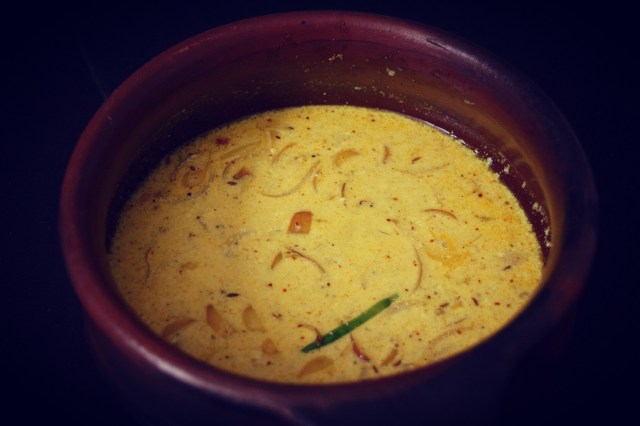
Recipe: Pyaaz ka Raita

All right, so I generally make this Raita in an earthen pot that I got from Dastkar exhibition (Delhi). When I cook this way, it comes out to be nice with a great texture. You can cook this in a mixed metal skillet as well. We don’t use non-stick pans, and I hardly connect with them so you could avoid them too. Do I make sense?

So, first, we will cook the onions on high flame with the spices. In fact, my mum just adds the onion with the spices and tosses it a bit. You don’t need to cook the onions till it’s completely soft. You just need to mix the spices and let it be crunchy.

The second step is to add the slightly beaten curd. This is a quick process. You see, it took me quite some time to crack this dish. It is simple, but there’s this one rule.

Cook the onions on high flame. Add the beaten curd. Switch off the flame. Transfer the Raita in another pan. Cook the onions on high flame. Add the beaten curd. Switch off the flame. Transfer the Raita in another pan. Cook the onions on high flame. Add the beaten curd. Switch off the flame. Transfer the Raita in another pan.

This way, you will get a Raita that has crunchy onions, and because you transfer it into another vessel, it won’t curdle. So, are you ready?

Ingredients

½ tsp cumin powder
a pinch of asafoetida
¼ tsp turmeric powder
½ tsp red chilli powder
fresh curry leaves (I didn’t have it when I clicked the picture)
salt to taste
oil for tempering the spices
¼ tsp black sesame seeds
1 big onion, chopped
2 green chillies, long-slit or chopped
coriander, chopped
½ tsp coriander powder, optional
1½ cup curd (I use homemade curd that is fresh and lightweight, but you could use those tight/stiff/thick looking store-bought yogurt that comes in a plastic box. Though, I avoid those completely)

Method

1. Add oil in a skillet. Add the curry leaves, asafoetida, turmeric and red powder, cumin, and sesame seeds, and green chilies. Sauté it for 10 seconds and add the chopped onion. Remember, the flame is on high.

2. Add salt, coriander powder and sauté for a minute.

3. Now, add the beaten curd and chopped coriander leaves. Stir it ever so quickly and transfer the whole thing into another bowl (in room temperature). This will give it a nice texture. Voila! The Raita is ready!

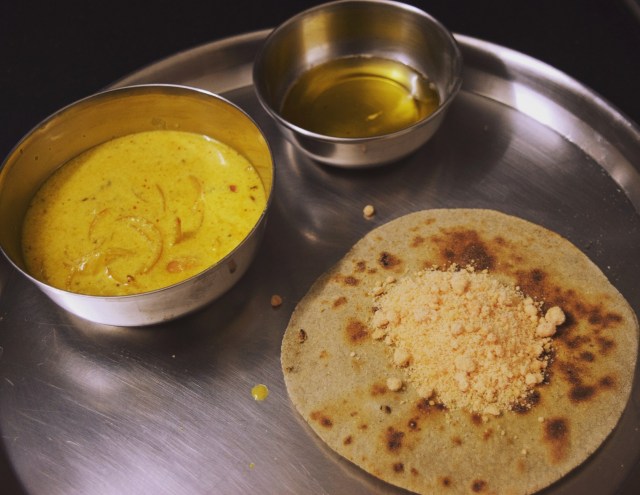
My mum serves it with roti, jowar ki roti (sorghum) or bajre ki roti (pearl millet). In the picture, you can make out a thali (prepared in last winter). To keep us warm, we keep having bajre ki roti and lots of jaggery in the colder months. With this type of roti, I like to have lots of clarified butter or ghee as well. During summers, you could have this Pyaaz ka Raita with crispy jowar ki roti (it’s gluten-free, rich with nutrients and my mum keeps sending me a small bag of it every couple of months so that I’m never out of it.)

I hope, this Raita helps you beat the blues that might hit you when you are stuck in a weird situation, a clueless dinner prep time or after an uninspiring day at work.

No looking back

DSC_0298 - Copy - Copy

I never used to cook much when I lived with my parents. After marriage, it was just me and my husband living together in Mumbai. My in-laws lived in a different state. So, there was no fear in my mind as such to get up early and prepare the tiffin on daily basis. 

One day, my mum gave me strict instructions over the phone. “Get up early. Take a bath. Say your prayers and ring the bell in the temple (present in the house). And then start cooking,” she said. The time was set. The lunch-box had to be ready by 8 AM as that’s when he left for work.

So, there I was, up at 5.30 AM, hell-bent on doing exactly what my mother asked me to do. I entered my kitchen only after doing all the three tasks. Rang the bell in my makeshift temple (felt heavenly). Washed my hands, and went near the basin to pick up the spinach leaves I kept the previous night to cook. The best part was, I did everything on time. Presently, the time was 6 AM sharp. And I saw an ant attack on my spinach leaves! The tiny warriors ran on the plate and I didn’t know what to do. So, I sat on my kitchen floor, and carefully, started separating the ants from the huge bunch of leaves.

I was extremely precise in separating them both ants and leaves. Slowly and steadily, I reached a level where my plate started weighing a bit lighter. Sometime, in between, my husband entered the kitchen and made himself a glass of Bournvita. “That’s okay, baby. I’m leaving for work,” he said. I, on the other hand, was in state of horror to push the million ants away from my spinach leaves. “I’m sorry. It’s such a mess here,” I responded, irritably.

And guess what? When he returned home in the evening around 6 or 7PM, I was still cleaning the same bunch of spinach leaves!

The following day, after the spinach and ant episode, I woke up in the last minute and prepared the lunch in my night-suit, gave the lunch-box to him and went back to complete sleep, while my husband went off to work. And that became my routine.

Well, now you would have guessed my speed when I started out working in the kitchen. I was damn slow. Things just registered late in my mind. Month after month, you could see my experiments with measurements going haywire, and I had to learn a lot from my mistakes. 

I have a passion for reading magazines, and it was in Marie Claire India magazine (discontinued now), in which I spotted the recipe of Amritsary Choley. The magazine used to carry beautiful photo essays, and I tore this particular page that comprised a chef’s recipe of it. In the big photo on that page, there was the holy Golden Temple, and in a small shot, you could see a bowl of Amritsary Choley. It was written in a simple language, and it just clicked to me that the recipe could be the path breaker for me as a home chef.

dsc_1342

So, I tried the recipe on one of the weekends, and loved it to the hilt. It’s rare when you make something that looks similar to the recipe’s original photo. And I was happy!

When I went to Amritsar, after a few years, I realised the flavours of the city’s local food items are not just magical, but inspiring as well. You start believing in good food, and good life. And when you can create an enchanting recipe at home, it does feel special.

And when it comes to my kitchen skills, I’d say, there is still a lot of scope of improvement. But, hey, it doesn’t matter more than one’s love for good food. Right? 

Recipe: Amritsary Chole with Ajwain Atte ki Poori

Ingredients

¾ cup – chickpeas (soaked overnight)
1 onion – finely chopped
1½ tomato – grind into paste
1 tsp – ginger and garlic paste
2-3 – dried red chillies
1 tsp – carom seeds (star of the dish)
1 tsp – cumin seeds
2 tsp – coriander powder
½ tsp – turmeric powder
1 tsp – red chilli powder (totally depends on your preference)
salt to taste
1½ tbsp – ghee
1½ tsp – chana masala (store-bought)
a few pinches – garam masala
a few pinches – anardana (for sour taste) OR tamarind pulp
For garnish

Coriander leaves – chopped
Ginger – finely cut, length-wise
Green chillies – as per your wish

Method

  1. Soak the chana or chickpeas overnight.
    2. Take the chana in a pressure cooker, add water, a tsp of ghee and turmeric powder, and close the lid. Give this 5 whistles, and then keep checking if the chickpeas have cooked properly or not. Keep the boiled chickpeas aside. Make sure there isn’t too much water, because we want a thick consistency, and not a runny one.
    3. I use a cast iron skillet to make my choley dark. So, in a cast iron skillet or kadai, add the ghee, turmeric powder, carom and cumin seeds, red chillies, and let it crackle for a few seconds. Now, dump in the chopped onion and ginger-garlic paste and start sautéing it.
    4. Now, add in the tomato paste, the spices, salt and sauté for a few minutes. You want the paste to become thick, but make sure that it doesn’t stick.
    5. Once the mixture is cooked well, add in the boiled chickpeas.
    6. Add some water, and let it boil for 10-15 minutes on low flame. Cover it with a lid, but keep checking in between.
    7. Once done, serve it with hot and fluffy pooris, and don’t forget to garnish. You can also serve some sliced raw onions, green chillies and lemon wedge to go with the dish.

Note: The last time I added anardana in this dish, I could take its hard texture in my choley. So, make sure you don’t add too much of it.

Recipe: Ajwain Atte ki Poori

Ingredients

whole wheat flour
2-3 pinches of salt
1 tsp carom seeds
1 tsp oil

Method

Mix all the ingredients, and make a tight dough. Make small balls, roll a ball into a small round shape, and fry it in oil. As you dip one in the oil, press it with the frying ladle from all sides to allow the poori to puff up. Make sure the flame is medium to high, and not low.

Basil in my jar

DSC_0269 - Copy (2)

The best part about summer is that one gets to enjoy tasty and enriching natural flavours. I like to see the cool, local fruits, especially, that we get during the season. I have also kept an earthen pot near my water filter machine, to store fresh drinking water. Didn’t get to use this in the last season. Matke ka paani (water stored in an earthen pot) is the best thing that one can drink to quench the thirst after a long summer day spent outside. We don’t have a single plastic bottle in the house. And not a single bottle in the fridge. Somehow, the chilled water of the fridge gets to my throat, and I don’t really like it. You may call me an old school, but I prefer matke ka paani only.

I have been through a few health issues, and a few elderly aunties in my family have recommended a few things to help me out. “This will keep your body cool from the inside,” said one. So, I’m on a constant look-out for kitchen ingredients, like this one, that will help me do just that.

After coming home from work, I and my husband like to catch up on two chilled glasses of milk. But who likes to drink plain milk. So, we add two spoons of Rooh Afza (rose-flavoured syrup) and one more secret ingredient.

Usually, Tukmaria or Sabja (sweet basil seeds) is added in the famous North-Indian drink called Falooda. I want to make sure that I regularly have my dose of this, as it really good for the body. And what better way to make my rose milk drink taste even better?

DSC_0282

I soak a spoon or two of Tukmaria in water. In a cup of water, you can add a teaspoon of the seeds. After about 10 to 15 minutes, the seeds puff up and reach the rim of the bowl. Strain this and add it to your rose milk. I add about two teaspoons of these puffed up seeds in my glass. You can also add these seeds in your water-based drinks. Isn’t it amazing, how such small things can make a big impact on one’s health?

Dear, summer heat, you can go on, because I’m having the best time here. See you around, dear readers.

Coconut diaries

IMG-20160228-WA0009For the longest time, I wondered how can I prepare coastal food in my kitchen. I know, this majorly covers sea food, but I wanted to try vegetarian coastal food. What were the options I had? Coconut is one such ingredient that is hugely consumed in coastal regions. And I started to get a few ideas. I still remember the first time I smelt cold-pressed coconut oil. Its aroma took me back to the sea, for some reason. And, so does grated coconut, that I use in my cookies. And, so does coconut milk for that matter.
My sister-in-law, who lives in San Francisco, recommended Thai cuisine to try, a few years back. Those were our early marriage days, and we never turned down an opportunity to step out of the home. So, we went somewhere at Palladium mall, in Lower Parel, Mumbai, and tried this cuisine. At the restaurant, I found the Thai Green Curry somewhat appealing, and somewhat bland. I knew I could make a better version of it. It was just a matter of convincing myself to do so.

Last year, I got my hands on a can of coconut milk at a gourmet store, here in Gurgaon. And I thought of the options, and, I put it back at the store’s rack. Later,  we went to a nearby Thai restaurant. It was jam-packed and meanwhile in the queue, we saw the menu card kept at the entrance gate. The prices made me think of that can that I left at the gourmet store, and I thought, it would be much better for me to try this green curry at home. We were no more that newlywed couple, and being at home seemed far more appealing to us. And, the restaurant didn’t seem to go empty anyway.

So, there I was. Looking at this can of coconut milk, and thinking, can I do this? I finally took the plunge to cook some Thai Green Curry myself. Quickly, I google-ed the recipe, and purchased the ingredients, and went home.

The process looked a tad bit long when I stood inside my kitchen with the bag of ingredients. “Please help me cook this dish,” I said to my husband. He was hungry, and so helping me make this dish was the best option he had. And then he went on with the list of ingredients. I chopped the veggies and herbs and did exactly what he said. I was way too doubtful and tired, when I reached the middle of the cooking process, if I can say so myself. But, it did give me a break from local flavours. For once, preparing something exotic excited me. Just when I added the coconut milk in my skillet, I knew I’m going to love this recipe. Which I did.

Last weekend, I prepared this Thai Green Curry again. Though I twisted the dish a bit with whatever was available in hand, it turned out to be good. And filling to the hilt. This nutritious curry tastes amazing, all thanks to coconut milk, the star of the dish. Although the whole preparation does need a bit of patience, as the ingredient list is long, I know it’s a matter of practice. All that said, the one thing I’m sure of is that I’m going to use coconut milk more often!

By the way, I have got a new job, and I’m finding it fulfilling too. What about you? What’s that one thing in your life that makes you feel accomplished?

Recipe: Thai Green Curry

Okay, so here’s a confession. I didn’t use all the ingredients mentioned in the usual recipes of this dish. Below is my version of it, where I have used a few local ingredients instead of the exotic ones. There are three basic steps to cook this dish. One, is making a paste in the grinding jar. Second, boiling the veggies and collecting its stock. And third, cooking it all with coconut milk. Lastly, it’s not compulsory for you to get all the ingredients. If you have coconut milk and a few veggies an herbs, you can go for it.

For the green paste
2-3 green chillies
1 tbsp coriander powder (or seeds)
1 tsp ginger, chopped
1 tsp dark soy sauce (optional)
a handful of basil leaves, chopped
a handful of coriander leaves, chopped (this will give a nice green colour)
3-4 lemon leaves
1 onion, roughly sliced (optional)
salt to taste
3-4 tbsp coconut milk or water

Veggies (cut them as you like it)
red capsicum (for the lovely colour)
green capsicum
broccoli (clean it well, cut it and soak in hot water for a minute and strain it)
a handful of French green beans
1 small carrot
1 small potato

Other ingredients
1/2 cup thick coconut milk
2 tbsp coconut oil
a handful of basil leaves
1 cup vegetable stock water
150 gm cottage cheese, cubed (you could use Tofu as well)
a handful of roasted cashew nuts (optional)

Method
1. Grind all the ingredients together, mentioned for the green paste. Keep it aside.
2. Boil all the veggies that you think needs it. You can skip capsicum. Also, don’t forget to save the vegetable stock.
3. Heat oil in a skillet. Once hot, add the capsicum. Roast it a bit.
4. Add the green paste, and cook it for 2 minutes.
5. Now, add the coconut milk and once it gives a boil, add the stock.
6. Throw in the veggies and basil leaves. Also, salt, if needed.
7. Lastly, add the cubed cottage cheese pieces.

Serve this fresh and nourishing Thai green curry with steamed rice.

A kitchen secret

20170405_194250

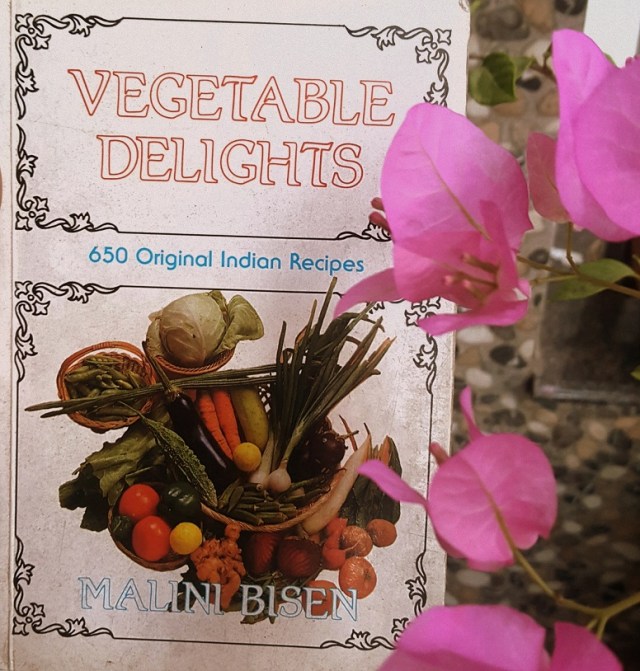
Once I was talking to my ex-boss, Archana Pai Kulkari, about the despair of deciding menus. She was the magazine’s editor for which I used to work as a sub-editor. I wanted a book that could help me in the true sense. No, I didn’t need any fancy photos. Didn’t want to bring exotic veggies or ingredients for a recipe as well. Essentially, I wanted a book that could give me recipe options that I could cook up with whatever I have in hand. Archana immediately asked me what cookbooks I have with me. And she highly recommended a book called Vegetable Delights by Malini Bisen. Now, it’s hard for anyone to put down a suggestion given by her. She’s that good. I wasn’t a fool not to follow her.

So, the next morning, I found a copy of Malini Bisen on some weird online bookstore, where I didn’t shop before. They promised to deliver the book in 15 days. May be it’s a rare copy, I happily thought to myself. I clicked the buy button.

When I received the book, and looked at its contents page, I knew exactly what Archana was talking about. Published by Wilco Publishing House, the book offers recipes for 51 vegetables. Plus there are many other varieties of recipes as well. It made my daily job in the kitchen simple. I couldn’t stop thanking Archana for this gem of a book.

In my kitchen, it’s all about authentic recipes. I rarely use packaged food or readymade food. In fact, I don’t even have a mircowave. I don’t mind working hard for hours on a dish and doing things like soaking and fermenting, if the recipe calls for it. It has become a way of life now. Being at home allows me more time, though. I get that. Whenever I have a job in hand and a cook in the kitchen, I’m no more creative with planning our meals.

There are times when I need to cook a dish in minutes, and here’s when a book like Vegetable Delights comes to my rescue. For a popular vegetable like potato, Malini has given 30 recipes in her book. For green peas, she’s come up with 11 recipes. And for a rare one like cucumber, she’s written five recipes. Who cooks cucumber? Certainly, Malini knows the vegetable world better.

The vegetables go alphabetically in the contents page, and believe me, there’s no easier way to use the book. I also go through the chutney section of the book many times. If you’re an eager Indian cook, or a lover of authentic Indian recipes, you must have this one in your kitchen shelf.

PS. I miss our crazy talks, Archana Meedem. Only if I had a time machine at my disposal.