A food tour of Chandni Chowk

A long overdue trip to an ancient Delhi area comes into being as I step out for a heritage walk with a friend. It was planned just a night before we took the metro train together from Gurugram to Chandni Chowk. And while life has its own commitments—for me, it’s my two kids—I could still take the trip as my husband pushed me for it. “We are changing cities in less than a month’s time. So, you better go for it,” he said. 

Thanks to the changes that happened to the busy area of Chandni Chowk in 2018, we had only E-rickshaws and cycle wallahs around us. Thank God, we had some space to walk. Minutes of us walking a few feet from the metro station, young men start following us as if we were looking for lehengas. “Bhaiya, lehenga nahi lena. Hum shopping ke liye nahi aaye hai,” I told one of the guys after he followed us for a couple of steps. 

I skipped my breakfast. Didn’t comb my hair. Just landed at Chandni Chowk with my jacket and a friend. It was a busy morning as my in-laws were stepping out to their city, but I really pushed myself for this local trip. And so, I was hungry. 

We started with Matar Kulcha. The freshly cut ginger, onions and tomatoes tricked us to believe that it might be tasty, and boy, we were not wrong. It was lip-smacking! It costed us some 30 to 50 bucks for a plate. The kulchas were thin and freshly roasted. 
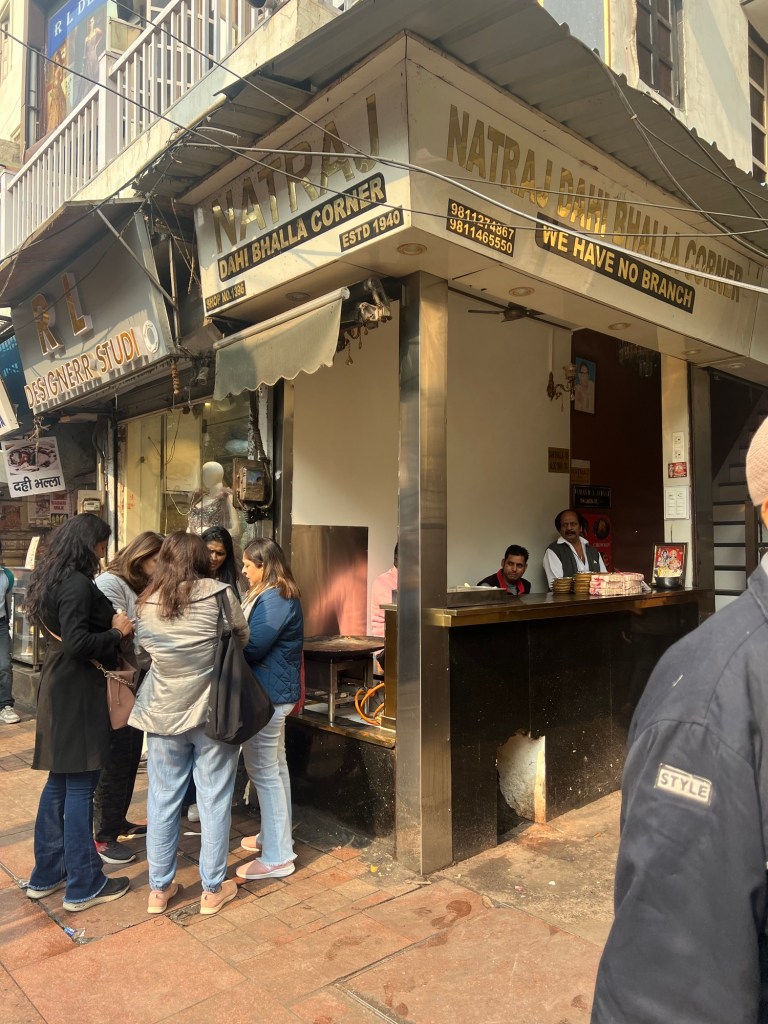
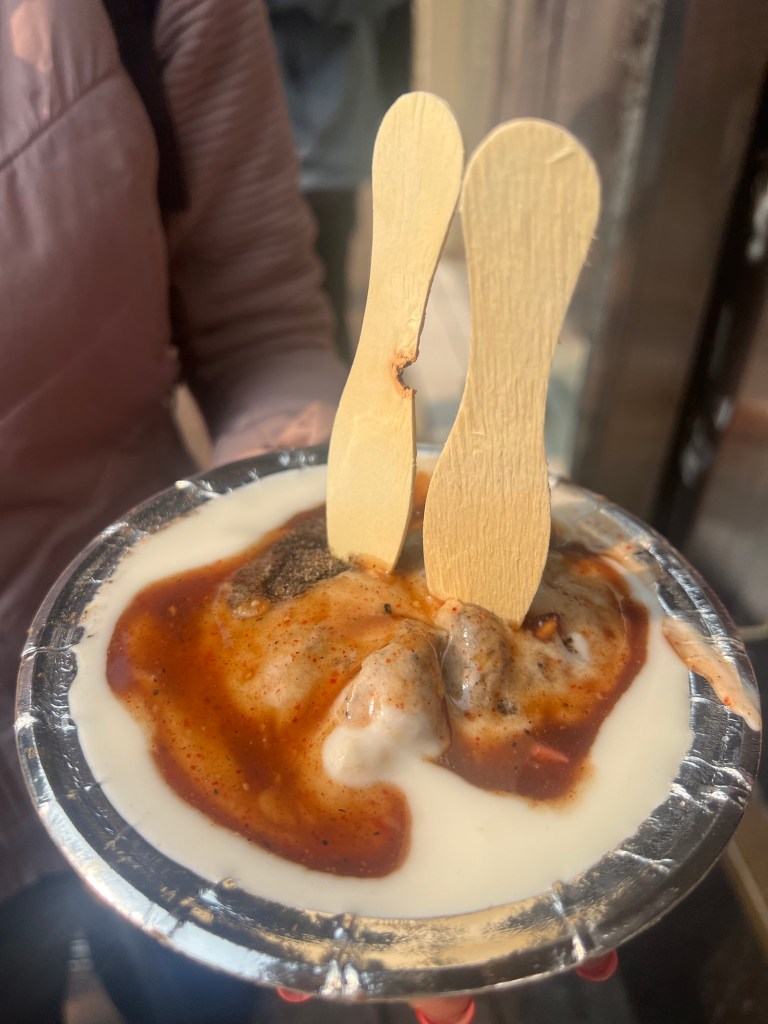
We left that lane (a few metres from the metro station), and towards the end of the lane was Natraj. So my friend, Namisha Singal, asked me if I was up for a plate of Dahi Bhalla. Though the plate was a bit cold for a cold December morning like this, we still liked it. She was wanting an aloo tikki or something with it, but we could easily finish the plate. The spice mix that went on the Dahi Bhalla made the cut. “My mother used to save this spice mix and use it on salads later on,” Namisha told me. Her father came to Chandni Chowk almost every month, and he went back to Faridabad with a little bag of Dahi Bhallas. 
After a few minutes, we met our heritage walk leader, Jibin George. It was amazing how he had these old paintings to show us on his iPad and we could clearly compare the changes. Soon we tasted our third dish. 
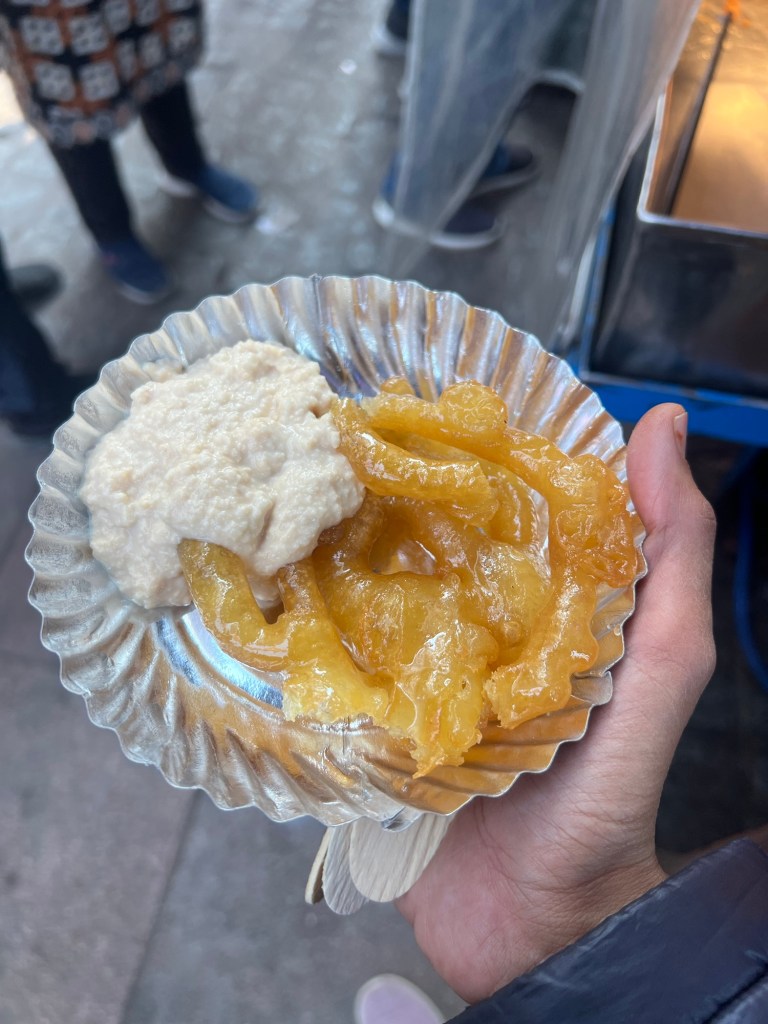
Jalebis. The shop’s name is Jalebi Wala. It had a board nearby that said Haveli Dharampura. So don’t get confused when you see 12 more Jalebi walas in the area. I was not so excited about this, but I was totally blown away by these jalebis! Two reasons I loved them: The chaashni or the sugar syrup was not so sweet. Plus, it had a runny texture, and not your typical sticky texture. Second, the labelis were both moist and crispy. And these were not too sweet either. So, the key for a really yum plate of jalebis is, hold on to that sugar. It really refrains you from having more. It is one of the best things I have tried in my lifetime! Imagine, I’m almost 40! So, you don’t have to miss these ever! I was told this shop has been running for 3-4 generations. And it’s the simplicity of these shop owners who make you respect them even more. 
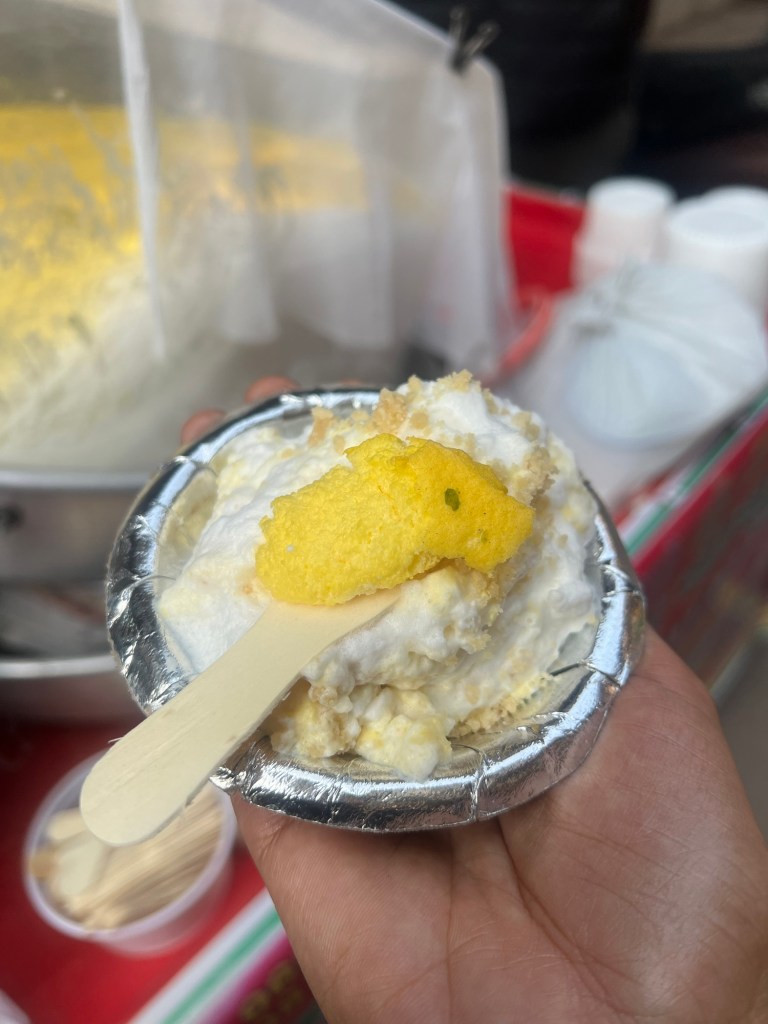
Daulat ki Chaat

My fourth dish came about in the same lane. Daulat ki Chaat. When people told me about it, I imagined a big blob of aloo tikki with mithi chutney or something. But it was way beyond it. Daulat ki Chaat is basically milk froth. It stays as is thanks to the cold weather. Some of it is white, while some of it tastes of Kesar and is yellow in colour. It had a spoon of mawa too and a sprinkle of dry fruits like pistachio. Did I like it? It was too sweet for my palate, but I still managed to complete half a plate. The guy took 200 Rs for three plates of this Chaat. 
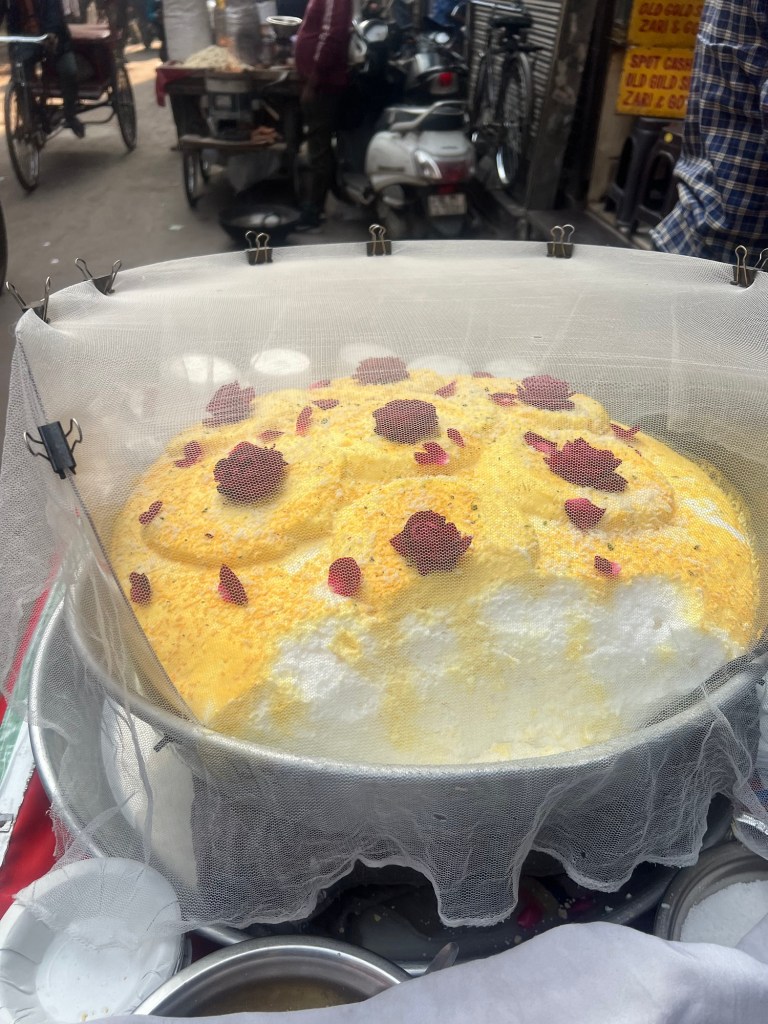
We entered a lane called Dariba Kalan. Interestingly, we happened to spot a Pani Puri wala. His cart looked super clean. He was also wearing gloves. So, I went ahead and asked my friend if she was up for a plate of Pani Puri. She ended up finishing her plate, but I couldn’t go beyond one puri. Even so, I didn’t finish that either. And I realised, if a cart is neat, it still doesn’t guarantee the best taste. Pani Puri is truly a tricky dish. She grabbed a nice cup of ginger tea, and we moved on to Parathe Wale Gali. Wow! I almost pinched myself here. As a mum of two toddlers, living in one of the best areas in Gurugram, what am I doing here? How could I manage to come so far? Am I mad? And I realised, it was one of the best decisions of my life. This heritage walks. We should take such walks often in life. Jibin explained the lanes and the history of the place so well—I could connect it so well; I will never get confused about any of the lanes next time. Delhi is truly beautiful if you take a chill pill and get the hang of it. Don’t just keep walking. Wait. Ask someone for the best way out, and you should manage to walk out of it with a smile! I don’t know if I make sense here, but anyway, here I was. Trying not to think of my elder child’s cough or the other child’s pick-up time from school. 

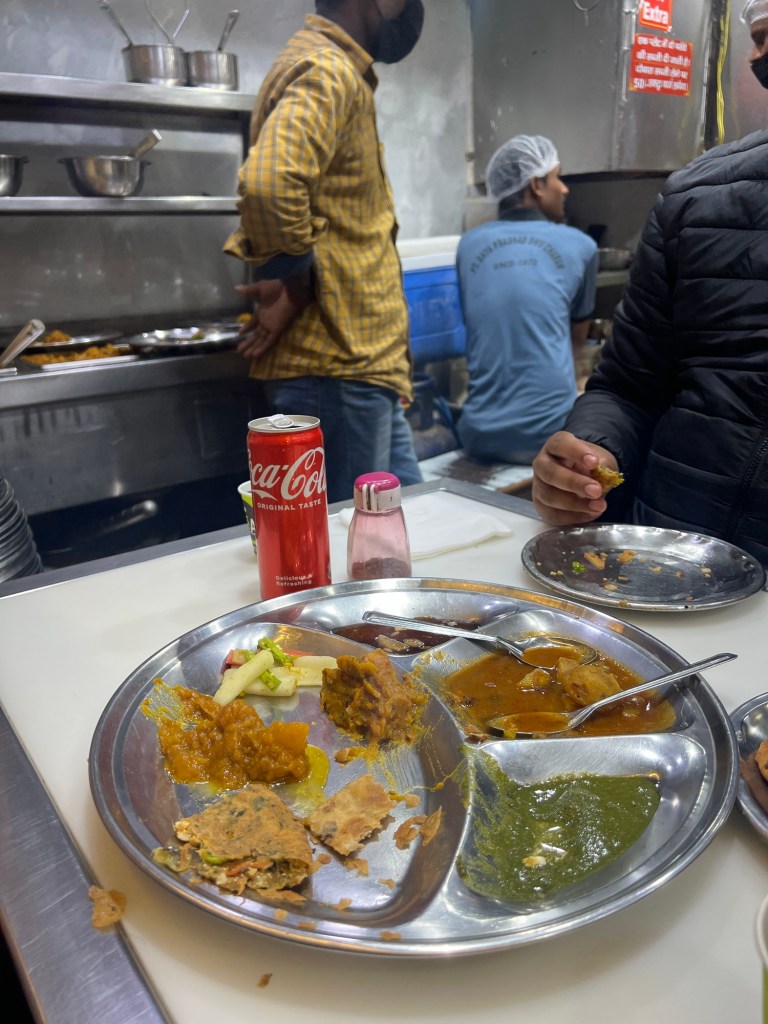
Enters: Pandit Gaya Prashad Shiv Charan. I have seen fried parathas on TV. Of course, I had my doubts if I would like any Parathas here. But I was wrong. The parathas were lip-smacking. But what truly made it work for me was the way it was presented. We get out seats early on, and are served a plate full of everything but parathas. We have tari wali aloo ki sabzi, sukhi aloo, hari chutney, mithi chutney, circa pickle (veggies in vinegar), and kaddu ki sabzi (pumpkin sabzi). The tables were wiped well, and the place looked tolerable in spite of the line outside the shop. The menu was damn confusing, but we somehow ordered two types of parathas. Lemon paratha was the first one. I was curious to see their style of serving lemons in a paratha and they were smart. There was a simple spread of lemon pickle inside the paratha. It tasted okay, and an eye-opener of a dish for me. Simple yet a bit complex. Next was a mixed veg paratha. And I totally enjoyed finishing my thali here. Will I go there again? Hell, yes. This is magic! 
The next dish in your list should be Chole Bhature. But we were too full for it. Of course, the next time I’m here, I’m going to try it. But Jibin pointed out the two places that serve the best Chole Kulche in Chandni Chowk. Kanwarji Bhagirath Mal and Tiwari Ji Chole Bhature. Life is simple, if we keep it simple. Going to the busy lanes of Chandni Chowk was so different than just reading about it on Instagram. We should go out there, more often. We shouldn’t abandon our historic, old corners of the city. It really brings so much together for me. Makes me feel small but valued. We got to value this. Do you know what I mean? 
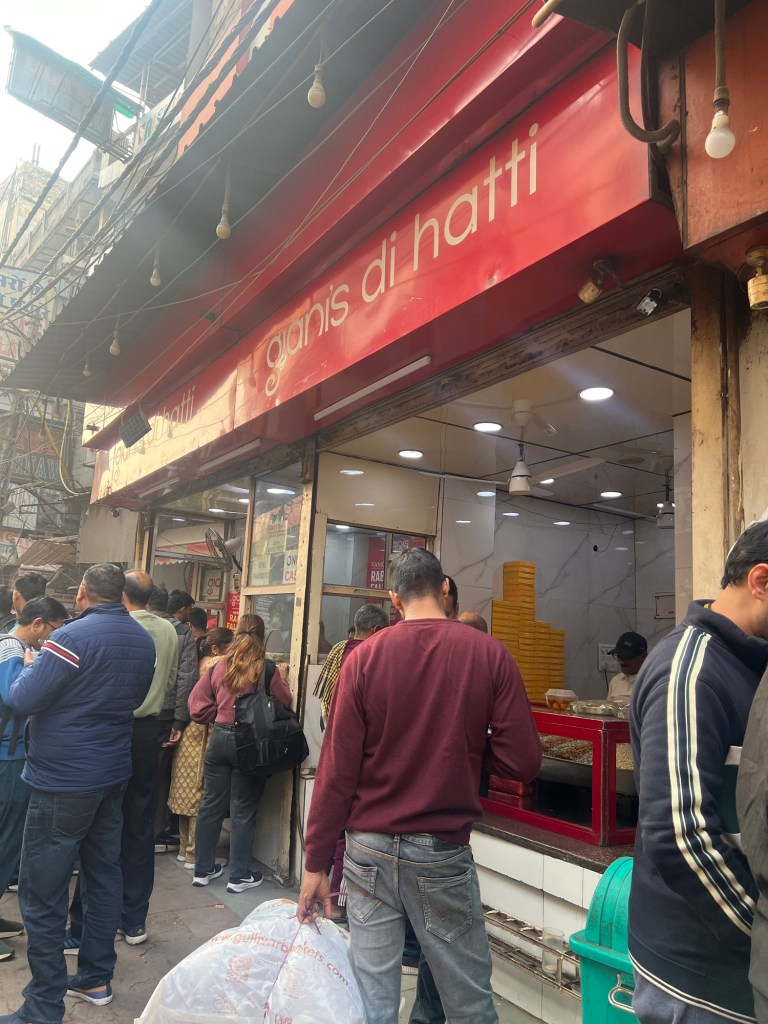
End your trip with a glass of Falooda Kulfi at Gianis di Hatti.

All pictures credit: Deepika Bhutra Nandal

What mangoes meant in Ramgarh

My father grew up in Ramgarh, a desert village near the district of Jaisalmer. It’s near the border, hence you can always see army trucks on the main road that leads to the village. Unlike the districts, desert villages didn’t procure the harvest of fruits and vegetables because of many reasons like limited supply of water and land quality. So, my grandparents always had to do with whatever was made available to them. My grandfather, whose name was Gyan Chand ji, ran a Kiryane ki dukan (general store) with his brother. They basically had two families to be fed with what they earned and what was left from the stock. And this about the ’60s, so at the time in India, people had huge families. Whatever produce my grandfather or his brother got, it always got divided among the kids and this meant limited supply. The kids (my father and his siblings counted five) were always offered small-sized portions of food items and there was always this competition of who’s going to get what.

The desert life was all about using what you have. There were many cows that my grandfather had, so there was always milk and its products for the kids. But fruits and veggies were luxury items, and the king of all–needless to say–was mango. When the mango season came, the kids dreamt of nothing but juicy mangoes. Everything else was secondary. In Ramgarh, mangoes, unlike now in cities, didn’t come in endless varieties and volume.

“My father used to get some mangoes from Jaisalmer (as the main market was there), and we, in the end of all distribution, got around one KG mangoes for us all. Which didn’t mean much. The five of us kids had to make up with two mangoes per day,” papa once told me. Every mango was like a treasure for us, and the fights were real. “A mango was divided in three parts. The one that came along with the skin, the middle juicy part, and the best part was the gootli (the seed),” he fondly narrated to me. Whoever got to eat the gootli was the lucky fellow as that is the tastiest layer of the mango. Dreams are made of this. You always have to earn the gootli. It doesn’t come easy.

My grandmother made Aam Ras (mango pulp mixed with water and sugar) which was supposed to be had with rotis. When the mango season came, it was only Aam Ras and Roti for the kids. They were ready to kick everything out. After a hard day of play and school in the sands, a dream-like reward meant all. “Imagine. My mom used to make Aam Ras with only two Langda mangoes for us five. A lot of water was added to suffice our portions, and we still loved every sip of it, ” papa told me with a smile that of a child. When you break a piping hot tukda of roti and dip it in the cool and sweet Aam Ras, it sparks stars in your mind, let alone the taste buds. And that was all for them in summers. Aam Ras Roti. And, all they knew, was life was good.

Glory of an afternoon tea

We had moved to a new place in Gurgaon, and I had a brief introduction with my neighbour. Although we often bumped into each other and she would sweetly invite me for tea but I hardly gave any attention to it. Back in Mumbai, nobody ever called me for tea, in fact, my neighbours used to happily shut their doors on my face. And as it is, I used to be too busy sulking in the bed when the clock ticked noon, and it usually were hours full of anxiety or restlessness or just boredom.

One day, Shesh, my neighbour, called me to have tea at her place. In my mind, I was like, no way! Have I turned into an aunty that I would go to her place for a cup of tea? I don’t even want to have tea (too lazy to walk into the kitchen for myself). The idea seemed way too weird to me.

In Gurgaon, I have had neighbours asking me what do I do, and when I blurt out that I’m a freelance writer or that I work from home, they quickly nod with disinterest and disappear. Mostly, I only found housewives or women who worked from home smiling at me after a line. Anyhow. I knew I had little scope of making friends, and having no kid didn’t help me either. Why would any mother at the park indulge in a talk with a fragile, pale-looking woman like me? I had no stroller to take around, and no smiles or hellos. But it was fine. I struggled with my writing career, and was mostly stuck at home. And that was life for me in Gurgaon.

Soon came the day when I did give in to idea of knocking at the neighbour’s door for tea. A few cookies would be good, too. But, yes, that was the sole idea. I was a little conscious in my Kurti-legging look that I layered with a mismatched pair of socks and a loose cardigan. Winters ruined my home looks to an extent. Shesh happily opened the door and I shyly went in. Still too nervous. “Will she like my fierce, strong and wild thoughts about life? I really hope not to reveal too much of my opinions about my life. Look at her lovely kids; she seems to be blessed,” I had too many things running in my head, and I didn’t seem to care too. We will see, I thought, and took a breath.

While I was sitting on the sofa, Shesh went into the kitchen to make the tea. I followed her, and for once, felt really good to see a woman making tea for me. Her kitchen was spick and span, in spite of the three kids running around the house. “What kind of tea would you like?” she asked me. I loved the question. “Just. Normal,” I replied. She was pounding some ginger in her steel mortar pestle, and I didn’t feel like telling anymore. Ginger tea would be perfect for a cold afternoon like this one. She then added in some cardamom too. Even better, I thought. Shesh made sure that the tea boils properly before pouring it into two colourful cups. She placed some biscuits in a plate, and then we walked back into the living room. Why didn’t no woman make tea like this for me before? It already felt good.

And then, started our usual talks and question-answer rounds. This woman didn’t seem like others. She had kept that judgement button behind for sure. I felt at ease while talking to her, explaining my almost non-existent writing career, and a bit about my family. She was much elder to me, but there was a connection, and I loved how she dealt with her kids in a composed manner. Shesh told me that she never had a neighbour so close before. “This building has been empty for years,” she said. The tea that she made was good; although I did ask for some namkeen (savoury dry snack) like bhujia later on. And our time went by. That cold afternoon didn’t feel bitter that day in some way.

That was how a beautiful friendship started off in a faraway land, my dear readers. I felt almost alone in the city, with hardly any friends. And it was humbling to see this woman whom I could trust for life. We loved sharing food, and talks that we couldn’t share with our husbands or mums. It’s wonderful how during our tea-time we used to lighten our heavy hearts to each other, and felt alive again. Sometimes our talks were plain silly, but the positive vibes bruised our souls for sure. You start your day in any manner, but when the noon hits, there can be days when you realise what’s wrong with your life. But with Shesh beside me, those empty hours filled up with happy cheers, and sometimes roars of laughter. Yes, there were days when one of us would tear apart with little hope, but by the end of our meet, both of us would be fine enough to face the remaining of the day with a big smile.

This is why I say the glory of an afternoon tea can be immense, my dear readers. It’s almost hard to define. Somehow, it was Shesh and her pure heart that took care of a messy me. And when I found her lost, I immediately tried to fuel her up with positive thoughts. Our friendship was like therapy for the soul. And, today, there are so many beautiful afternoon teas to look back and cherish. In our last days in Gurgaon, Shesh took care of me like a mother; yes, there is a huge age gap between us. I might find it difficult to explain to people how we spent our time together. But who cares? I got a friend whom I can keep for life.

Next year, I plan to visit that city for a day and knock at her door for a hot cup of tea. I would, as usual, be folding my legs on her sofa before we start pouring our hearts out to each other. Wouldn’t it be wonderful?

I always miss you, Shesh. Care for some tea?

No such thing as thandi roti

One of the things that I should learn from my Nani ma (mum’s mother) is the way she eats. She’s extremely disciplined in almost everything, and especially when it comes to food. You can spread a luxurious buffet in front of her and she would still choose her simple food, and her native grains. That’s the kind of self-control she has.

Nani ma would add a few tablespoons of milk in her tea; she would make her food and eat it right away. There’s no system of refrigerators in her world. She would hardly use it. Her food is that fresh.

You know in the world where people have full-time jobs, a refrigerator plays a vital role. And why not. They believe that no food can go stale in the fridge. They are meant to keep food fresh and nutritious. But, somehow, my 70-something Nani ma doesn’t seem to be impressed with this technology. I would like to mention here that Nani lost her husband (my Nana ji) almost 40 years ago and has raised five kids alone; struggling her way to settle each one of them. So you’d rather not talk about money issues, work pressure and a tough life. Nani has seen it all. And yet, simple and fresh food has been her mantra in her house.

When I got to spend a few days with Nani in her kitchen, the last time I was in Jaisalmer, I was amazed. I had to note down a few things that she followed. You see, I was no more a kid but a 30-year-old grown up woman who is still trying to find her way to work in the kitchen. There are these two worlds in front of me: the modern, American-inspired one and the traditional world of my mum. So, what did I manage to learn from my Nani in that cold month of December? I secretly noticed her with a corner of my eye.

First, keep the stove, the kitchen floor, counter and the sink neat. She would constantly wipe it clean with an old fabric, even if it ticked 12 in the night, to make sure that the place where she cooks is spick and span. There’s no quick setting that she does. Second, stick to the local grains. In her case, bajra (pearl millet) scores the highest. Nothing comes out of a plastic packet but fabric bags and tin/steel boxes. Yes, the choices can be rather limited, but she’s too busy to look at the food trends to change her kitchen staples.

She loves ginger and black pepper in her tea and believes in keeping herself hydrated with loads of water. She would always eat on time, and get on with work. If given a chance, she would never sit in a bed corner, gossip or only make speaking ill about others her job. But, she would keep moving. Climb up the stairs. Sit on the floor and eat. Take on those heavy bags on her shoulders instead of looking at someone to help her with puppy eyes. That’s not my Nani. She’s someone who gets up early and watches CNBC to check the status of the stock market and the prices of gold, fuel, grains, etc. Yes, that’s the woman I’m talking about.

Here’s the highlight, the one thing I want to share with you guys. She would finish making her rotis, and never keep the dough for later. According to her, a roti kept for a few hours on the kitchen counter is better than the dough kept in the fridge. No wonder my mum has followed the same thing in her entire life (though she does store it during the daytime and uses it by dinnertime), and this habit has come to me as well.

Why it works for me, you may ask. Well, I cannot eat a heavy meal and stay outside the kitchen the entire day. Which is why, I keep reaching out for that roti ka dabba (roti box). My mum used to make a batch of rotis (about six whole-wheat rotis and two bajra/pearl millet rotis) and store it for later. It’s the best thing because when you have those little hunger pangs, you can just grab this box. It’s either some homemade mango pickle rolled in a roti or bajra roti with kadi (recipe in one of my previous posts). Which reminds me, have you tasted thandi (dry) bajra roti with homemade butter (makhan) spread and tiny crystals of sugar lightly sprinkled on it? Boy! I could die for it!

Nani ma prefers making her rotis when winding up the kitchen in the night, and having them with tea in the morning. These leftover rotis (I have seen people only giving these away to street dogs) are nutritious for you, but not that dough that you might keep for two-three days or even a week, in the fridge.

Back in Bangalore, when I used to live a student’s life, there was a local guardian of mine (Deepa Kaki) whom I frequently visited. She would ask me the special home dish that I would want to eat, and all I would say is leftover roti (thandi roti as we call it in our language) with kadi (spiced and cooked buttermilk). I used to crave for my mum’s roti ka dabba, and to see those thandi rotis covered inside a white mulmul fabric. My heart literally poured for them. Burgers and fries? No, thanks. Thandi roti is my quick go-to meal any given day.

Before I end this post, I would like to mention that one thing Nani ma would always reheat: her homemade ghee (clarified butter). She would want me to do the same when I was there inside her kitchen. “Heat up the ghee up on the hot griddle (roti tawa) that we’ve just taken off the flame and then use it,” she would say. Which went like, “Ghee tapaye daal,” in our local Marwari language.

And just like me, my dad is also fond of these thandi rotis (made in the morning). That’s one of the common things we have.