
I walk towards the main road from my homestay while the fresh Peora air soothes my face. It’s a place that is secluded yet not-so-quiet.
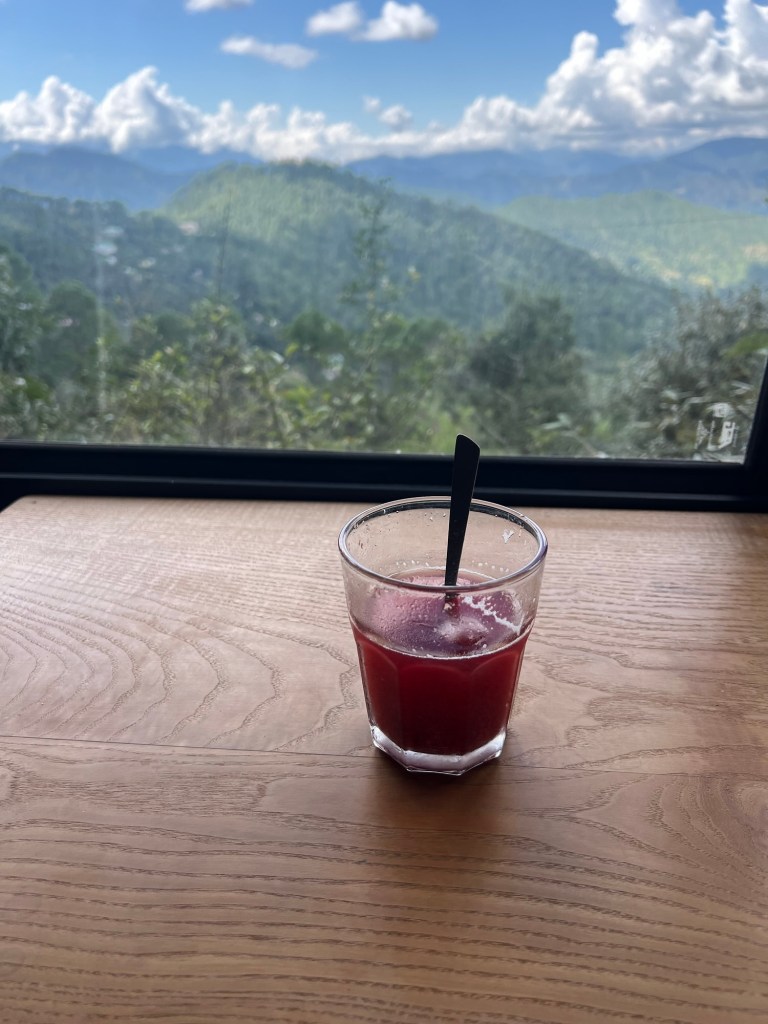
As I walk into Ek Satoli, the café, I see a cabin-like structure and broad, grey stairs leading up to it. Kiran Budhiraja, the café owner, is working on her counter, and a young man follows her instructions. I see wooden tables attached to the windows, and a breathtaking view of the hills and the bright sun throwing its light on the green hills. Kiran offers us a lovely drink made of plums, and we know it’s a good holiday.
When I wished to interview Kiran, I had left Peora. Blame it on the star alignment (after her father breathed his last), one of the days when she was with her family for her father’s Bhog ritual in Mumbai, just to distract herself, she decided to come back to me with her answers—a stack of voice notes.
I, on the other hand, couldn’t stop jumping with joy when I saw her messages. I was ready to share her journey with the world; only after about 18 months—here I’m, with her story on my screen.
A journey to the hills
As someone in her early 40s, Kiran Budhiraja worked in Gurgaon as a qualitative consumer market researcher. Things changed when she became a mother in 2016. She moved closer to the mountains (her husband’s home, Haldwani) after her first child was born. Soon, they had their second. It was during her maternity break in Peora that she decided to find a place to live somewhere nearby.
“My push was better to move early than to retire,” says Kiran, who was more than happy to get her kids in a local school. Soon, things started working out for her. Her husband, Parinay, decided to continue working in Delhi, and Kiran wanted to work on a remote basis. And that’s that. “I love it in the mountains. Call it courage or stupidity that made us make this move. I wish it was earlier. This is how I want to live,” she adds.
Mastering the art of baking
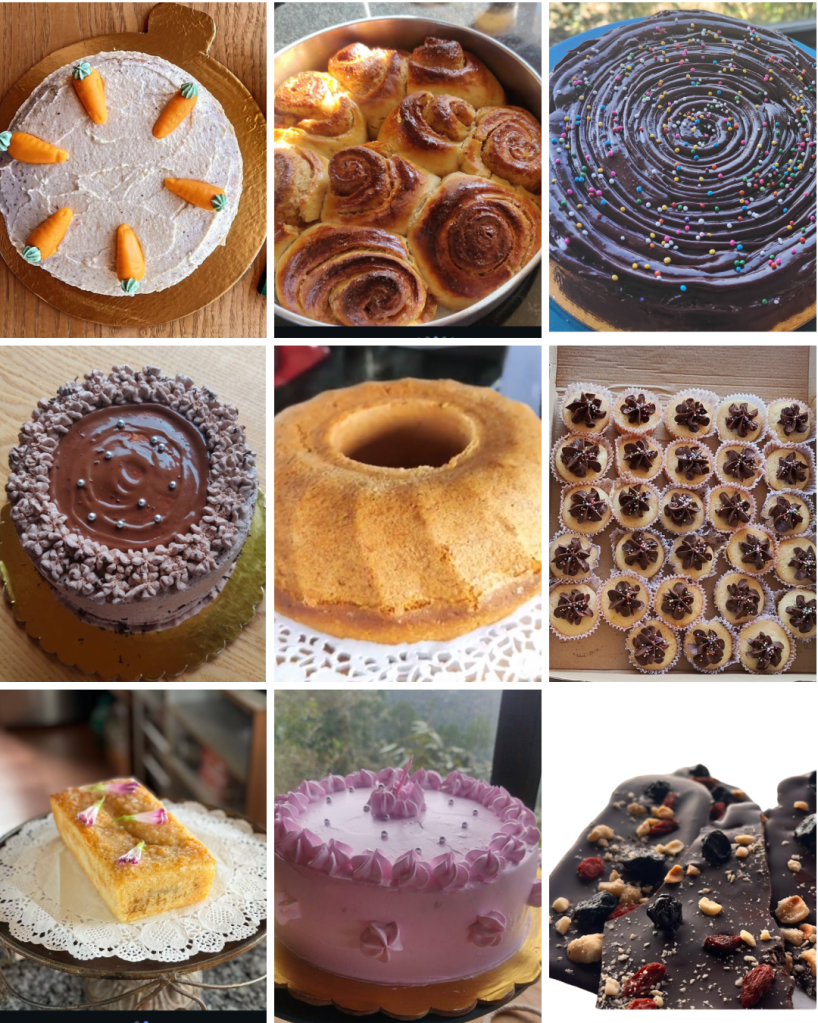
Kiran always loved baking, even as a child, and more so, during the lockdown period. She baked, made a cardboard rocket with her children, nailed classic, European-style cakes from the onion tarte tatin and pound cakes to the trendier versions of flourless cakes—all while she enjoyed the perks of motherhood.
“I still don’t believe I have mastered any recipe. Every time I make the same recipe, I play around with the ingredients, be it the sugar or the different vanilla flavours. Mastering a recipe—it doesn’t define the process, as it keeps evolving,” beams a modest Kiran, who was born in Mumbai and grew up in cities like Baroda, Nainital and Pune.
Kiran likes to experiment more with recipes when she has people to relish it. After moving to a village called Satoli in 2020, she continued making cakes every day, without fail, and made folks around her taste them. Her love for baking grew even stronger than before. She was ready to create a permanent place where she could showcase all her baked goodies. But was it all really that easy?
Establishing a café
“I wanted a small, cute, easy-to-manage set-up,” says Kiran. “After banging my head on a wall when I had all the intention, nothing moved. So, suddenly, when everything started working out, I wanted it faster than before. I found these two guys who took not 20 days (the initial deadline) but two months to build this structure. Life works in such ways,” adds Kiran.
Sourcing great ingredients was one of her top priorities. For instance, the chocolate varieties she sources for her cakes and shakes are from artisan cocoa makers (like Oona Cacao & Chocolate in Ranikhet). From Delhi, Haldwani to Baroda (where her friend runs a chocolate factory), her kitchen is well-equipped to offer visitors the best of both worlds, the urban and the local rural landscape.
For Kiran, who has a master’s degree in social work from the Tata Institute of Social Sciences (TISS), it took experimenting day in and day out to master recipes. Her perseverance pays off every time a visitor steps out from her café with a big smile.
“If you use not-so-okay ingredients, you get a not-so-okay cake. If you use great ingredients, you get a great cake,” says Kiran, and adds, “Chocolate is a game-changer. Let me tell you, there are fewer people who use good chocolate. People use compound products like Morde, which are not even real chocolate. Butter is another fabulous addition to cakes, which is why I struggle to make carrot cakes, as they use oil instead. Brown butter can take the flavour a notch higher when it comes to brownies and pound cakes. Vanilla extract (not essence), curd, buttermilk, lemon, fruits—are all amazingly good.”
Food influences
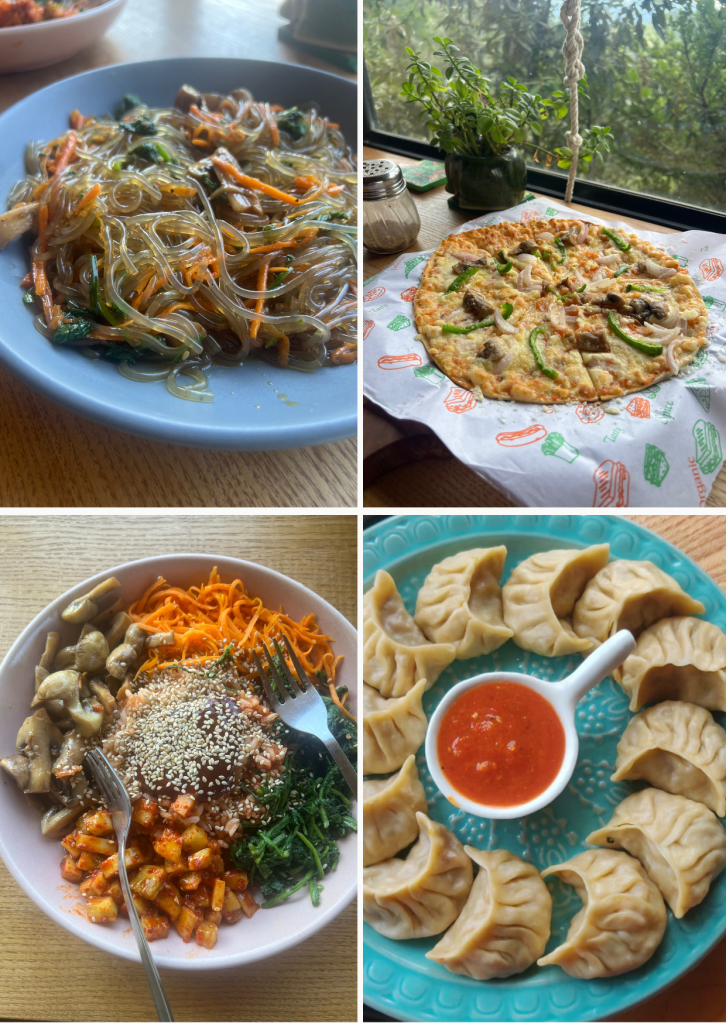
When I visited her café in Peora, I was more than impressed with the menu that had a global influence. Kiran, who loves Asian flavours and plans to move more towards it, says, “I have chosen dishes that I make well with ingredients that are easy to source.” You’ll find Korean food (Japchae, Bibimbap—you name it) and European dishes in her kitchen. “I thought I can’t be only serving baked goodies to travellers, which is why I added savoury items to the menu as well,” adds Kiran.
She continues, “My idea is to serve fresh food—something that doesn’t need preparation. So, when I say pasta, I don’t want the pasta to be made and kept in the fridge for days. I want the pasta to be boiled there and then; the sauce to be made there and then. The same thing goes for sushi. I don’t want to cook my rice overnight. That’s my ambition: to serve food that can be made within half an hour to an hour of getting an order.”
The idea of success
Is it truly a dream to run a café in a place like Satoli? “I don’t know if I’m successful in the worldly definition of success. But I’m successful in my definition of it, which is giving me happiness, not making a loss, not making enough money to run my entire life but being happy. If you want to make a significant profit as a café owner in the mountains, it will never quite work out. If you want to start it as a livelihood, it’s much harder and the fun will go out of the entire process,” says Kiran. For people who aspire to do the same, it’s best to get a reality check.
She adds, “It depends on the intention you start your café with. If you’re retiring in the mountains, totally do it. But it also calls for maintenance of ingredients. Which is why I like the idea of supper-clubs (or private pop-up dine-outs) that happen in the cities nowadays. Just have tables for Saturday and Sunday, with a fixed menu. Let people book it. Work with a minimum investment. In fact, maybe I would go that way. Who knows.”
City versus mountains
“Mountains are tremendously forgiving. I don’t think my food is fabulous. But I can tell you one thing—I strive to get the best ingredients. What I feed my family is what I serve at the café. And, therefore, it tastes what it tastes like. At a mountain café like mine, food is not looked at in isolation. It’s the ambience too. You are on a holiday, and you want to enjoy the experience, the reason it becomes far more forgiving. If I make and bake the same things in Delhi, I will take much longer to catch on with people,” says Kiran.
“I don’t focus on how my dish looks. My focus is on quality and taste. Looks are not important to me, but to a world that eats with its eyes first than tasting anything, I would have been a flop in the cities. The only reason I get the love that I do is because I’m in the mountains and because people who come here are far more tolerant,” smirks Kiran.
The learning curve
As a chef in a higher terrain, there are a few challenges that she has to combat, especially when she is travelling. “I haven’t yet reached the point where the person working with me can simply make the same food. I feel that while there are recipes and measures, there are also a few non-measures involved in terms of getting the taste right. I need to work in terms of delegation, training someone to understand flavours. All so that I don’t have to run on half a menu while I’m away,” she adds.
Treasured food moments
As part of my last notes, I asked Kiran about a few of the ‘Aha!’ food moments she’s had in her life that are close to heart. To which she says, “My ‘Aha!’ food moments are not about taste. They have always been about my mom’s food, when we sat together to eat, getting that umami flavour, eating with your hands—it’s that feeling the food leaves you with at the end. Flavour is just a part of it.”
Picture credits: Kiran Budhiraja. A few of the food shots are clicked by Deepika Nandal.
 TASTE MEMORY